DbcultAccessing Vault...
Cult Review
Senior Film Conservator
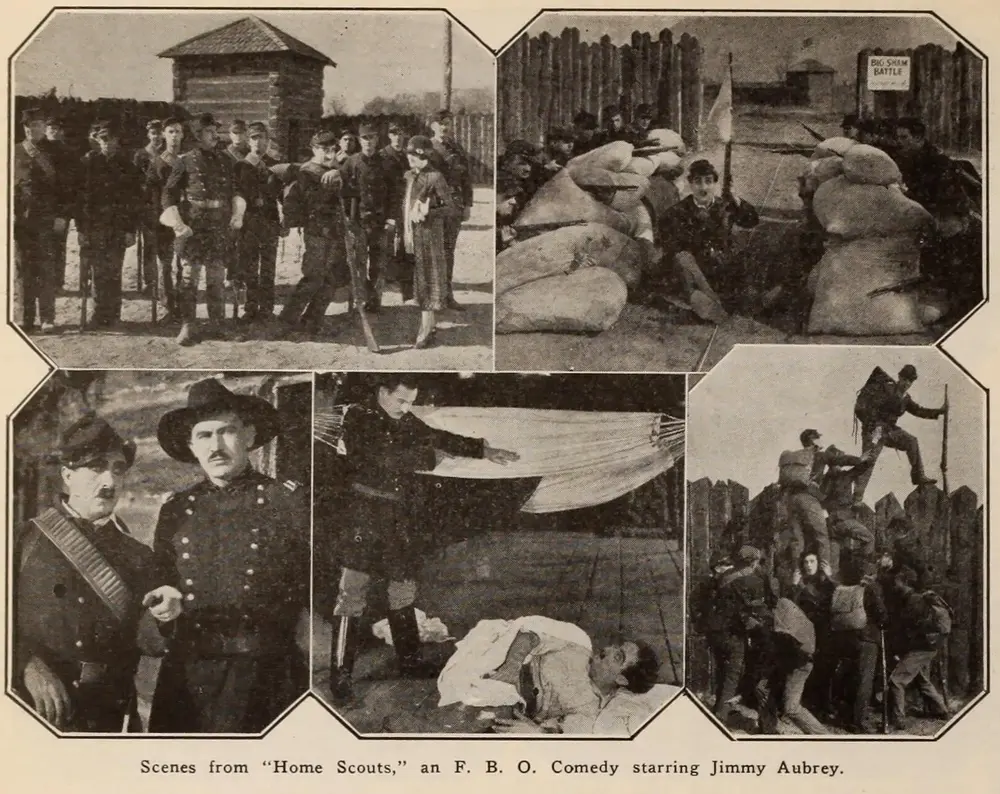
Is 'Home Scouts' worth watching today? Short answer: yes, but with significant caveats that ground it firmly in its era. This film is an absolute must for aficionados of silent-era slapstick and those curious about the comedic stylings of Jimmy Aubrey.
However, viewers accustomed to modern narrative complexity or sophisticated humor might find its broad strokes and simplistic premise a considerable test of patience. It’s a historical curiosity more than a timeless comedic triumph, perfect for a niche audience.
The premise of Home Scouts is disarmingly simple, yet it speaks to a universal human desire: the need to impress. Our protagonist, portrayed with an endearing blend of bluster and insecurity by Jimmy Aubrey, is a man on a mission. He wants to prove his mettle, not on a genuine battlefield, but in the domestic arena of romantic conquest.
His chosen vehicle for this transformation from perceived coward to proclaimed hero is the 'Home Scouts' – an organization whose name itself suggests a certain lack of grand adventure. The brilliance, or perhaps the audacious absurdity, of the plot lies in Aubrey's character's complete commitment to artifice.
He doesn't merely join; he weaponizes every situation, every benign circumstance, twisting them into opportunities for performative heroism. The climax, a 'sham battle' complete with meticulously constructed trenches, is less a military exercise and more a meticulously choreographed theatrical production.
This isn't just about winning a girl; it's about constructing a narrative of self, a persona of bravery, through elaborate deception. It’s a comedic exploration of how far one might go to craft an image, a theme that, surprisingly, resonates even in our social media-obsessed age.
Let's cut directly to the chase about Home Scouts.
This film works because of Jimmy Aubrey's undeniable physical comedic prowess and the sheer audacity of its central conceit. Aubrey commits fully to the bit, selling the illusion of heroism with every exaggerated stumble and triumphant pose. The idea of a 'sham battle' to prove oneself is inherently funny, and the film leans into it with gusto.
This film fails because its narrative is incredibly thin, even for a short. There's little character depth beyond the immediate goal, and the humor, while effective for its time, can feel repetitive and predictable to a modern audience. The lack of stronger supporting characters also means the comedic weight rests almost entirely on Aubrey's shoulders, which, while capable, can become a singular note.
You should watch it if you are a devoted fan of silent-era comedies, particularly those focused on physical gags and broad situational humor. It’s a fascinating glimpse into the comedic sensibilities of the 1920s and a testament to Aubrey’s unique, if often overlooked, talent.
The entire edifice of Home Scouts rests squarely on the shoulders of Jimmy Aubrey. While perhaps not as universally recognized as a Chaplin or a Keaton, Aubrey possessed a distinct comedic style, characterized by a certain everyman desperation coupled with an almost rubber-faced expressiveness.
Here, he embodies the archetype of the well-meaning but utterly out-of-his-depth protagonist. His physical comedy is precise, yet often chaotic. Consider the moments leading up to the 'battle' – his nervous glances, his exaggerated chest-puffing, the way his limbs seem to flail independently when confronted with a minor obstacle, only to snap into a pose of mock-bravery when his love interest is nearby.
Aubrey's genius lies in his ability to sell the illusion within the illusion. He's playing a character who is performing heroism, and Aubrey himself performs that performance with delightful conviction. His eyes, wide with feigned terror one moment, narrow with cunning resolve the next, are a masterclass in silent film acting.
He doesn't just fall; he *collapses* with a theatrical flourish. He doesn't just run; he *scampers* with a comical urgency that speaks volumes about his character's internal panic. This kind of physical storytelling is the bedrock of silent comedy, and Aubrey is a skilled practitioner, even if the material itself gives him limited range for emotional nuance beyond the comedic.
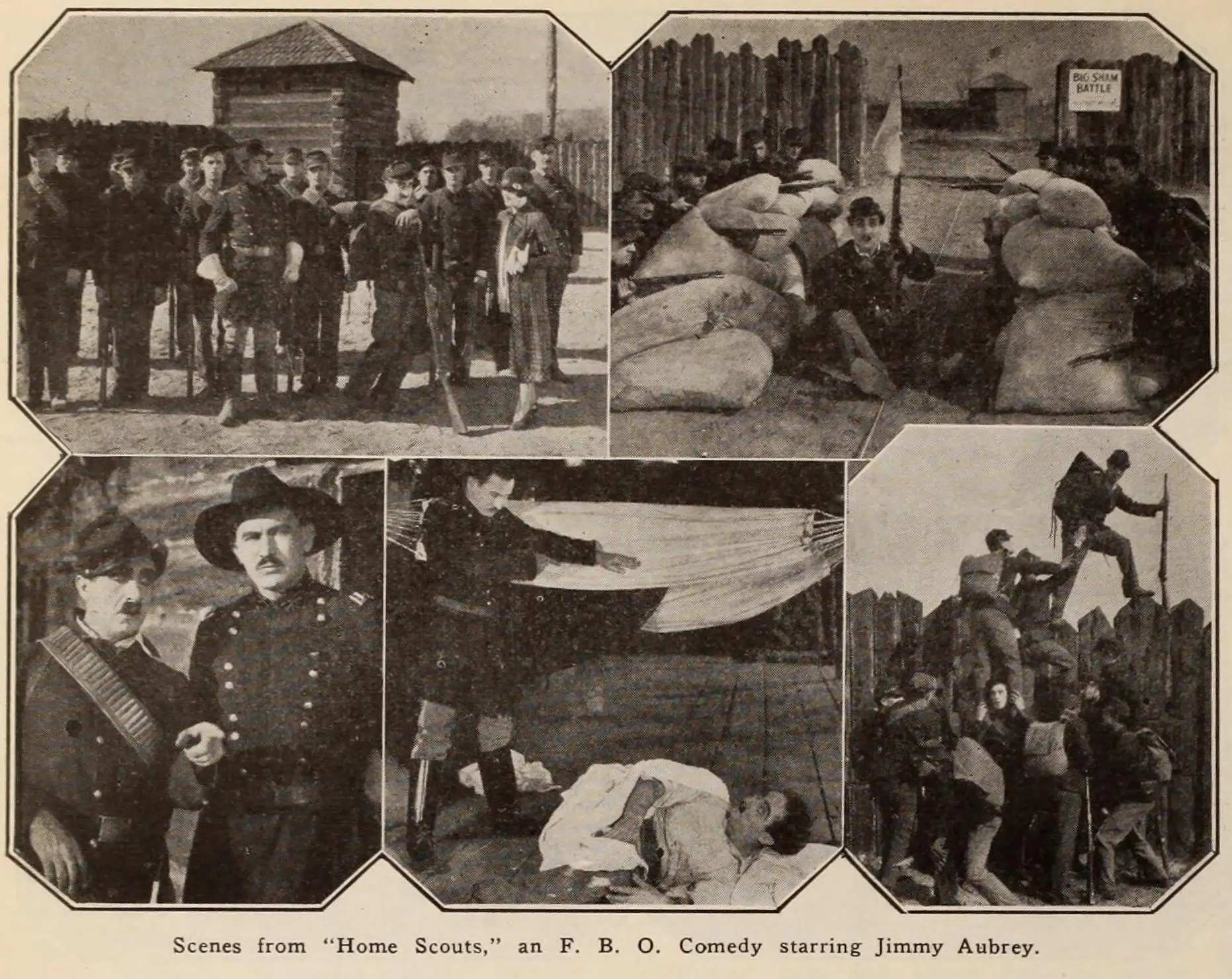
The direction in Home Scouts, typical of many shorts from this era, is functional and direct, primarily serving to frame Aubrey's antics. The camera is largely static, relying on wide shots to capture the full scope of the physical gags. This allows the audience to appreciate the choreography of the 'sham battle' and Aubrey’s full-body commitment.
Pacing is brisk, as one would expect from a comedy short. Gags are delivered with a rapid-fire rhythm, leaving little time for reflection or emotional depth. This approach ensures the comedy remains light and accessible, preventing the audience from dwelling too long on the absurdity of the premise.
The use of intertitles is sparse but effective, often delivering punchlines or essential plot points with brevity. There’s a particular intertitle that announces the 'battle' that perfectly sets the tone – a blend of mock-seriousness and impending farce.
While it lacks the innovative camera work or complex editing often seen in the works of more celebrated directors of the era, the film's simplicity is also its strength. It doesn't distract from the primary comedic engine: Jimmy Aubrey's performance. The director understands the assignment: let the comedian do his work.
The humor in Home Scouts is quintessential silent-era slapstick. It relies on visual absurdity, exaggerated reactions, and the inherent comedy of a character desperately trying to maintain a facade. Much of it still lands, particularly for those with an appreciation for the genre.
The gags involving the 'trenches' and the various 'traps' Aubrey sets are genuinely inventive, if predictable. There’s a timeless quality to someone tripping over their own feet or getting into a ridiculous predicament due to their own hubris. It works. But it’s flawed.
However, some of the humor, particularly the broader strokes of the romantic pursuit, feels undeniably dated. The notion of a woman being so easily swayed by such transparent deception might raise an eyebrow today. This isn't a criticism of the film's quality, but rather an observation on how comedic sensibilities and societal norms have evolved.
What's surprisingly modern, though, is the film's subtle commentary on performative masculinity. Aubrey’s character isn’t genuinely brave; he’s merely good at *acting* brave. This distinction, played for laughs, is a surprisingly resonant theme in an era saturated with curated online personas. It's a testament to the enduring power of comedic archetypes that even a century later, we can still recognize the desperate need for validation.
While Jimmy Aubrey might not have achieved the enduring star power of a Charlie Chaplin or a Buster Keaton, his work in films like Home Scouts offers a valuable snapshot of the diverse comedic landscape of the 1920s. His style is less poetic than Chaplin's Tramp and less stoic than Keaton's Great Stone Face. Instead, Aubrey carved out a niche for himself as the frantic, often befuddled everyman, prone to grand schemes that inevitably unravel in hilarious fashion.
One could draw parallels between Aubrey's character in Home Scouts and the ambitious, often misguided protagonists seen in other shorts of the era. For instance, while vastly different in execution, the theme of a man striving for status or love through unconventional means is also present in films like The Idle Class, albeit with Chaplin's signature blend of pathos and physical comedy.
Aubrey's strength lies in his uninhibited physical commitment. He throws himself into every gag with full force, a quality essential for silent film comedians. His brand of humor is less about subtle irony and more about overt, in-your-face absurdity. This makes Home Scouts a straightforward, punchy comedic experience, devoid of complex subtext, which can be both its charm and its limitation.
The film, like many of its contemporaries, was designed for immediate, visceral laughs. It was part of a broader cinematic output that prioritized entertainment and spectacle, setting the stage for more sophisticated comedic narratives that would follow. Viewing Home Scouts is not just watching a film; it's engaging with a piece of comedic history, understanding the building blocks upon which future generations of comedians would build.
Home Scouts is a charming, if undeniably slight, relic from the golden age of silent comedy. It’s a film that demands an appreciation for its historical context and the specific brand of humor it offers. Jimmy Aubrey delivers a performance that is both energetic and endearing, carrying the entire production on his expressive shoulders.
While it won't redefine your understanding of cinema or offer profound insights, it provides a valuable glimpse into the early techniques of comedic storytelling. It’s a fun, quick watch for the right audience, a testament to the enduring power of a good physical gag. Don't go in expecting a philosophical treatise; expect a man tumbling, scheming, and ultimately, winning the girl through sheer, delightful fakery.
It's not a film for everyone, and its age shows in places. But for those willing to embrace its straightforward charm, Home Scouts offers a solid dose of vintage laughter. It’s a piece of history, and a pretty funny one at that.
IMDb —
1927
Community
Log in to comment.