DbcultAccessing Vault...
Cult Review
Senior Film Conservator
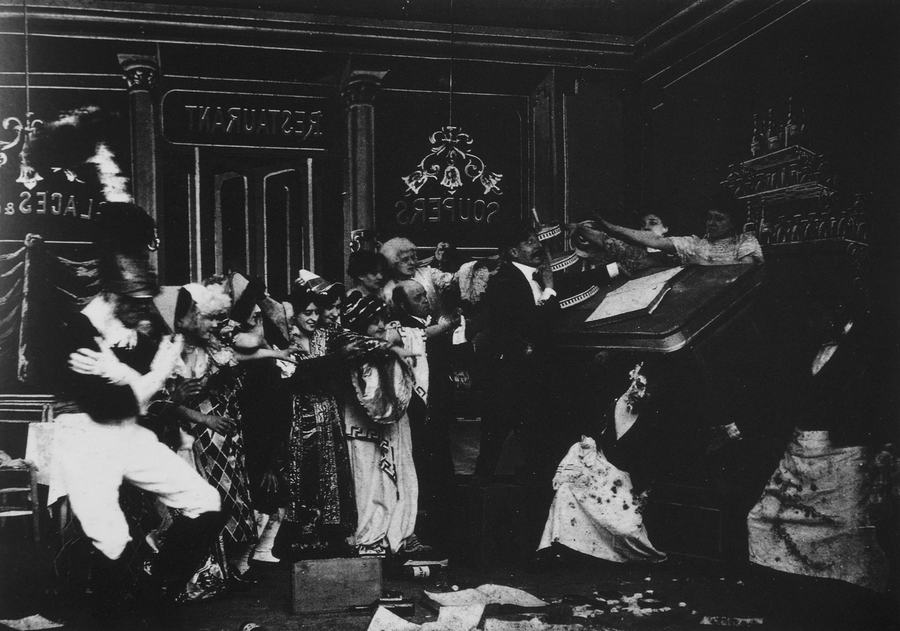
There are films you watch, and then there are films that watch you—films that slither behind the cornea and set up camp in the folds of your memory. Nuit de carnaval belongs to the latter phylum: a 1925 fever dream shot on the Riviera back when “Nice” still sounded like an adjective rather than a destination.
Imagine opening a lacquered music-box only for a phantom hand to yank you inside. That is essentially what Ivan Mozzhukhin—actor, auteur, émigré enigma—does to his audience. The plot can be synopsised in a gasp: engagement soirée, gatecrasher in obsidian silk, chase through confetti-strewn labyrinths. Yet within that skeletal armature Mozzhukhin grafts veins of dread, Catholic guilt, and erotic vertigo until the film pulses like a wound under gauze.
Mozzhukhin’s camera, operated by Viktor Tourjansky—later to helm opulent historical sagas—behaves like a somnambulist poet. It glides across ballrooms where chandeliers drip like inverted fountains of frozen gin, then spirals down staircases whose railings resemble vertebrae. Tinting veers from bruised violet interiors to sodium-yellow boulevards, each hue announcing emotional barometry without a title card to hold its hand.
Observe the moment the lady in black first lifts her veil: the frame halts for a microsecond, just long enough for the viewer to register a face that is both marble and bruise. It’s an effect achieved by printing two identical frames, splicing in a freeze, then resuming—primitive yet uncanny, predating Hitchcock’s psychological stutter-cuts by decades.
Archival notes tell us the premiere came with a live quartet hammering Saint-Saëns through a haze of Gauloises. Even mute, the film drips auditory suggestion: the crunch of Jeanne’s beaded dress as she pivots; the flapping of the pursuer’s cloak like a raven with a theatre addiction; the distant tuba oompah that bleeds into nightmare foghorns. You swear you hear hearts ricocheting against ribcages—proof that Mozzhukhin understood cinema’s ventriloquial power.
“Silence is not absence but a velvet membrane upon which the spectator projects their private orchestra.”
—Programme note, Cinéma des Cinéastes, 1926
Nathalie Kovanko’s Jeanne is every virgin who ever suspected she was a chimera. Her eyes, saucer-wide yet furnace-bright, oscillate between porcelain doll and cornered animal. When she runs, arms flail less in panic than in semaphore, as though negotiating with gravity. Opposite her, Nathalie Lissenko (the ubiquitous vamp of Ukrainian silent cinema) incarnates the lady in black with nun-like austerity. No hisses, no talons—just a stare that could audit your soul and find the ledger short.
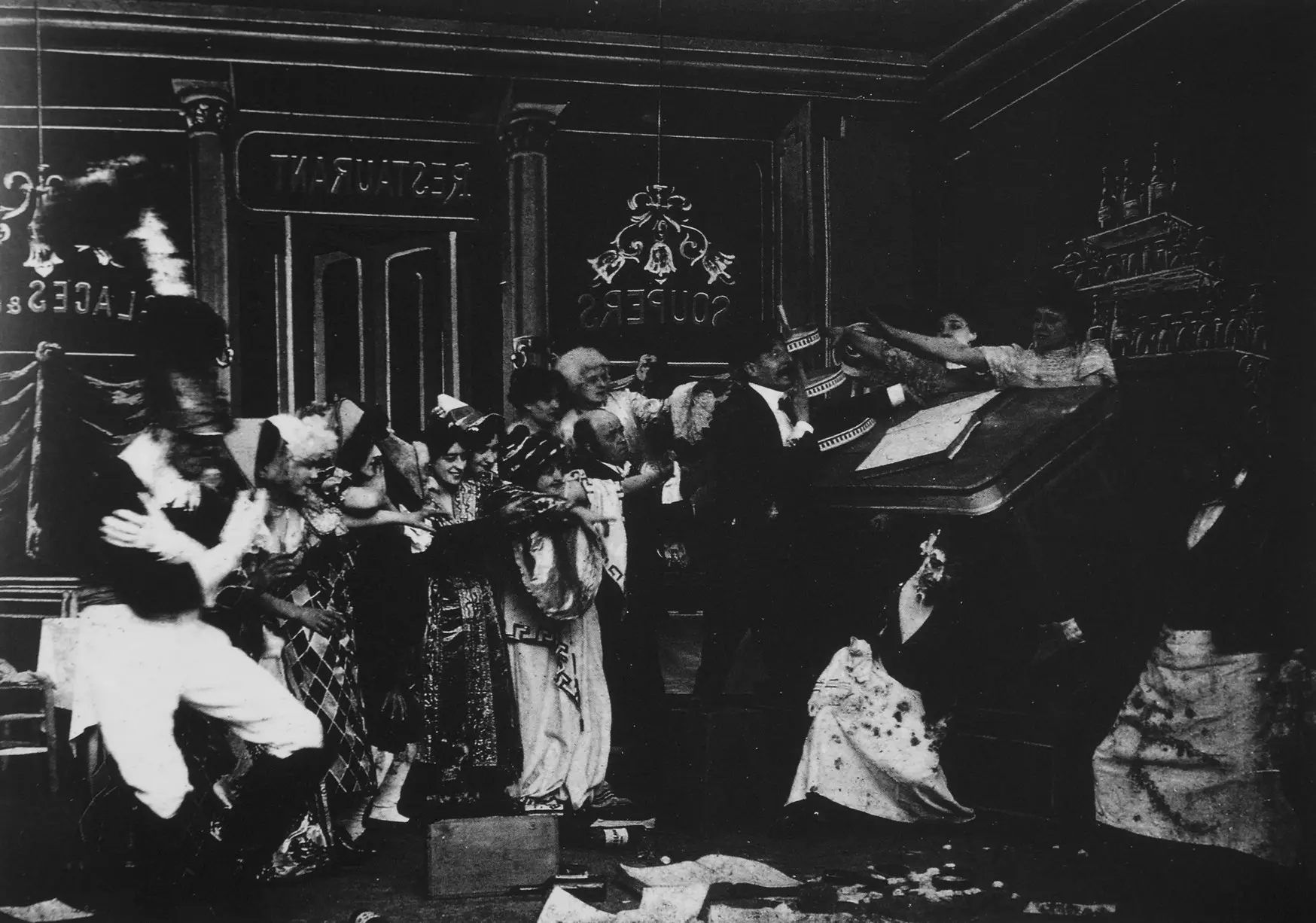
Paul Ollivier, playing the fiancé left holding a wilting boutonnière, has perhaps five minutes of screen time yet etches a miniature study in bourgeois impotence. Watch him thumb the ring box like a defective compass: he knows north no longer exists.
On the surface the film marches linearly: party, curse, flight, confrontation. But Mozzhukhin fractures chronology with flash-frames of Jeanne’s childhood communion—white dress, candlewax, priest’s hand hovering like a black spider. These shards intrude without warning, suggesting the lady in black may be an externalised superego, a punitive facet of Jeanne’s own psyche. The pursuit therefore becomes a Möbius strip where pursuer and pursued share identical cartilage.
Compare this to The Forbidden Room where corridors devour identity, or to The Breaking Point where every embrace draws blood. Mozzhukhin anticipates both, yet refuses catharsis. The final tableau—two silhouettes merging into one elongated shadow—implies the chase will loop ad infinitum, a carnival waltz whose refrain is the whip-crack of self-recrimination.
Mozzhukhin’s biography reads like picaresque myth: Kiev seminary dropout, Moscow cabaret sensation, exile after the revolution, Parisian matinée idol. One senses he smuggles personal guilt across every border. The lady in black may well be the filmmaker himself, demanding his protagonist—his nation, his audience—renounce comforting illusions. The Riviera, playground of displaced Romanovs and speculators, becomes a limbo where passports expire but nightmares travel visa-free.
Critics often yoke the movie to Ambrose in Bad for its slapstick carnivalesque, but that’s like comparing a migraine to a birthday balloon. Closer kin reside in the toxic lullabies of Das Milliardentestament or the sulphur-tinged religiosity of Stronger Than Death. All three hinge on inheritance—of sin, of property, of narrative culpability.
Meanwhile the chase structure echoes Gasoline Gus, though where that romp converts anxiety into petrol-burning whimsy, Mozzhukhin distills it to absinthe vapor.
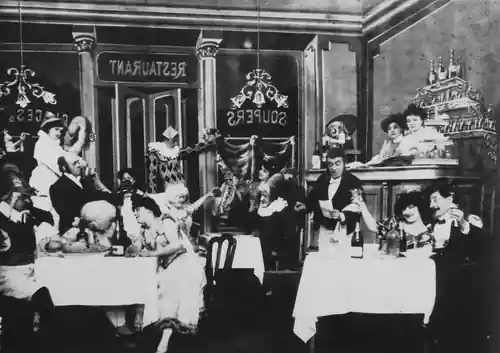
Only a 47-minute decomposed nitrate print survived the 1930s, resurfacing in a Ljubljana attic beside moth-eaten posters for Bulgarian diplomatic newsreels. Digital artisans at Éclair rehydrated the emulsion, filled perforation tears with laser grafts, and tinted new copies using Saint-Saëns’ original scoring cues. Purists decry interpolated explanatory cards; I mourn the loss of cigarette burns that once danced like fireflies. Yet without such necromancy the film would exist merely as footnote.
Post-#MeToo, the lady’s imperative to “renounce” lands with fresh thud. She demands bodily autonomy stripped of patriarchal contract. Jeanne’s panic is the terror of realising agency was always a rented dress. Conversely, some queer readings recast the pursuer as liberator, urging escape from heteronormative masquerade. The film refracts according to the viewer’s own carnival mask.
Technically, the on-screen speed fluctuates between 18 and 22 fps, creating a flutter that 21st-century apps spend millions imitating for “authentic vintage” filters. Mozzhukhin got there by accident of hand-crank variability—proof that authenticity is often failure sanctified by time.
I first encountered Nuit de carnaval in an underground Paris cinémathèque, projected onto a bedsheet soaked with rain from a leaking skylight. The images seeped through the fabric, colours bleeding like watercolour on wet paper. Halfway through the screening the projector bulb popped, and for thirty seconds the audience sat in darkness listening to our own breathing—an inadvertent tribute to Mozzhukhin’s obsession with voids. When light returned we were no longer spectators but accomplices.
Since then I’ve tracked prints across continents: a private collector in Montevideo who stores reels beside Nazi memorabilia; a Beirut archive that smells of cardamom and cedar; a Tokyo university where students perform live synth-scores. Each viewing peels fresh strata of meaning, yet the core remains elusive—like trying to hold perfume in your fist.
Masterpiece? Unquestionably. Entertaining? Only if you find beauty in dental extraction. The film gnaws, lingers, re-visits you at 3 a.m. when radiator pipes sound like distant tubas. It belongs on the same shrine shelf as Cameo Kirby’s moral quicksand and The Dishonored Medal’s chivalric rot.
If you seek closure, chase another carousel. Nuit de carnaval offers only a mirror framed by night-blooming cereus—gorgeous, pungent, and impossible to forget.
Review by Cinephile_Nyx • © 2025 • All screenshots under fair use for critical analysis
IMDb —
1935
Community
Log in to comment.