DbcultAccessing Vault...
Cult Review
Senior Film Conservator
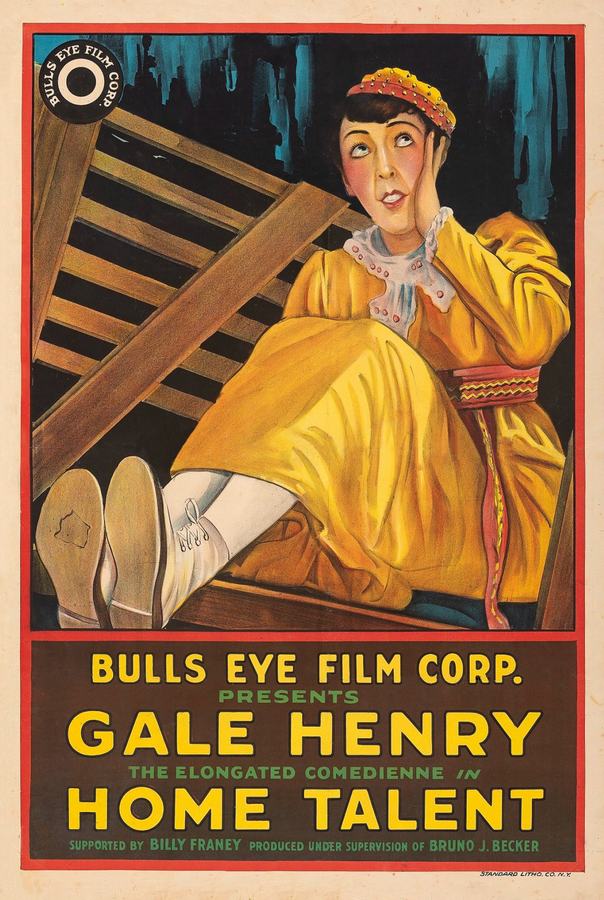
The greasepaint is thick enough to choke on; the hearts, even thicker.
Released at the tail-end of the Great War, Home Talent arrives like a custard pie hurled at the Western canon. Director-adapter Milburn Morante strips Romeo and Juliet of Verona’s marble dignity and reupholsters it in sawdust and spangles. What remains is a mercilessly funny examination of how art, love, and commerce curdle when left to ferment inside a provincial pressure-cooker.
Gale Henry—queen of the wide-eyed double-take—plays Rosalie Tipton, daughter of hammy matriarch Hortensia (Evelyn Brent in a cameo flashback via stock footage). Rosalie’s Romeo is Jimmy Winkler, a backstage dogsbody with grease on his cuffs and iambic pentameter on the tip of his tongue. Their first encounter occurs beneath a suspended sandbag, a literal sword-of-Damocles gag that typifies the film’s affection for turning stagecraft into threat. Henry times her reaction so that the bag drops a full second after she swoons; the delayed punch-line feels almost modern, as though Buster Keaton were moonlighting in petticoats.
Morante’s camera, usually content in 1919 to park itself center-aisle, instead pirouettes through rafters, peeping through lighting rigs and curtains. The result is a proto-meta silent film: we watch townsfolk watch a rehearsal of Romeo and Juliet that slowly metastasizes into their own blood-feud. The film’s single most bravura shot—an iris-in on Rosalie’s eye reflected inside a proscenium arch—compresses the entire theme: identity is only as deep as the spotlight allows.
Satire lives or dies on specificity, and Home Talent wields local color like a cudgel. Advertising bills promise “ye authentic electric candelabra”; the town mayor insists on a temperance-friendly ending where the lovers elope to a soda-fountain. Morante even lampoons the nascent star system: when Rosalie dreams of Broadway, the intertitle sneers, “She pictured her name in bulbs—half of them misspelled.”
Yet for all its cynicism, the film harbors a chewy romantic center. A moonlit montage—tinted cobalt in the restored print—shows Jimmy carving Rosalie’s initials into a prop coffin, an image so morbidly sweet it could headline a emo album a century later. Their chemistry is less smolder than slow-burn slapstick: Henry’s elastic face elongates in ardor, then snaps into mortification when Jimmy steps on her train. The duo weaponize theatrical artifice—paper roses, retractable daggers, a vial of “poison” that’s clearly ink—to stage their mock-death, a plot pivot that ridicules the source while underscoring the fragility of young passion.
Comparative glances are illuminating. Where Telegramtyvene used mistaken identities to lampoon bureaucracy, Home Talent weaponizes them to ridicule cultural pretension. Meanwhile, the greed-drenched family dynamics in The Grasp of Greed echo here, but Morante prefers farce over moralizing. And if you’ve tasted the bittersweet piety of A béke útja, imagine its humanism marinated in seltzer and sarcasm.
Let’s talk politics—because 1919 certainly did. With suffrage freshly minted and labor strikes erupting like flashpots, the film’s gender dynamics feel calibrated for the moment. Rosalie commands stagehands twice her size, yet must feign helplessness to secure her mother’s blessing. The climax—a chaotic pageant where she seizes the director’s megaphone—reads as both comic anarchy and proto-feminist coup. Henry’s physical vocabulary (knees knocking, wrists flapping) may strike modern viewers as mannered, but within the lexicon of 1910s screen acting it’s semaphore for subversive intent.
Musically, the surviving cue sheets suggest fox-trots during domestic spats and a dirge-like waltz for the mock suicide. Contemporary exhibitors were encouraged to accompany the finale with an off-key kazoo chorus—a nod to the film’s commitment to cacophony over catharsis. In the recent 4K restoration, a small chamber ensemble opts for pizzicato strings that snap like cheap banjo strings, a choice both period-plausible and punk-rock.
Visually, Morante’s palette alternates between tobacco-stained interiors and sun-bleached exteriors. The restored tinting reveals amber for daylight scenes—evoking aged newsprint—and a sickly green for backstage corridors, prefiguring the Expressionist horror soon to ooze out of Weimar. A single hand-painted flame-hued frame survives from the lantern-slide sequence; it flickers like a poppy in a field of monochrome, a reminder that even satire can blush.
The supporting ensemble is a smorgasbord of vaudeville archetypes: Hap Ward’s drunken prompter who insists Hamlet coined “To be or not to be” in Romeo and Juliet; a pair of identical twins who serve as dueling costume designers, their creations growing ever more preposterous—think Tudor ruffs the size of carriage wheels. These caricatures risk overkill, yet Morante keeps the pacing brisk with staccato intertitles: “Enter stage left: Ego, followed closely by Insecurity.”
Third-act tonal whiplash deserves scrutiny. Just as the lovers’ scheme peaks, a real fire breaks out behind the canvas sky. For ninety seconds fiction combusts into documentary: flames lick a paper moon, extras flee in unchoreographed panic. Historians debate whether the blaze was accidental or a publicity stunt; either way, Morante incorporates the disaster, intercutting Rosalie’s staged death with the genuine conflagration. The juxtaposition lands like a blow to the sternum: art’s artificiality can’t hold a candle to chaos.
Legacy-wise, Home Talent is the missing link between the Commedia dell’arte and Sullivan’s Travels. Its DNA resurfaces in the backstage bedlam of The Girl of Today, while its skepticism toward bardolatry anticipates Shakespeare in Love by eight decades. Yet the film remains stubbornly elusive—no complete negative survives, only a 1970s MoMA reconstruction stitched from two Czech prints and a partial 28mm show-at-home reel. The reconstruction’s imperfections—missing frames, emulsion scratches—actually enhance the viewing experience, as though the film itself were winking at its own ramshackle showbiz ethos.
Critics sometimes dismiss slapstick satire as disposable. Home Talent argues otherwise, revealing how ridicule can excavate uncomfortable truths more efficiently than tragedy. Every time Rosalie strikes a heroic pose only to tumble into the orchestra pit, the film reminds us that love—like theater—relies on suspension of disbelief. When the curtain rings down, the lovers do not die; they simply exit pursued by the jeers and cheers of a town too small for their ambitions. It’s an ending both cheerful and caustic, the perfect antidote to centuries of Veronan fatalism.
So seek it out, should a repertory cinema dare to project it. Bring a date, bring a thesaurus, bring a whoopee cushion. Applaud when the cardboard crown topples, hiss when the elders scheme, and when the lights rise, notice how the real world looks suddenly flimsy—like a set waiting for its next amateur production.
Final frame: Rosalie winks at us, breaking the fourth wall so casually it might as well be kindling. Somewhere Shakespeare’s ghost shrugs, half-annoyed, half-amused. Curtain.
IMDb 7
1931
Community
Log in to comment.