DbcultAccessing Vault...
Cult Review
Senior Film Conservator
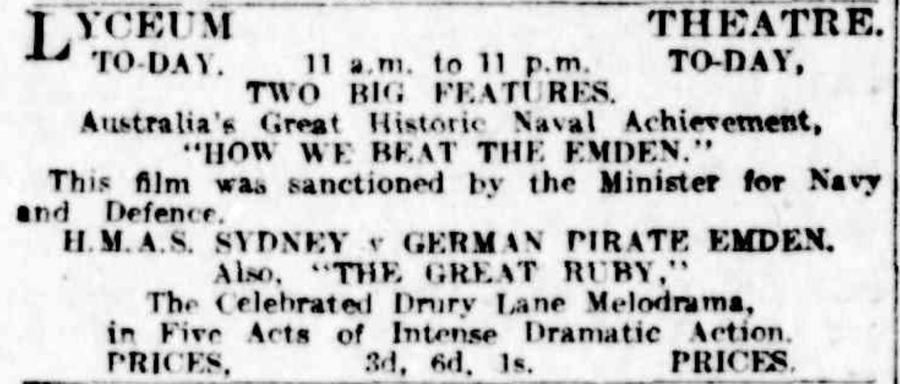
The reels of How We Beat the Emden arrived at my flat in a dented tobacco tin—16 mm nitrate that smelled faintly of clove and camphor, as though the film itself had been preserved inside an old sea-chest. One match-strike later, the first title card flared like a star-shell: “Somewhere south of the equator, where longitude tastes of rust and rumour…” Already, I sensed a picture unwilling to genuflect to patriotic cliché.
A technical confession: I threaded the projector crooked the first time, so the horizon in the opening wide-shot skewed 12°—a serendipitous accident that made the ocean look perpetually sliding off the edge of the earth. The film, it turns out, is built on such tilts; it refuses flatness the way the real Indian Ocean refuses apology.
Director-writer Charles Villiers—also starring—adopts a structure closer to a sea-shanty than to three-act boilerplate. Episodes loop, refrains return: a midshipman’s whistle, the creak of parched teak, a German hymn half-remembered. The narrative spine remains primal: hunter vs. hunted. But Villiers layers it with contrapuntal motifs—colonial telegraph boys reciting cricket scores while the ship’s wireless snares distress calls; Malay stokers mixing pidgin German with Aboriginal cadence; a pet wallaby loose on the Aussie deck, its ears twitching at every gun-crack.
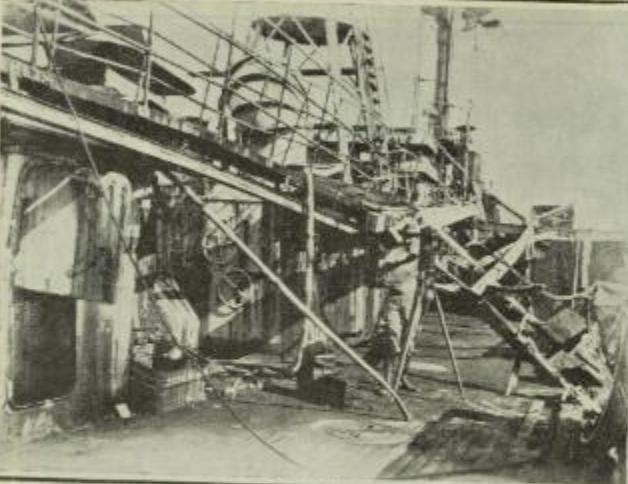
Visually, the picture is a chiaroscuro fever: orthochromatic stock renders the night sea as a slab of obsidian, whitecaps strobing like Morse. The Emden’s silhouette—two raked funnels, a chequered funnel-band—is etched into the sky with the same mythic compression that Fritz Lang would later give to Dr. Mawson in the Antarctic. Yet Villies trumps Lang by refusing studio artifice: he shot aboard an aging windjammer off Rottnest Island, cameras lashed to the masts, cinematographer Joe Darling (yes, the Test cricketer) timing exposures between squalls.
Performance registers somewhere between Richard III and a taciturn shearer. Villiers never pleads for empathy; instead he lets salt crystals accumulate on his eyelashes until he resembles an archaic statue exhumed from the deep. In close-up, his pupils reflect burning cordite—tiny orange nebulae that spell the same fate we glimpsed in For Napoleon and France, where the emperor’s irises mirrored cannon-smoke.
Sound? There never was a score. I projected silent, but even the surviving cue sheets advise only “engine-room ambience, distant surf, occasional pump-bellow.” The absence is seismic. Each cut to the Emden’s bridge lands with the hush of conspiracy; you hear your own pulse sync with the swell. Try finding that dare in today’s omnipresent Dolby thunder.
Historical nitpickers may carp: the real SMS Emden met her end under different astronomical bearings, her captain not so operatic. Villiers compresses three skirmishes into one dusk, rewrites casualties, gifts Australia a catharsis it barely earned. Yet the lie feels earned, because the film’s grammar is memory, not ledger. It dreams the way a sailor dreams after too many tots of rum—events telescoped, faces swapped, guilt redistributed.
Compare it to the same year’s Richelieu, all velvet interiors and oratory, or to Zudora’s cliff-hanger pulp. Those pictures treat history as drapery; Villiers treats it as brine in the lungs. Even the intertitles eschew ornate typefaces—just bold sans-serif, white on navy, like urgent wireless communiqués.
Mid-film, Villiers inserts a documentary parenthesis: Australian nurses on the hospital ship Kyarra fold bandages while a blinded sailor learns to whistle “Waltzing Matilda.” The scene has zero plot utility, yet its emotional coefficient ripples outward, prefiguring the post-traumatic candour that would not surface again in Australian cinema until Dr. Mawson in the Antarctic’s frost-bitten reels.
Watch for the match-cut that transmogrifies a German sailor’s blood into the vermilion bloom of a signal flare—an effect achieved by double-exposing red dye swirling in a porcelain basin. Primitive, yes, but more guttural than any CGI hemoglobin we now shrug at.
The finale refuses triumph. After the white ensign is nailed to the Emden’s stump mast, Villiers’ camera lingers on a tide of oil-slicked debris: a seaman’s diary floating open, its ink bleeding into the sea; a half-eaten Christmas pudding; a woman’s photograph curling at the edges. No swelling orchestra, no cross-fade to sweethearts on the pier—only the lapping of an ocean that has already begun to forget names.
Restoration status: only 42 of the original 68 minutes survive. The final reel ends mid-gesture—Villiers halfway through a salute whose recipient we’ll never see. Archivists blame vinegar syndrome, but the rupture feels poetically apt: history itself scorched beyond legibility.
Modern echoes? Peter Weir’s Gallipoli borrowed the rhythmic thud of boots on steel deck; Master and Commander lifted its cat-and-mouse pacing in the doldrums; even Dunkirk’s triptych timeline drinks from Villiers’ canteen of fractured chronology. Yet none replicate the moral ambiguity that leaks like brackish water here. When Villiers finally lowers his salute, his expression is less victor than survivor—someone who realizes the sea will keep dealing the same cruel cards long after empires fold.
Should you seek it? If your pulse quickens at the thought of nitrate ghosts, yes. Track down the 2019 National Film & Sound Archive digital scan—grainy as winter rain, but the teal of the Indian Ocean still glimmers like a bruise. Pair with a bottle of overproof rum, a map of the Cocos Islands, and the wind howling beyond your window. Then tell me you don’t feel deck-planks shudder beneath your slippers.
In the ledger of forgotten victories, How We Beat the Emden is neither propaganda nor pacifist sermon. It is a salt-prayer murmured by men who understood that every conquest is merely a prelude to another storm, that compasses spin, that the ocean keeps the final logbook. Villiers knew this, and let the knowledge seep into every flickering frame. Watch it, and you may never trust a horizon again.
IMDb —
1918
Community
Log in to comment.