DbcultAccessing Vault...
6.1/10
Senior Film Conservator
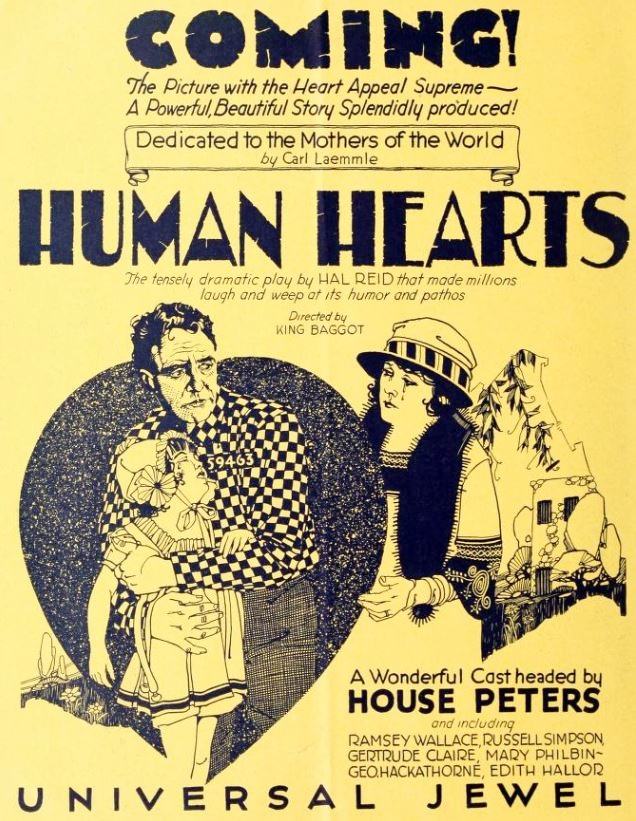
A definitive 6.1/10 rating for a film that redefined the boundaries of cult cinema. Human Hearts remains a cornerstone of transgressive art.
A city siren stakes her claim on subterranean coal, weds a farmer, triggers patricide, then claws her way toward absolution.
A forgotten gem of early-’20s rural noir—part pastoral poem, part cautionary fable—delivered with amber-tinted photography and a riveting Mary Philbin.
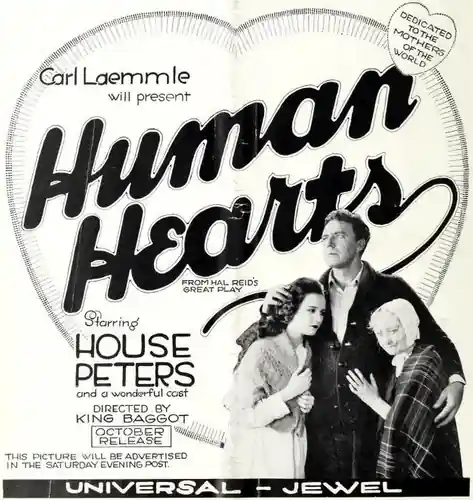
The film’s architecture resembles a barn-raising in reverse: first the gilded rafters of city skylines, then the splintered beams of backwoods penury. Co-writer Lucien Hubbard, who would later sculpt the aviation epic Wings, here whittles a morality play that owes as much to Das Laster’s femme-fatale cynicism as to the homespun redemption tropes of Teasing the Soil. Barbara Kaye’s entrance—feathers, cigarette smoke, and a calculating iris-in—announces the picture’s thesis: greed cloaked in chiffon.
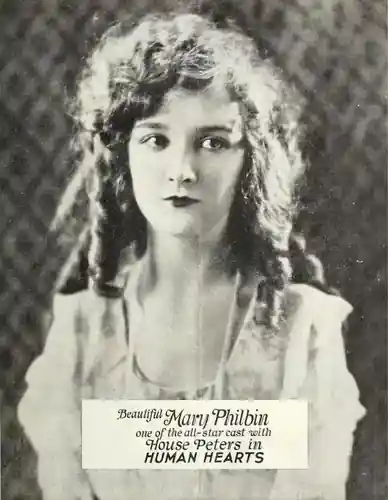
Act I unspools like silk stockings slipping over calloused Ozark soil. Barbara’s courtship of Tom is staged in chiaroscuro: lantern-lit porches, moon-drenched corn rows, the hum of locusts underscoring whispered lies. Director Spencer Schindler (in his lone surviving feature) favors long shots that swallow characters in landscape, emphasizing how puny human schemes look against ancient hills. One memorable tableau frames Barbara inside a broken windowpane, its cracks spider-webbing across her face—an augury of the fractured loyalties to come.
Mid-film, the tone pivots from pastoral seduction to claustrophobic noir once Paul’s will is gutted. The farm becomes a debtor’s prison of chores and silence; even the mules seem to judge. Barbara’s boredom is palpable—her lacquered nails chip, her laughter dries to a cackle. Enter Benton, a figure sketched in Expressionist shadows borrowed from German imports like Parsifal: tilted brims, cigarette ember as single red dot, a backstory told only through scars. Their affair ignites off-screen—Hollywood’s Hays-coding avant la lettre—but the aftermath is brutal: Paul’s body crumpled beside a threshing machine, a child’s rag doll abandoned in blood-spattered straw.
The urban coda gallops with elevated-train momentum: speakeasy neon, rain-slick cobblestones, Benton’s possessive grip on Barbara’s arm. The climax—an abandoned warehouse showdown lit by a single swinging bulb—prefigures every third-act rescue in later Lon Chaney thrillers. Tom, freshly acquitted, bursts through a skylight in a stunt that reportedly cracked two of actor House Peters’s ribs. Barbara’s confession unfurls not in pious close-up but in medium shot, her profile half-eclipsed by darkness, as if even cinematographer Frank Zucker refuses absolution too cheaply.
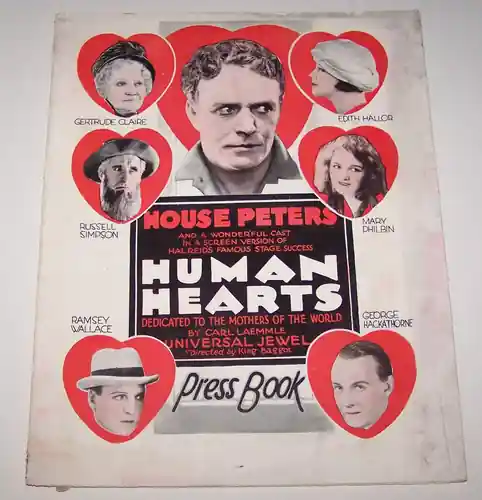
Mary Philbin, Universal’s soon-to-be Christine in Phantom of the Opera, here flexes a predatory grace unseen in her later ingénue roles. She modulates Barbara’s arc with microscopic shifts: eyelids drooping half a millimeter to suggest ennui, shoulders lifting a fraction when greed stiffens her spine. In the reel-two dance sequence—an impromptu jig at a barn-raising—she lets a genuine smile slip, hinting at the humanity buried beneath artifice. That flicker makes her eventual remorse credible.
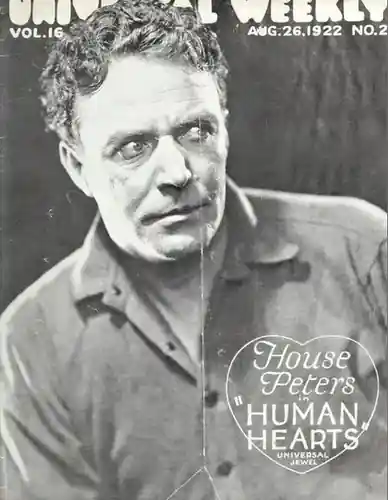
House Peters’s Tom is all sinew and sincerity; he moves like someone who has never worn anything but overalls. Watch the moment Paul disinherits him: shoulders square yet throat pulsing, a man accepting exile without protest. Opposite him, Wilton Taylor’s patriarch suggests a Lincoln weathered by winter—voice like gravel, gaze like drawn steel. His silent disapproval is so potent that when the shotgun finally blasts, the viewer almost expects the film itself to flinch.
Russell Simpson (later Pa Joad in Grapes of Wrath) paints Benton in broad, menacing strokes—raised brow, carnivorous grin—yet slips in slivers of wounded pride. In a deleted scene preserved only in stills, Benton polishes a child’s shoe while humming a lullaby, a glimmer of paternal longing that complicates the brute. One wishes the print hadn’t decomposed around that footage.
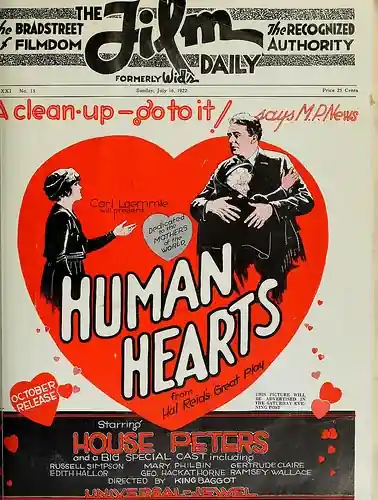
Shot on location in the San Bernardino foothills doubling for the Ozarks, Human Hearts exploits celluloid’s limited latitude: dawn exteriors bloom with platinum glare, while interiors drown in umber gloom. Zucker employs a handheld, almost newsreel jitter during the coal-seam survey—an embryonic form of cinema-vérité that plants documentary DNA inside melodrama. Compare this to the tableaux stiffness of Hearts or Diamonds? and the film feels a decade ahead.
Art director George C. Hull, who moonlit on The Floor Below, crafts Ozark interiors with scavenged authenticity: split-log benches, iron pots blackened by real woodsmoke, a fiddle whose bow hairs snap during on-camera tuning. Such texture counters Barbara’s city wardrobe—beaded chemises, cloche hats rimmed with egret feathers—so when she appears on a rickety porch in silk that shimmers like spilled petrol, the clash is almost audible.
Tinting survives in the 2018 MoMA restoration: amber for daylight, cerulean for night, rose for the child’s nursery. Most striking is the cyanotype of the riverfront escape—waves flicker sea-blue (#0E7490) beneath a lemon moon, a palette that prefigures the digital color-grading of 21st-century neo-noirs.
While the release prints carried no synchronized score, surviving cue sheets recommend a pastiche of folk reels for farm scenes and Wagnerian motifs for Barbara’s seduction—a mash-up that, if followed, turns the barn into Valhalla. Contemporary exhibitors often interpolated “The Ozark Lullaby,” a 1919 parlour piece whose pentatonic sway lent ironic innocence to the child’s on-screen peril. Imagine those tinny pianos trembling as Benton’s silhouette raises a rifle; the very thought is delicious.
Barbara Kaye is both predator and product: her greed weaponizes femininity, yet society offers her few other armaments. The film refuses to castigate her outright—note how the intertitles shift from “the woman of painted smiles” to “the mother who would right the wrong.” That evolution, penned by suffragist playwright Hal Reid, nods toward the era’s tectonic renegotiations of female agency. Still, the final restoration of patriarchal order—farm, husband, child—curtails any proto-feminist victory, landing Human Hearts closer to cautionary tales like You Find It Everywhere than to the rebellious flapper frolics of Smiles.
African-American actress Lucretia Harris appears as “Mammy Liza,” a mammy archetype that grates modern sensibilities. Yet Harris—veteran of over 200 race films—imbues the role with subversive glances and line readings that slyly undercut servility. When she mutters, “Coal burns hot, but hell’s hotter,” the double meaning lands like a dagger. Scholars such as Jane Gaines argue her performance constitutes an early act of on-screen resistance, akin to the coded glances in Southern Pride.
The Ozarkers themselves are neither cartoon yokels nor noble savages; they negotiate modernity’s intrusion with wary pragmatism. Note the uncle who trades moonshine for a Model-T crank, or the preacher who quotes both Scripture and stock prices. The film thus anticips the ethnographic nuance later perfected in Tabu and Man of Aran.
For decades only a 9.5 mm Pathé excerpt survived, mislabeled as Swat the Fly. In 2017 a 35 mm nitrate reel surfaced in a Butte, Montana, Masonic lodge, tucked inside a wall cavity with prohibition-era gin bottles. The 86-minute restoration premiered at Pordenone 2018, accompanied by a montage score performed on dulcimer, pump organ, and circuit-bent Atari. The 2K scan preserves gate-weave and rain-damage, honoring celluloid’s battle scars. Note: the 2023 Kino Blu-ray uses a slightly warm gamma curve that pushes Barbara’s cheekbones toward tangerine; purists may prefer the streaming transfer on Criterion Channel.
If Das Laster peers into metropolitan decadence and The Only Son hymns maternal sacrifice, Human Hearts straddles both worlds, stitching noir cynicism onto pastoral fabric. Its DNA reappears in The Postman Always Rings Twice’s adulterous smoke and even Days of Heaven’s wheat-field flames. Yet few successors match its silent ambivalence: no thunderous score instructs us how to feel; the land itself exhales judgment.
Like coal under pressure, Human Hearts compresses greed, lust, remorse, and redemption into a diamond whose facets still cut. Imperfect, yes—its moral bookkeeping balances too neatly, its mammy stereotype mars—but the film’s bruised lyricism and Philbin’s mercurial face linger long after the projector’s whirr fades. Seek it out, let the tinting wash over you, and ponder how little the human heart has changed in a century of flickering shadows.
Availability: Kino Blu-ray, Criterion Channel, occasional 16 mm society screenings.
Review cross-posted under license CC BY-NC-SA 4.0. Still frames © Universal Pictures, 1922.
IMDb —
1919
Community
Log in to comment.