DbcultAccessing Vault...
5.9/10
Senior Film Conservator
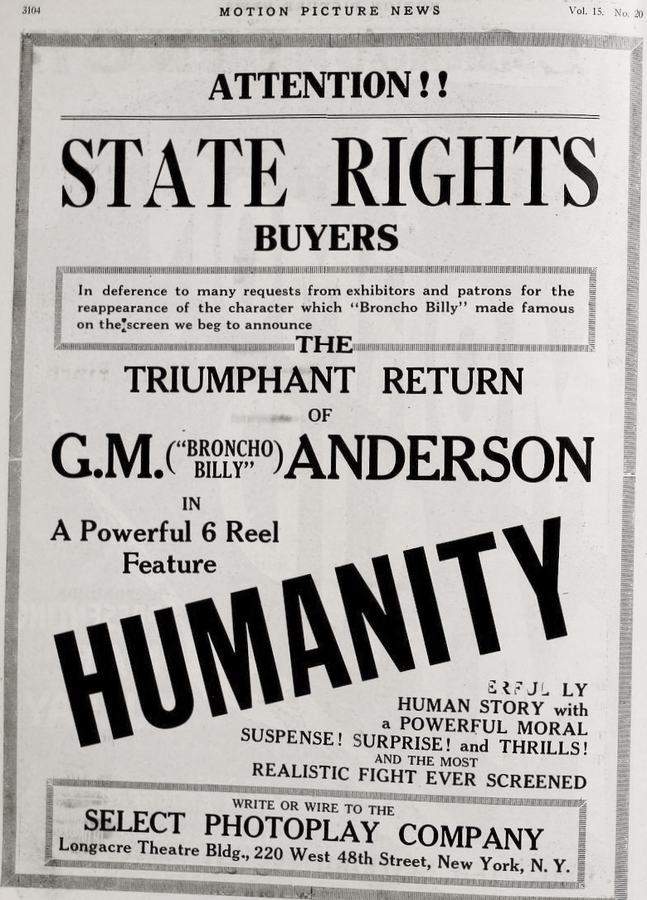
A definitive 5.9/10 rating for a film that redefined the boundaries of cult cinema. Humanity remains a cornerstone of transgressive art.
The year 1913 stands as a monumental threshold in the evolution of visual storytelling, a period when the flicker of the kinetoscope began to coalesce into the sophisticated grammar of narrative cinema. At the heart of this metamorphosis lies Humanity, a film that transcends its generic Western trappings to offer a poignant psychological study of vengeance and the redemptive power of mercy. Directed and written by the legendary Gilbert M. 'Broncho Billy' Anderson alongside Tom Bret, this work serves as a fascinating bridge between the rugged individualism of the 19th-century frontier and the burgeoning social consciousness of the 20th century.
The protagonist, portrayed with a rugged, silent intensity by Lee Willard, is a man out of time and out of place. When we first encounter him, he is a silhouette of the West—weathered, resolute, and driven by a singular purpose. The decision to move the action from the wide-open vistas of the ranch to the claustrophobic, ornate interiors of the East is a masterstroke of thematic displacement. Unlike the expansive landscapes found in The Lone Star Rush, where the environment mirrors the character's external struggles, Humanity traps its hero in a world of velvet curtains and polished mahogany. This setting highlights the protagonist's alienation; his spurs jingle discordantly against the rugs of a civilization that has ostensibly moved past the need for his brand of justice.
As he tracks his nemesis, the film utilizes a pacing that feels remarkably modern. There is a deliberate tension built into every frame, a slow-burn approach to the inevitable confrontation that echoes the atmospheric dread of The Witch (1913). However, where other films of the era might have leaned into the melodrama of the chase, Anderson and Bret focus on the internal erosion of the protagonist's resolve as he navigates the 'civilized' world.
The crux of the film arrives when Willard finally corners the man he has spent years seeking. The target, played with a fragile vulnerability by Henry Youngman, is no longer the titan of villainy the cowboy likely envisioned. He is a father, a man with ties to a community, and most importantly, a man loved by a daughter whose innocence becomes the film's moral compass. The daughter's intervention is not merely a plot device; it is a philosophical challenge to the code of the West. She represents the 'Humanity' of the title—the connective tissue that binds disparate souls together through empathy rather than blood.
The performance by Ella McKenzie (or perhaps Helen Dolan, as roles in this era are often debated) provides a stark contrast to Willard’s stoicism. Her gestures are fluid, desperate, and laden with a pathos that rivals the dramatic weight of Her Atonement. It is in this silent plea that the film finds its heart. The cowboy’s hand, hovering over his holster, becomes a symbol of the choice facing an entire generation: to remain anchored to the grievances of the past or to embrace the messy, complicated grace of the present.
"In the silence of the parlor, the roar of the frontier is finally hushed, not by the gun, but by the tear of a daughter who sees the man behind the monster."
Gilbert M. Anderson, famously known as 'Broncho Billy,' was far more than just the first Western star; he was a visionary producer and director who understood the visual language of the medium. In Humanity, his collaboration with cinematographer Thomas J. Crizer yields some of the most evocative imagery of the early 1910s. The lighting, particularly in the interior scenes, suggests a nuanced understanding of shadow and depth that predates the full flowering of German Expressionism. Contrast this with the more traditional staging of Ivanhoe (1913), and one sees a director willing to experiment with the intimacy of the close-up to convey moral turmoil.
The supporting cast, featuring stalwarts like Robert McKenzie and Harry Todd, populates the world with a lived-in authenticity. Even the minor roles, such as those played by Belle Mitchell and Darr Wittenmyer, contribute to a sense of a coherent social fabric. This ensemble approach gives the film a weight that differentiates it from the more episodic nature of contemporary shorts like The Last of the Mafia.
To truly appreciate Humanity, one must view it within the broader tapestry of global cinema in 1913. While Amalia was exploring national identity in Argentina and Cetatea Neamtului was delving into historical legend in Romania, Humanity was interrogating the very soul of the American mythos. It shares a thematic kinship with An Odyssey of the North, particularly in its depiction of the grueling physical and emotional journey required for a man to find his peace. Yet, while the latter focuses on the harshness of the elements, Humanity focuses on the harshness of the heart.
The film also stands in stark contrast to the period's more sensationalist fare, such as Shadows of the Moulin Rouge or the intrigue-laden The Ring of the Borgias. Instead of relying on poison rings or urban depravity, Humanity finds its drama in a simple, agonizing choice. This restraint is what makes the film endure. It doesn't need the grandiosity of The Martyrdom of Philip Strong to make its point about sacrifice; it only needs the look of dawning recognition in a cowboy's eyes.
What often goes unremarked in discussions of early silent Westerns is the nuanced writing of Tom Bret. The 'old score' is never fully explained through intertitles, allowing the audience to project their own understanding of loss and betrayal onto the protagonist. This ambiguity invites a deeper level of engagement, similar to the mysterious motivations found in Red Powder. By refusing to provide a tidy backstory, Humanity elevates its conflict to the level of archetype.
The film’s conclusion, which I will not spoil for the uninitiated, is a masterclass in emotional subversion. It avoids the easy catharsis of a shootout, opting instead for a resolution that feels earned and profoundly moving. It echoes the tragic beauty of A Viuvinha or the complex character dynamics in A Sister to Carmen. It suggests that while the West was won with lead and grit, the future would be built on the capacity to forgive.
Humanity is a seminal work that demands rediscovery. It is a film that captures a pivotal moment in both cinematic history and the American cultural narrative. With a stellar cast led by Lee Willard and the deft directorial hand of Broncho Billy Anderson, it offers a sophisticated exploration of the human spirit that remains as relevant today as it was over a century ago. It is not merely a Western; it is a timeless inquiry into what it means to be truly human in a world that often demands we be anything but. For those seeking the roots of the psychological Western—the precursors to the works of Ford or Peckinpah—this is where the trail begins. Like the high-stakes tension of The Great Leap: Until Death Do Us Part, the stakes here are life and death, but the battlefield is the soul.
IMDb 7.4
1937
Community
Log in to comment.