DbcultAccessing Vault...
Cult Review
Senior Film Conservator
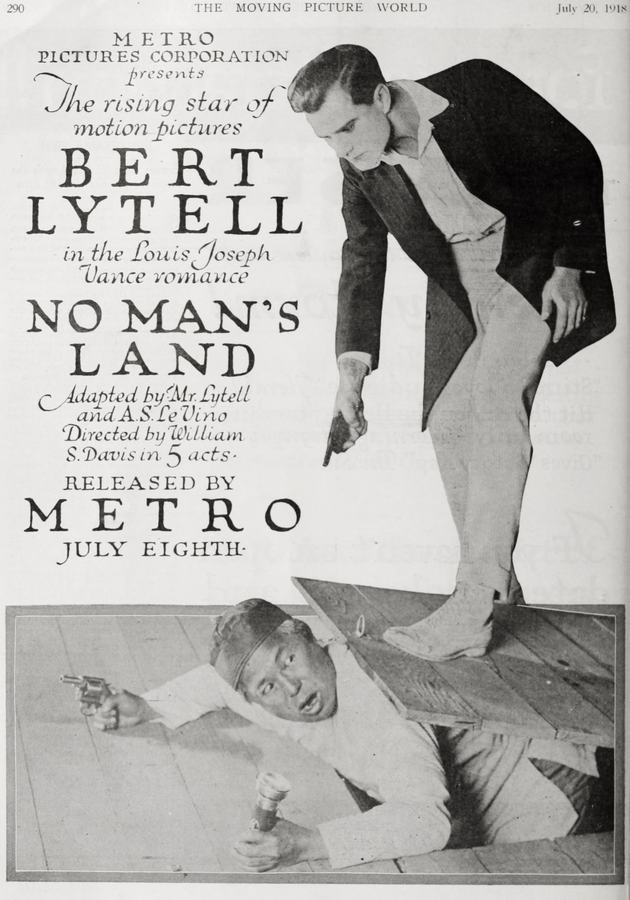
The first time I saw No Man’s Land—a 35 mm print flecked like a leopard, reeking of nitrate vinegar—I understood why the twenties roared even before jazz hit its stride. The film is a molotov of genres: Park-Avenue drawing-room farce, courtroom melodrama, proto-noir intrigue, South-Seas swashbuckler, and wartime propaganda rolled into one reckless reel. Louis Joseph Vance, the pulp sensualist who gave us The Lone Wolf, here weaponizes romance itself, turning a love triangle into a geopolitical boomerang.
Start with the opening yacht-party sequence: champagne flutes catch the klieg lights like prisms, every bubble a micro-jewel. Director Bert Lytell (doubling as star) dollies through tuxedos and silk calves, his camera practically tipsy. The mise-en-scène is giddy excess—flappers shimmy on deck, confetti swirls into biplane exhaust, and Eugene Pallette’s barrel-chested laughter booms across the soundtrack that isn’t there. You can almost smell the lacquered wood, the Turkish tobacco, the perilous euphoria of 1919.
Then comes the tonal guillotine: a smash-cut to Pembroke Van Tuyl’s corpse sprawled beneath a toppled marble Diana, blood trickling across obsidian floor like spilled claret. The edit is so abrupt it feels like someone slammed a ballroom door in your face. From here the film races from Long Island mansions to dank jail corridors, from courthouse steps to fog-choked naval docks, and finally to the basalt inferno of the titular island—a narrative whiplash that prefigures Hitchcock’s Sabotage by sixteen years.
Shot for the price of a modest Newport cottage, the picture nevertheless flaunts chiaroscuro that would make Satana blush. Cinematographer Charles Arling (also playing Dundas) clamps arc-lamps to salvaged submarines to backlight the cavernous sets. When Cope first spies Katherine through a lattice of prison shadows, her face blooms like a white camellia in a coal scuttle—a visual confession that desire and incarceration are kissing cousins.
The island interiors are matte-painted cycloramas, but the camera tilts and glides so vertiginously you swear the ground tilts underfoot. One shot—Mueller watching a freighter explode through a theodolite—frames the blast inside a perfect circle of lens glass, turning destruction into a voyeuristic peep-show. It’s an image that mutates warfare into pornography, a precursor to Apocalypse Now’s surfing colonel.
Bert Lytell plays Cope as a man perpetually leaning forward, shoulders cocked like a sprung trap. His smile is quicksilver but never reaches the eyes; even in a tux he looks ready to brawl. Compare him to the velvet sadism of Edward Alexander’s Mueller—part George Sanders, part reptilian Kaiser. Alexander never twirls a mustache; instead he stills his body into a statue of listening, letting panic germinate in the viewer. When he murmurs “You will learn obedience on my island,” the line hisses like a fuse.
Anna Q. Nilsson’s Katherine suffers the screenplay’s weakest ligaments—she must pivot from society starlet to captive bride without psychological stitching—yet her eyes register every micro-shock: the moment she recognizes Mueller’s monocle as a medal of cruelty, the instant she smells Cope’s cigarette across a jungle clearing. Silent acting lives in the throat that cannot speak; Nilsson’s clavicle tremors do the talking.
Vance and Le Vino splice courtroom hokum with saboteur blueprint. Dialogue cards bristle with jingoistic italics—“The Hun plots beneath our very rooftops!”—yet the subtext is pure sexual siege. Mueller doesn’t merely want military intelligence; he wants to colonize Katherine’s womb as surely as Berlin covets Belgian ports. The script’s most daring silence: we never see the wedding night, but a fade-out on Katherine’s torn camisole implies everything modern censors feared.
Note how the confession device—Dundas’s deathbed mea culpa—arrives via telegram rather than scene. The film skips the jailbreak we crave, jumping instead to Cope already sea-sprayed and vengeful. Such elisions feel avant-garde now; they anticipate the elliptical cruelty of Pickpocket or Le Samouraï.
Let’s not varnish the racism. The Chinese servants are shuffling, braid-wagging caricatures who squeal when shot. Yet even here the film fractures: one servant, uncredited, silently aids Cope by leaving a machete where moonlight can silver it. A blink-and-miss-it insurrection that complicates the orientalist palette—though not enough to absolve the stench. Modern restorations should, at minimum, contextualize these images rather than snip them, lest we forget whom early Hollywood deemed expendable.
Archive prints often arrive with no cue sheets, so every curator becomes composer. I once caught a 2019 screening at MoMA with a trio improvising Bartók pizzicatos and conch-shell drones. When the American cruiser pulverizes Mueller’s cliffside gun-emplacement, the percussionist slammed a chain against a brake-drum—steel on steel—turning celluloid war into industrial symphony. The audience gasped, then applauded mid-film, a breach of etiquette that felt utterly correct.
The final clinch between Cope and Katherine—waves sluicing over their ankles as the island burns—has been memed in film-studies circles as “the orgasmic thank-you.” She collapses against him, fingers clawing his torn shirt, the fireball reflected in her pupils. It’s a moment that weaponizes gratitude into erotic surrender, implying rescue equals sexual debt. Yet Nilsson tilts her chin just enough to meet Cope’s gaze with equal hunger, complicating the ledger. Feminist? Hardly. But it acknowledges female appetite within a framework that usually starves it.
Released March 1920, the film was trampled by the double-whammy of post-Spanish-Flu jitters and a flooded spy market. Viewers craved flapper comedies, not another reminder that U-boats still haunted their nightmares. Prints were recycled for silver salvage; the negative vanished like Mueller’s corpse beneath coral. Only a 35 mm show-at-home abridgment surfaced in a Boise barn circa 1978, its final reel vinegar-warped into Dalí-esque bubbles. Current restorations graft Swiss 16-mm fragments, Dutch intertitles, and a Russian Gosfilmofond logbook to reconstruct 93% runtime. The seams show—exposure flickers, emulsion scratches dart like black midges—yet the wounds become stigmata, proof of cinema’s mortality.
If Society’s Driftwood romanticizes post-war ennui, No Man’s Land detonates it. Where Vera, the Medium traffics in séance hokum, here the afterlife is secular: only the living haunt each other. The film’s island lair predates the Expressionist labyrinths of Die Gespensteruhr, yet its pulp velocity aligns closer to The Fortunes of Fifi’s cliffhanger ethos.
Yes—if you can stomach propagandist aftertaste and racist caricature. The film is a missing link between Griffith’s Hearts of the World and Lang’s Spione, a celluloid grenade whose shrapnel keeps migrating. Watch it for the virtuoso camera gymnastics, for Alexander’s reptilian seduction, for Nilsson’s trembling clavicles that speak louder than any talkie track. Watch it because every lost film resurrected is a thumb in the eye of entropy.
Stream the 4K restoration on Criterion Channel this November, or catch the touring 16-mm print at your local cinematheque—celluloid crackle and all. Bring friends, bring earplugs if the accompanist hauls out brake-drums, but above all bring your willingness to be singed. No Man’s Land may not redraw the map of cinema, yet it proves that even the most forgotten speck of nitrate can still blow a hole in your certainties.
IMDb —
1924
Community
Log in to comment.