DbcultAccessing Vault...
Cult Review
Senior Film Conservator
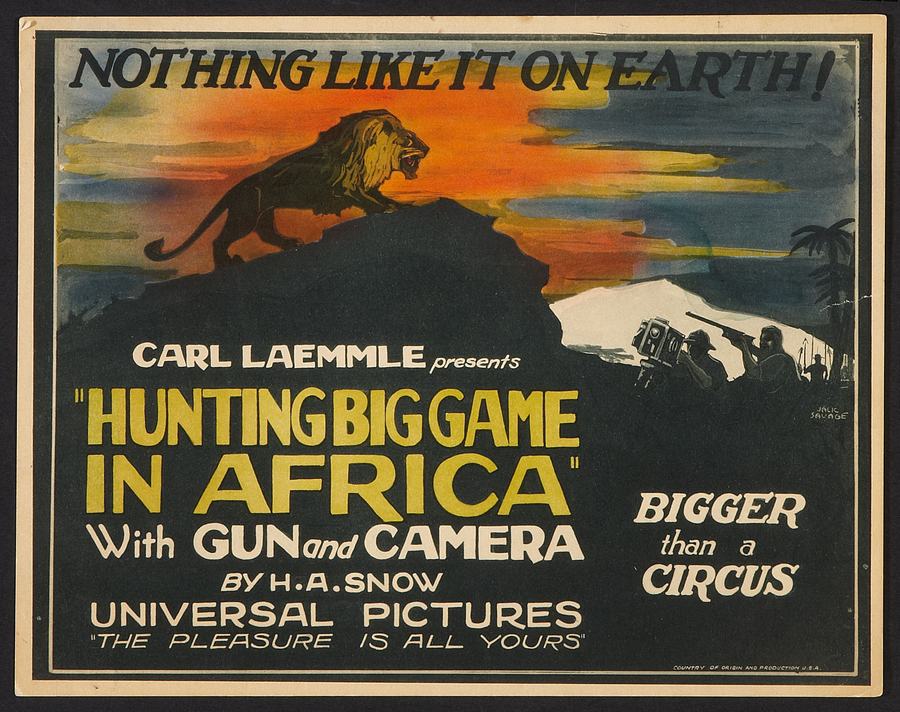
The first thing that strikes you about Hunting Big Game in Africa with Gun and Camera is the frank oxymoron of its title: a marriage of ballistic steel and celluloid ribbon, consummated somewhere between the Rift Valley and the twentieth century’s hunger for spectacle. Shot in the waning days of 1919 and circulated through small-town America throughout the Roaring Twenties, the Snow brothers’ footage predates television’s wildlife blockbusters by decades, yet already smells of concession-stand popcorn and gunpowder. Viewed today, the hour-long assemblage (surviving only in patchy 16 mm dupes laced with vinegar syndrome) plays like an accidental prophecy: every frame foretells both National Geographic grandeur and the ethical hangover that still haunts nature media.
Unlike Kapten Grogg bland vilda djur or the Swedish cartoon fauna in Kapten Grogg skall fiska, the animals here are emphatically real, their hides scarred by tsetse flies. Yet the Snows rarely deliver the coup de grâce on camera. Instead, the rifle cracks are heard off-screen, followed by a cut to the triumphant men posing beside inert tusks or limp manes. This editorial elision is the film’s sleight of hand: it lets middle-class audiences in Kansas or Ohio imagine both the thrill of the hunt and the moral comfort that the actual slaughter remains discreet. In 2024 parlance, it’s the original "viewer discretion"—achieved not through content warnings but through the simple economy of missing footage.
Cinematographically, the brothers favor long shots that swallow the human figure into topographic immensity. The horizon sits lower than the rule of thirds would decree, compressing sky into a molten slab of ochre. Dust becomes a visual instrument: when a rhino charges, the rising plumes resemble scratches on the emulsion itself, as though the animal were etching its own furious sigil onto the film. Scholars sometimes compare these passages to the apocalyptic vistas in The Last Man, but where that feature relied on studio-built desolation, the Snows’ deserts and swamps are terrifyingly indifferent to narrative payoff.
Modern viewers will note how porters, trackers, and camp cooks flicker through the periphery, rarely granted a portrait or even an intertitle name. Their erasure feels systemic, not negligent: the film’s governing myth demands an Africa empty of history so that white adventurers can inscribe destiny upon it. Still, occasional slippages occur. In one shot, a tracker’s knowing glance toward the lens lasts perhaps twelve frames—barely half a second—but it punctures the colonial reverie with the force of a thrown spear. Such micro-rebellions accumulate, turning the viewing experience into an archaeology of ghosts.
Compare this to Out of the West, where Native Americans function as narrative furniture. The Snows, constrained by documentary verisimilitude, cannot wholly fictionalize their labor force, so they opt for spectral occlusion instead. The result is arguably more insidious: an Africa populated by fauna and foreigners, but almost never Africans.
Archive prints are silent, though many exhibitors in 1920 would have supplemented them with live narration, trap drums, or even gramophone records of "savage jungle" effects. Today’s cinephiles often pair the film with ambient scores of their own curation—something percussive by Hausa griots or maybe a droning synth suite. I’ve tried both, then opted for pure hush. The absence of sound magnifies tiny visual cadences: the twitch of an elephant’s ear becomes seismic; the click of the camera’s shutter gate seems to echo across a century. Silence also exposes the film’s moral vacuum: without orchestral cues to instruct your empathy, you’re left alone to negotiate complicity.
Paradoxically, Hunting Big Game helped galvanize the very conservation movement that now views it as cringe-worthy artifact. Urban audiences, confronted with images of dwindling herds, began to suspect that maybe the planet wasn’t inexhaustible. The film thus occupies the same awkward lineage as Motherhood or The Kid: works instrumental in forging social conscience even as they traffic in exploitative sentiment.
In 2018, Italy’s Cineteca di Bologna stitched together the most complete print yet, using a hybrid wet-gate / digital workflow that arrested vinegar syndrome without ironing out the lovely gate weave. The tints—saffron dawn, indigo dusk—follow historical references scribbled on the original cans. Meanwhile, Kenyan artist Ng’ang’a wa Njeri projected the film onto a white rhino carcass molded from recycled flip-flops, reframing the Snows’ opus as eco-guerrilla installation. Such interventions prove the footage is still chemically alive, capable of new chemical romances with contemporary anxieties.
On the surface, the film is a testosterone pageant: khaki shorts, pipe tobacco, pith helmets cocked at rakish angles. Yet the camera’s reflexivity complicates the swagger. Repeated shots of H.A. Snow cranking the Eyemo while perched on a termite mound betray a certain vulnerability; the apparatus dwarfs him, its brass innards glinting like steampunk organs. At such moments the hunt becomes secondary to the hunt for images, suggesting that masculinity itself is a frantic montage, spliced together to mask the terror of being small.
Compare that anxiety loop to the flapper escapades in Trixie from Broadway or The Dazzling Miss Davison, where gender performance is all jazz razzmatazz. In the Kenyan savanna, far from Broadway’s footlights, masculinity is a lonely kinetic ordeal, performed for an audience of vultures.
Film schools often teach Eisenstein’s montage as the locus of ideological persuasion; Hunting Big Game suggests that absence can also be propaganda. By withholding the bullet’s impact, the Snows let spectators fill the gap with personal thresholds of tolerance. Some viewers relish the implied kill; others wince and thereby declare themselves civilized. The film becomes a moral Rorschach, its meaning flickering depending on who cranks the projector—and who watches.
Streaming platforms have lately bundled the film into "Adventure Cinema" playlists alongside CGI-laden nature docs. Compression smears the 16 mm grain into mush, yet uploads keep proliferating, often titled with breathless SEO bait like "REAL 1920s Jungle Killers!" Each click is a miniature echo of the original imperial gaze, proving that the hunger for exotic adrenaline has merely traded nitrate for bandwidth. Still, every now and then, a TikTok creator splices the elephant herd footage with climate-strike slogans, letting the ghosts of 1920 speak back to our Anthropocene guilt. In those fleeting mash-ups, the camera’s century-old crank resumes turning, not to celebrate conquest but to beg for atonement.
Whether you treat it as archival sin, campy hoot, or proto-eco wake-up call, Hunting Big Game in Africa with Gun and Camera refuses to stay stuffed. Like the taxidermied trophies it once celebrated, the film sits in culture’s display hall, glass eyes glinting, waiting for the next visitor to decide whether to gawk, apologize, or simply walk away.
Community
Log in to comment.