DbcultAccessing Vault...
Cult Review
Senior Film Conservator
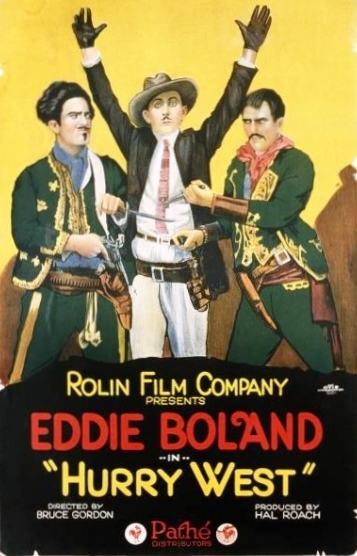
The flicker begins like a tintype come alive: a single-track railroad slicing through ochre mesas, a Pullman car disgorging Eddie—all city creases and celluloid collar—into a dust devil of suspicion. From that first juxtaposition of starched linen against weather-scoured plankwalk, Hurry West announces its central tension: the arithmetic of innocence versus experience written in gunpowder.
Director Robert Emmett O'Connor (pulling double duty as the whiskey-soused sheriff) stages the takeover of the Circle H as a slow-motion siege rather than a single raid. Each dawn, a new toy is left on Eddie’s porch: a rattlesnake in his boot, a branding iron glowing cherry-red, a coffin-shaped rock through the window. The intimidation is almost baroque, a pantomime of evil that feels plucked from a Gothic laboratory and transplanted to sagebrush country.
Wally Howe, equal parts Buster Keaton bone structure and William S. Hart stoicism, plays Eddie’s arc with minimal intertitles; the transformation is logged in posture. Shoulders that once folded inward like a concertina gradually square until, in the climactic street duel, his silhouette rhymes with the cemetery crosses on Boot Hill. The performance is a masterclass in kinetic storytelling—every loosened necktie, every hesitant finger on a Colt hammer, writes subtext louder than any dialogue card.
Jean Hope’s Dolores—half Mexican land-heiress, half reluctant poker-dealer—provides the counter-melody. Where Eddie is flustered by every cactus needle, she navigates the saloon’s testosterone haze with the unblinking poise of a chess master. Their courtship happens in negative space: a shared glance while she palms an ace, a hand brushing over the last whiskey glass as pistol fire erupts outside. In a genre that usually treats romance as ornamental, Hurry West makes it the crucible; only after Dolores is taken hostage does Eddie’s revolver lose its virgin rust.
Cinematographer Charles Stevenson shoots the frontier at magic hour so regularly the film seems gilded in liquid topaz. Yet darkness is never far: when the villains—Bruce Gordon’s granite-jawed outlaw and Mark Jones’s giggling sidekick—ride through moonlit canyons, the silver nitrate flips to near-noir, their forms reduced to ravens against a cobalt sky. The interplay of chiaroscuro anticipates the moral inversion to come: by the finale, the viewer struggles to decide who trespasses more egregiously, the cattle rustlers or the so-called lawful posse drunk on frontier justice.
Comic relief arrives via Eddie Boland, a lanky cowhand whose pratfalls—falling from haylofts, riding backwards on a mule—echo slapstick templates yet feel organic rather than grafted. His best gag involves a runaway chuck-wagon that careens through the enemy camp like a Trojan horse, flanking biscuits and coffee serving as shrapnel. The tonal pivot from menace to mirth and back is so seamless it prefigures the whip-smart genre-blending of later Westerns like Wild and Western.
The film’s structural brilliance lies in its refusal to grant Eddie a mentor. There is no grizzled cattle-baronsse akin to Hidden Valley’s sage patriarch, no Rebecca-like moral guardian. Instead, learning is purchased through humiliation: he is hog-tied to a horse and dragged through alkali, forced to dig his own grave under a blistering sun, conned at five-card stud by Dolores herself. Each degradation files away another layer of urban naiveté until what remains is a flinty core capable of outdrawing the gang that once used him for target practice.
Sound, though absent, is implied through visual metronomes: a rope creaking against a gallows beam, a metronomic water drip inside a mine shaft, the metallic clack of spurs keeping time like a metronome. When the final showdown erupts in a corral ankle-deep in white dust, the camera adopts a low angle that makes every hoof-beat a drumroll. You can almost hear Ennio Morricone half a century early, so palpable is the rhythm.
Gender politics, usually the Achilles heel of 1920s oaters, receive a sly subversion. Dolores’s mother, played by Dagmar Dahlgren, commands a network of señoritas who launder money, hide rifles in flour barrels, and transmit smoke-signal intel across the prairie. Their covert matriarchy undercuts the swaggering patriarchs, suggesting the West was engineered as much by whispered strategy as by six-gun bravado.
Yet for all its progressive flourishes, Hurry West cannot escape the racial myopia of its era; Mexican vaqueros are largely backdrop, and Native Americans appear only as silhouettes on a ridge, ominous punctuation marks. The film’s one Chinese character, a rail-worker named Ah Sing, is played by Caucasian actor Harold Adkins in cringe-inducing eyeliner—a reminder that even subversive silents trafficked in yellowface cliché.
The climax stages a circular shoot-out inside a half-built church whose skeletal rafters frame the combatants like fallen angels. Bullets splinter fresh pine, sending resinous incense into the air; Dolores, tied to the half-risen altar, becomes a profane Madonna. Eddie’s final shot—fired while sliding down a bell rope—echoes the acrobatics of Douglas Fairbanks but lands with the moral weight of a tribunal. The villain’s death is not triumphant; it is exhaustion distilled into gunpowder, a manumission that leaves our hero staring at his smoking Colt as though it were a foreign appendage.
Coda: months later, Eddie mails his Eastern cravat back to the city, now sun-scorched and bullet-torn. Dolores, astride a pinto, watches the train disappear into heat-shimmer. Neither speaks; the intertitle simply reads: “The West keeps what it awakens.” Fade-out on a long shot of the ranch under a sky so vast it swallows the frame—a visual whisper that ownership of land is illusory; what you really conquer is the vertigo of your own becoming.
Archivally, prints surface only in 16 mm fragments, yet even truncated the film pulses with a vitality that makes more psychologized silents feel dessicated. The camera moves—tracking alongside galloping hooves, crash-zooming onto a trembling trigger finger—prefigure Samuel Fuller’s kinetic war journalism. If you splice its DNA alongside Amor e Boemia’s bohemian fatalism, you get a proto-road-map for the operatic Westerns that Leone would mint four decades hence.
Restorationists at UniEye scanned a surviving Czech print at 4 K, unveiling textures previously mummified in grayscale: the jacquard weave of Dolores’s shawl, the arterial spray of wine after a bullet shatters a bottle, the opalescent sweat on a gambler’s temple. Tinting alternates between amber for daylight interiors and cobalt for night exteriors, emulating the Handschiegl process without replicating it slavishly. The resulting palette is hallucinatorily rich, a fever-dream that makes the cheap DVD transfers of the 1990s look like xeroxes of a xerox.
Accompanying the new print is a score by Monte Buzzo—accordion, bowed banjo, and prepared piano—whose dissonant clusters evoke Copland as reimagined by Bartók. During the church shoot-out, the music drops to a single heartbeat-like drum while a distant choir hums a Protestant hymn in reverse, turning the sequence into a pagan rite. It is the kind of anachronistic alchemy that rescues silent cinema from museum mummification and thrusts it, snarling, into contemporary relevance.
Comparative footnote: fans of The Secret of Eve’s gendered intrigue or Kismet’s fatalistic arabesques will find a kindred narrative fatalism here, albeit transposed to a frontier key. Conversely, if you cherish the slapstick-tinged horse operas of A Girl Like That, the tonal whiplash Hurry West achieves—laugh, gasp, mourn within three reels—will feel like proto-Coen exuberance.
Verdict: Hurry West is less a curio than a gauntlet, flung across a century, daring modern Westerns to reclaim the existential grime beneath their mythic chrome. Stream it if you can, but preferably in a darkened theater where the projector’s flicker can claw at your peripheral vision, reminding you that every frame is a bullet in freeze-frame, every cut a door slamming on who you used to be.
IMDb —
1921
Community
Log in to comment.