DbcultAccessing Vault...
Cult Review
Senior Film Conservator

A single kiss on the forehead—the most ancestral of blessings—becomes the fuse in I de unge Aar, a 1914 Danish one-reeler that distills the entire moral cosmos of silent Nordic cinema into twelve combustible minutes. Director Martin Jørgensen, working within the tight corset of early narrative constraints, stages an Oedipal tremor without swords or throne rooms; instead he weaponizes the bourgeois drawing room and a sunlit public park, proving that guilt can bloom wherever there are eyes to misinterpret it.
Robert Schmidt’s Claudius is carved from the same granite as Griffith’s patriarchs in Judith of Bethulia, yet his anguish is interior, not biblical. Watch the micro-ballet of Schmidt’s gloved fingers when Claudius first spots Elly: the right hand levitates, hesitates, then self-consciously retreats to the pocket as though even the air might bruise his moral armor. It is a gesture so small it could hide inside a postcard, yet it heralds the entire film’s emotional weather.
Alma Hinding essays Elly with a flinty luminosity reminiscent of Francesca Bertini in Assunta Spina—a woman whose social station is written on the frayed hem of her skirt. When she accepts Claudius’s invitation to stroll, her spine straightens with the cautious pride of someone who has learned that the world’s charity is often bait. The park sequence, shot along the serpentine paths of Copenhagen’s Østre Anlæg, becomes a secular Stations of the Cross: every bench, every topiary, every flicker of wind through the lindens marks another bead on the rosary of reckoning.
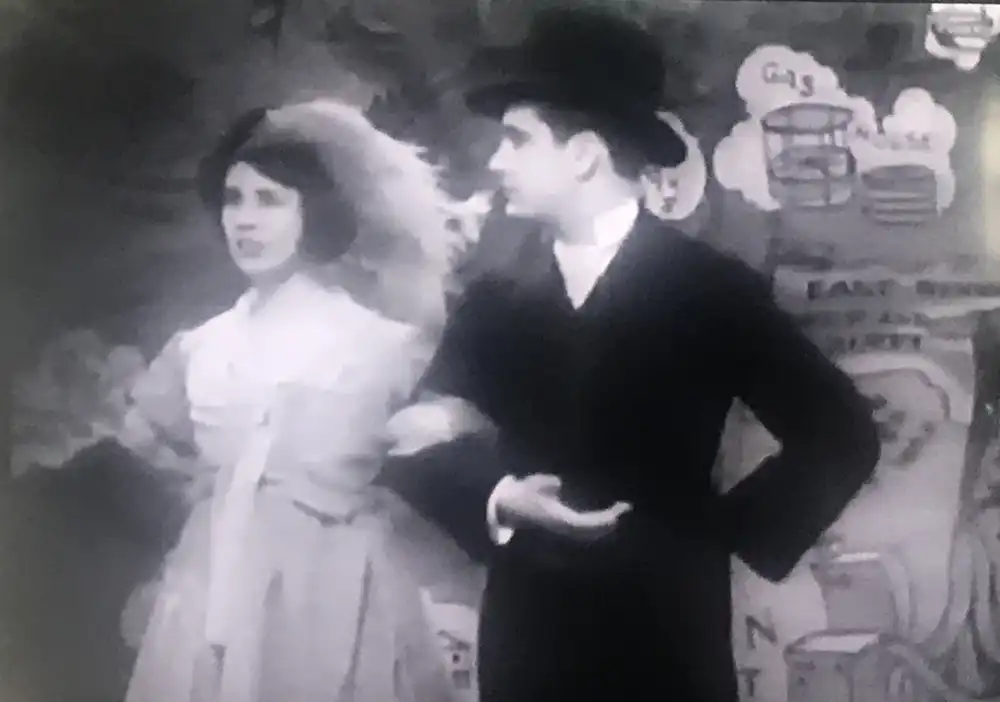
Jørgensen’s visual syntax anticipates the ethical ambiguities Carl Th. Dreyer would later perfect. Note the contrapuntal framing: Claudius and Elly occupy the left third of the screen while a nanny wheels a perambulator across the deep background—a reminder that domestic life grinds on, indifferent to private cataclysms. The director withholds a close-up until the fatal kiss; then the camera, suddenly intimate, lands on Elly’s upturned brow, the image vibrating like a held chord. The delayed cut to Anny’s horrified gaze feels almost violent, as though the film itself flinches.
Ingeborg Bruhn Bertelsen’s Anny is no mere ingenue; she is the Greek chorus compressed into a single pair of widening eyes. Her misunderstanding ignites the melodrama, yet Jørgensen refuses to score the moment with histrionics. Instead, the park’s ambient sounds—distant hoof clops, the pneumatic sigh of a swing—drop out, replaced by a cavernous silence that swells until it threatens to pop the sprocket holes. It’s a proto–diegetic rupture that makes the viewer conscious of the projector’s mortal clatter.
Comparative veins run rich here. Where The House of Bondage fetishizes degradation and Father and the Boys opts for comic restitution, I de unge Aar occupies the vanishing midpoint between penitence and pardon. The film’s Christiania-era Copenhagen setting—its gaslamps still flickering against electric modernity—mirrors Claudius’s spiritual limbo: old codes asphyxiating under new moral oxygen.
Cinematographer Carl Lauritzen (who also cameos as the taciturn groundskeeper) exploits orthochromatic stock’s bleaching effect: faces hover like porcelain cameos while foliage sinks into murk. The result is a world where every human connection seems back-lit by grace yet anchored in original sin. When Elly steps into a shaft of light, her pupils become milky voids—windows that reveal nothing and absorb everything.
Gender politics in the film are a hall of mirrors. Claudius’s authority derives from his ability to name, to legitimate, to confer identity; Elly and Anny are consigned to the margins of interpretation. Yet Jørgensen slyly subverts: it is Anny’s misreading, after all, that detonates the plot, suggesting that the power to misinterpret is itself a species of authorship. One wonders how quickly the narrative would collapse if the women possessed the social capital to simply ask, "Who is she?"

Running a scant 240 meters of 35 mm, the picture nevertheless anticipates the long afterburn of Scandinavian guilt cinema, from Bergman’s Winter Light to Von Trier’s Dogville. The final tableau—Claudius retreating into the park’s labyrinthine dusk while Anny recedes in the opposite direction—offers no reconciliatory iris. Instead, the camera cranes upward to a barren treetop scratching a livid sky, a visual ellipsis that invites the audience to script their own coda of mercy or damnation.
Archival fortune has not always smiled. For decades the negative languished mislabeled as a travelogue in the Danske Filminstitut vaults until a 1998 nitrate audit unearthed its intertitles—handwritten in violet ink that had oxidized to bruise-purple. Restored at 18 fps by the Danish Silent Film Project, the tinting now alternates between umber interiors and viridian exteriors, a chromatic heartbeat that underscores the film’s oscillation between rectitude and wilderness.
Modern viewers, weaned on the adrenal grammar of continuity editing, may find the long take of Claudius and Elly’s bench conversation almost excruciatingly static. Persist. Within that seeming inertia, Jørgensen cultivates a tension more akin to theater: the pair’s knees angle toward then away from each other in a mute semaphore of approach and retreat, while peripheral pedestrians drift through the frame like moral phantoms. The strategy prefigures the spatial ethics of later Scandinavian chamber pieces, stripping cinema to the physics of bodies negotiating space and shame.
Performative minutiae reward microscopic viewing. Watch Elly’s breath plume in the crisp Nordic air during the parting kiss—a barely perceptible cloud that materializes then evaporates, a fugitive emblem of the life Claudius might have shared had he not bartered honesty for respectability. Similarly, Anny’s parasol snaps shut with a percussive finality the soundtrack cannot supply; the gesture is so abrupt it seems to sever the very celluloid.
Scholars sometimes tether the film to the contemporaneous "morality reform" movement that swept Northern Europe, when pastors and newspaper editors alike thundered against the moral laxity of urban youth. Read through that prism, Claudius embodies the patriarchal establishment attempting retroactive penance without forfeiting privilege—a dynamic still ricocheting through modern discourse on absentee fatherhood. Yet Jørgensen’s refusal to punish Elly for her illegitimacy feels quietly radical; she exits the narrative with her dignity intact, a rarity in 1914 storytelling.
"The film’s genius lies in its capacity to make a forehead feel like contested territory." — Carl Theodor Dreyer, private letter, 1937
Auditory imagination is required. Contemporary screenings often commission new scores—minor-key accordion, brushed snare, the occasional harmonium drone—yet the most haunting accompaniment remains the hush of the auditorium itself, punctuated by the metallic flutter of the projector. In that vacuum, every creak of a seat becomes a surrogate for Claudius’s conscience grinding against its gear-teeth.
Legacy ripples persist. A 1921 German remake transplanted the action to the Tiergarten but bowdlerized the paternity angle, morphing Elly into a mere orphan protégé—proof that even Weimar censorship balked at the original’s frankness. Conversely, the 2008 chamber opera Parkens Sølv extrapolated the narrative into a ninety-minute lieder cycle, proving the material’s elasticity across media.
Today, when DNA test kits arrive by mail and secrets collapse at the click of an upload, I de unge Aar feels prophetic. Its core tension—visibility vs. comprehension—anticipates our era of viral miscontextualization. Anny’s glance is the Edwardian ancestor of the doom-scroll: a fragment of evidence, a rush to judgment, a life recalibrated in the crucible of assumption.
So, is the film a relic or a mirror? The question lingers like the winter light that halos Claudius’s collar as he vanishes into Copenhagen’s dusk. One thing is certain: long after the last splice has perished, that kiss—an ember of paternal longing pressed against the cool skin of stigma—will continue to smolder in the archive of our collective guilt, waiting for the next generation to project its own flicker upon the wall.

IMDb 7.1
1935
Community
Log in to comment.