DbcultAccessing Vault...
Cult Review
Senior Film Conservator
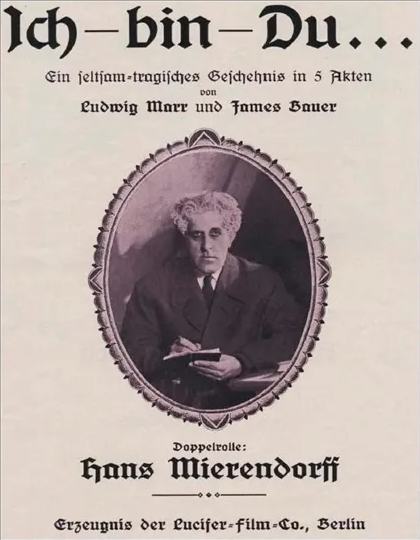
There are films that merely tell a story, and then there are those that excavate the very foundations of human experience, leaving the viewer to sift through the intellectual debris long after the final frame fades. James Bauer and Ludwig Marr's 'Ich bin Du,' a work of profound psychological penetration, unequivocally belongs to the latter category. It is an unsettling, almost visceral exploration of identity, performance, and the terrifying fragility of the self, rendered with a chilling precision that belies its era. The title itself, 'I am You,' serves not merely as a plot point, but as a philosophical proposition, daring its audience to confront the uncomfortable proximity of the 'other' to one's own perceived uniqueness.
At its heart lies the formidable Ludwig Sachs as Anton Meier, a celebrated actor whose life is a meticulously choreographed performance, both on and off the stage. Sachs imbues Anton with a captivating blend of theatricality and underlying vulnerability, a man whose public persona is so polished it risks obscuring his private self. His world, a realm of applause and adulation, is violently disrupted by the sudden appearance of Klaus Richter, a vagrant played with unnerving subtlety by Fritz Richard. Richard’s portrayal is a masterclass in quiet menace; his Richter is not merely a look-alike, but a spectral mirror, reflecting Anton’s anxieties and unacknowledged fears with unnerving accuracy. The initial encounters between these two men are pregnant with an almost gothic dread, hinting at a narrative far more sinister than a simple case of mistaken identity.
Bauer and Marr’s script is a taut, intricate tapestry, slowly weaving a narrative where the lines between the protagonist and his doppelgänger become increasingly porous. Richter’s infiltration of Anton’s life is not a sudden, dramatic usurpation, but a gradual, insidious erosion. He begins by observing, then mimicking, and finally, by subtly replacing Anton in minor, then increasingly significant, aspects of his daily routine. This slow-burn approach amplifies the psychological tension, making Anton’s descent into paranoia all the more believable and terrifying. The genius of the screenplay lies in its refusal to offer easy explanations, instead presenting Richter as an almost elemental force, a manifestation of Anton’s own buried anxieties about authenticity and the performative nature of his existence.
Maria Zelenka, as Elise, Anton’s fiancée, delivers a performance of remarkable emotional depth. Her character serves as the anchor to Anton’s fracturing reality, her growing concern and confusion mirroring the audience’s own disquiet. Zelenka expertly navigates the subtle shifts from loving adoration to fearful bewilderment, her eyes reflecting the dawning horror of realizing that the man she loves is becoming a stranger, or perhaps, was always a stranger underneath the mask. Margit Barnay, in a supporting role, adds another layer to the film’s exploration of identity, perhaps as a former lover or rival performer, whose presence complicates Anton’s emotional landscape and provides further opportunities for Richter to exploit the cracks in his life. The ensemble cast, including the ever-reliable Robert Forsch and Max Neumann, contributes to the rich, often suffocating, atmosphere of suspicion and psychological unease.
Even without the benefit of sound, the visual storytelling in 'Ich bin Du' is breathtakingly effective. The direction utilizes stark contrasts and evocative mise-en-scène to convey Anton’s internal turmoil. Shadows are not just shadows; they are encroaching threats, extensions of Richter’s omnipresence. Close-ups on Sachs’s face, particularly his eyes, become windows into a mind teetering on the brink of collapse. The urban landscapes of Berlin, with their bustling streets and hidden alleys, transform into a psychological maze, mirroring Anton’s trapped state. This visual language is reminiscent of the German Expressionist movement, employing distorted perspectives and exaggerated emotions to externalize subjective experience, a technique also powerfully used in films like The Silent Lie, which similarly delves into the psychological toll of deception, though through a different narrative lens.
The film’s pacing is deliberate, allowing the psychological tension to build organically, rather than relying on cheap scares. Each interaction between Anton and Richter, or even Anton’s interactions with others while Richter is subtly manipulating events, is loaded with unspoken dread. The audience is invited to become a co-conspirator in Anton’s paranoia, questioning what is real and what is a figment of his unraveling mind. This sustained atmosphere of uncertainty is a testament to the directorial prowess, ensuring that the film operates not just as a thriller, but as a chilling character study. In this regard, it shares a thematic kinship with The Conspiracy, which also explored the insidious nature of hidden threats and the psychological toll of being targeted, albeit in a more overtly political context.
Ludwig Sachs’s performance is nothing short of phenomenal. He embodies Anton’s initial arrogance, his theatrical flair, and then his agonizing descent into a state of profound disorientation. The physical transformation Sachs undergoes, from the confident stage idol to the haunted, desperate man, is heartbreakingly convincing. His gestures, his posture, the subtle shifts in his facial expressions – all communicate a man losing his grip on reality. Fritz Richard, as Richter, provides the perfect counterpoint. His performance is one of unsettling stillness, his gaze often vacant yet deeply penetrating, suggesting a being devoid of a true self, yet capable of effortlessly inhabiting another’s. This dynamic interplay between the two leads is the engine of the film’s psychological power.
"'Ich bin Du' delves into the very core of what it means to be an individual, questioning the stability of our perceived selves when confronted by a mirror that reflects not just an image, but an encroaching, consuming void."
The supporting cast, featuring talents like Waldemar Pottier, Martha Hartmann, and Otto Schiller, contribute significantly to the film’s rich texture, portraying the bewildered, often complicit, witnesses to Anton’s unraveling. Their reactions, ranging from polite concern to outright fear, amplify the sense of isolation Anton experiences. Ernst Behmer and Paul Rehkopf, in their roles, provide glimpses into the broader societal context, perhaps representing the indifferent or opportunistic elements that thrive on the fringes of fame, adding a layer of social commentary to the personal drama. This broader societal backdrop, where a celebrated individual can become so easily displaced, echoes themes found in works like The Reform Candidate, where public perception and political maneuvering could similarly dismantle a man's standing, or even The Man on the Box, which humorously, yet pointedly, explored identity shifts and class distinctions.
'Ich bin Du' is not merely a period piece; its themes of identity theft, psychological manipulation, and the performative aspect of modern life resonate with startling relevance even today. The film challenges us to consider how much of our identity is truly innate, and how much is constructed, a role we play for others and for ourselves. The writers, Bauer and Marr, crafted a narrative that transcends its genre, transforming a potential thriller into a profound philosophical inquiry. The film’s climax, devoid of easy resolutions, leaves a lasting impression, forcing the audience to grapple with the terrifying implications of Anton’s fate. It doesn't offer catharsis, but rather a chilling contemplation of the self's ultimate vulnerability.
The intricate dance between Sachs and Richard is the film’s undeniable core, a ballet of psychological warfare where the prize is nothing less than one’s soul. The nuanced performances, coupled with the evocative direction and a script that masterfully builds tension, elevate 'Ich bin Du' far beyond a simple narrative of mistaken identity. It becomes a meditation on the human condition, a stark reminder that the boundaries of the self are often more permeable than we dare to imagine. The film’s brilliance lies in its ability to make the audience feel Anton’s encroaching dread, to question their own sense of self as they witness his disintegration. It is a cinematic experience that challenges, disturbs, and ultimately, profoundly enriches the viewer’s understanding of identity's complex architecture.
The meticulous attention to detail in the set design and costuming further immerses the viewer in this unsettling world. Every prop, every piece of clothing, seems to reinforce the dualities at play, the contrast between Anton's opulent theatrical life and Richter's threadbare existence. This visual dichotomy is crucial in establishing the stakes of the identity struggle. The film, in its quiet intensity, compels one to reflect on the societal pressures that shape our public personas and the internal battles fought to maintain them. The film's influence can be seen in later works exploring similar themes of psychological fragmentation, even if they operate in different genres, such as the romantic entanglement in My Husband's Other Wife, where identity and perception are warped by emotional turmoil, or the more direct impersonation in Across the Pacific, where a character assumes a new identity for espionage, though without the same existential dread.
Ultimately, 'Ich bin Du' stands as a powerful testament to the enduring power of early cinema to explore profound psychological depths. It is a film that demands active engagement, inviting viewers to dissect its layers of meaning and to confront the uncomfortable truths it reveals about the human psyche. The collaborative genius of James Bauer and Ludwig Marr in crafting such a compelling narrative, brought to life by a stellar cast under evocative direction, ensures its place as a seminal work in the exploration of identity on screen. It is a film not easily forgotten, its echoes reverberating long after the credits roll, prompting a deeper introspection into the very essence of who we are, and how easily that essence might be challenged, or even consumed. The finality of Anton's plight, leaving ambiguity in its wake, ensures its status as a timeless piece of art that continues to provoke thought and discussion about the delicate construction of the self, much like the profound character studies found in films like Romance, which explores the complexities of love and societal expectations, or even the more dramatic shifts in fortune and identity depicted in The Orphan, where a character's true origins profoundly reshape their life. 'Ich bin Du' is a stark, unforgettable journey into the heart of human vulnerability, a cinematic experience that continues to haunt and fascinate.

IMDb 6.2
1931
Community
Log in to comment.