DbcultAccessing Vault...
Cult Review
Senior Film Conservator
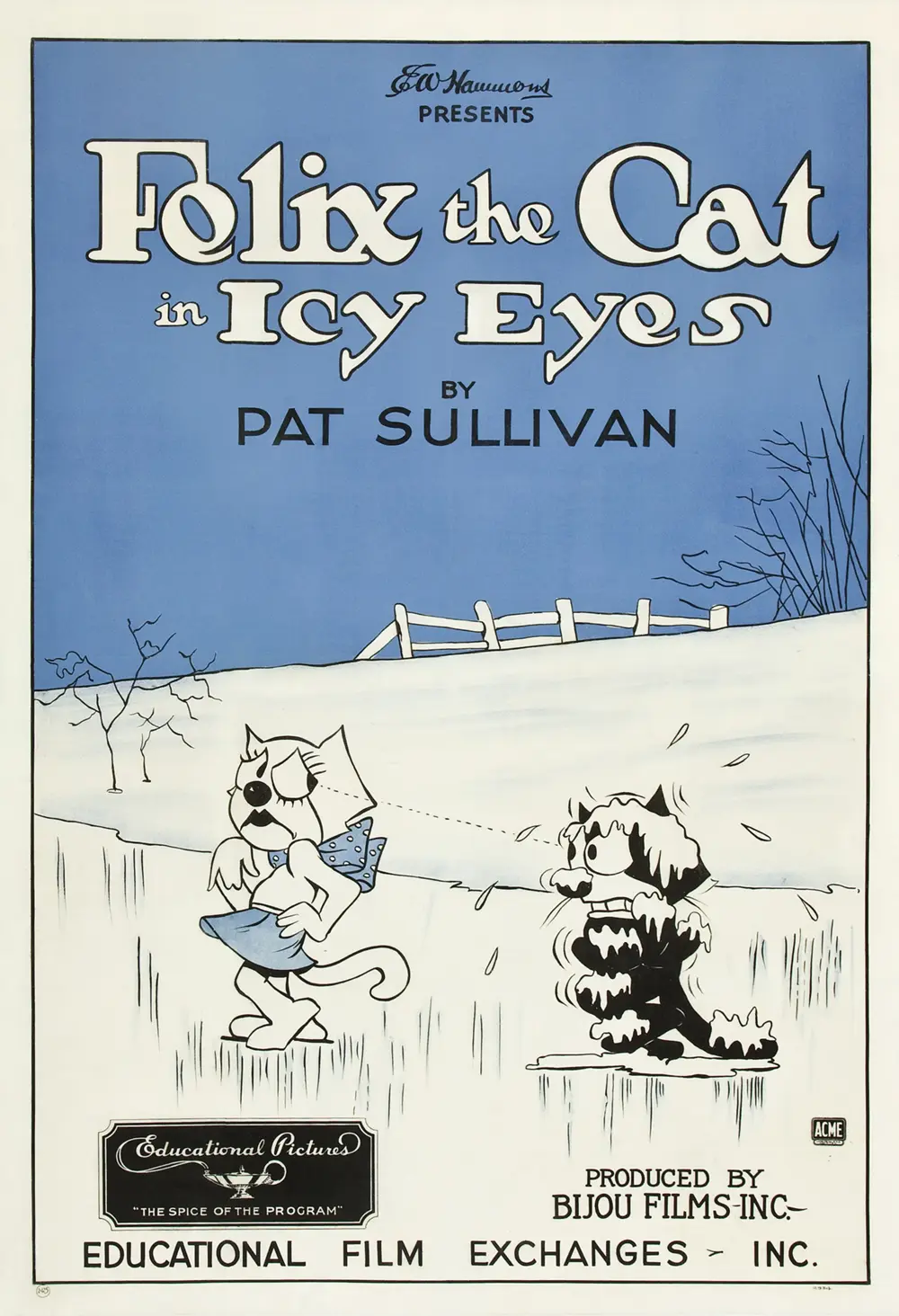
Is 'Icy Eyes' a silent-era curiosity or a truly timeless piece of animation worth seeking out today? The short answer is a resounding yes, but with the understanding that its charm lies in its historical significance as much as its enduring comedic brilliance.
This film is an absolute treat for animation historians, fans of classic slapstick, and anyone curious about the foundational elements of character animation. However, those accustomed to modern narrative complexity or high-definition visual spectacle might find its simplistic storytelling and black-and-white aesthetic a harder sell.
'Icy Eyes,' a charming Felix the Cat short, stands as a testament to the inventive spirit of early animation. It encapsulates an era where visual gags reigned supreme, and characters were defined by their boundless elasticity and expressive simplicity. While seemingly a straightforward tale of romantic pursuit, the short offers more than just laughs; it provides a fascinating window into the evolution of character design and narrative economy.
For those who appreciate the roots of an art form, this cartoon is invaluable. It’s not merely a historical artifact; it's a vibrant, living piece of cinema that continues to resonate with its clever visual storytelling and the sheer charisma of its protagonist.
This film works because: It showcases groundbreaking rubber-hose animation, boasts an incredibly expressive lead character in Felix, and delivers a consistent stream of effective, timeless sight gags.
This film fails because: Its narrative simplicity might not engage all modern viewers accustomed to complex plots, and its ultimate 'twist' is more a historical novelty than a profound narrative device.
You should watch it if: You have an appreciation for the origins of cartooning, enjoy pure visual comedy, or are a devoted fan of Felix the Cat and his pioneering exploits.
The narrative of 'Icy Eyes' centers on Felix, our ever-resourceful cat, who becomes utterly smitten with Peaches, a vision of feline grace he encounters gracefully gliding across a frozen pond. His initial act of heroism—rescuing her from a perilous tumble—is met not with the expected gratitude or a flutter of affection, but with a gaze so utterly devoid of warmth, it earns her the moniker 'icy eyes.'
Undeterred by this frigid reception, Felix, in a classic move of romantic desperation, concocts a grand scheme: he will capture a notorious jewel thief and his equally cunning pet crow, believing such a heroic feat will surely melt Peaches' seemingly impenetrable heart. What follows is a delightful chase sequence, brimming with Felix's signature ingenuity and improbable escapes.
Yet, the narrative takes an unexpected turn upon the successful capture of the villain. The film culminates in a revelation about Peaches that completely recontextualizes Felix's entire pursuit. It’s a moment that, while played for laughs, subtly hints at the superficiality of initial attraction and the folly of projecting ideals onto an object of desire.
To discuss 'Icy Eyes' without acknowledging Otto Messmer's pivotal role in its creation would be a disservice. Messmer, widely credited as the primary animator and often the uncredited director of the early Felix the Cat shorts, possessed an intuitive understanding of animation's potential. He wasn't just drawing characters; he was breathing life into concepts, transforming simple lines into dynamic, expressive beings.
The animation style, often referred to as 'rubber-hose' animation, is on full, glorious display here. Felix's limbs stretch and contort with impossible flexibility, his body morphing to suit any situation. Consider the moment Felix’s tail literally transforms into a question mark above his head when he’s pondering his next move, or how it becomes a useful tool, a lasso, or even a weapon. This fluidity wasn't just a stylistic choice; it was a narrative device, allowing Felix to overcome obstacles with a visual wit that transcended the lack of dialogue.
The character of the crow, the jewel thief's accomplice, is another marvel of Messmer's design. Its movements are sharp, mischievous, and perfectly convey its cunning nature, often outsmarting Felix with surprising agility. These visual gags, though simple, are executed with precision and a clear understanding of comedic timing, proving that often, less is more.
In an era where live-action silent films like Fig Leaves (1926) were pushing the boundaries of visual storytelling through human expression, Messmer was doing the same for animation, using exaggeration and impossible physics to convey emotion and action in a wholly unique way. His work laid much of the groundwork for the character-driven animation that would follow decades later.
Felix the Cat, as portrayed in 'Icy Eyes,' is more than just a cartoon character; he's an archetype. He embodies persistence, ingenuity, and a touch of lovelorn naiveté that makes him instantly relatable. His pursuit of Peaches, despite her clear disinterest, is a universal tale of unrequited affection, albeit filtered through a uniquely animated lens.
His expressiveness, achieved through minimal facial changes and exaggerated body language, is a masterclass in silent performance. A tilt of his head, a shrug of his shoulders, or the iconic wag of his tail communicates entire internal monologues without a single intertitle card. This isn't just animation; it's acting distilled to its purest visual form.
The film leans heavily on Felix's established persona as a clever problem-solver. Whether he's evading the thief's traps or devising new ways to corner the crow, Felix's quick thinking is always at the forefront. This consistency in character, even in a short film, is a testament to the strong foundation Messmer and his team built for him.
It's easy to dismiss these early cartoons as mere relics, but Felix’s enduring charm proves otherwise. He’s a character who transcends his era, a testament to the power of simple, yet effective, character design.Pacing and Tone: A Rhythmic Dance of Gags
'Icy Eyes' maintains a brisk and engaging pace, characteristic of silent-era shorts designed to capture and hold attention without dialogue. The film moves from one gag to the next with a rhythmic precision, ensuring there’s never a dull moment. The chase sequences, in particular, are expertly choreographed, building momentum and suspense before releasing it with a comedic flourish.
The tone is predominantly lighthearted and comedic, even with the underlying theme of unrequited love. Slapstick abounds, from Felix's tumbles on the ice to the frantic antics of the crow. Yet, there’s a subtle undercurrent of melancholy in Felix’s initial rejection, a quiet vulnerability that makes his subsequent heroic efforts all the more endearing.
The film doesn't linger on emotional beats, preferring to pivot quickly to the next visual joke or plot development. This rapid-fire approach keeps the audience engaged, a technique that modern animation still employs, albeit with different tools. It’s a masterclass in how to tell a complete story with a clear beginning, middle, and end, all within a compressed runtime.
A Surprisingly Nuanced Twist: Beyond the 'Icy Eyes'
Here's where 'Icy Eyes' offers a touch more depth than
IMDb —
1924
Community
Log in to comment.