DbcultAccessing Vault...
Cult Review
Senior Film Conservator
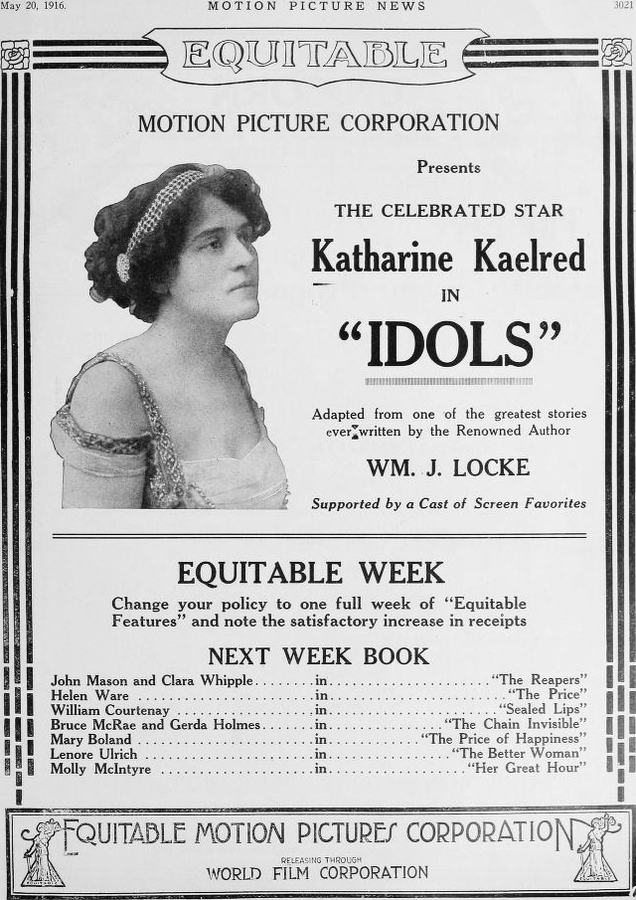
In an era brimming with cinematic spectacles and nascent storytelling, William J. Locke’s 'Idols' emerges as a surprisingly nuanced and profoundly philosophical drama, a testament to the power of silent film to convey complex human truths without a single uttered word. Starring the compelling Arnold Daly and the enigmatic Katharine Kaelred, this picture, while perhaps not as widely remembered as some of its contemporaries, offers a searing critique of societal values and an intimate portrait of one man's spiritual awakening. It's a film that demands introspection, peeling back layers of public veneration to expose the fragile, often hollow core beneath.
Arnold Daly, a stalwart of the stage and screen, delivers a performance of remarkable depth as Richard Thorne, a sculptor whose hands craft monumental figures that embody abstract ideals: Justice, Triumph, Beauty. These are the 'idols' of the title, not pagan deities, but the societal constructs we are conditioned to worship – wealth, reputation, superficial perfection. Thorne is at the zenith of his career; his studio is a temple, his creations are revered, and his social standing is impeccable. Yet, Daly imbues Thorne with a subtle, almost imperceptible weariness from the outset, a quiet desperation that hints at the profound emptiness lurking behind his public persona. His eyes, even in moments of triumph, betray a certain detachment, a man observing his own life rather than truly living it. This inner turmoil is a masterclass in silent acting, relying on subtle gestures, a downturned mouth, or a fleeting glance to convey a universe of unspoken regret.
The arrival of Katharine Kaelred's Elara Vance is nothing short of a seismic event in Thorne's carefully curated world. Kaelred, with her striking presence and intense gaze, portrays Elara not merely as a love interest, but as a force of nature, an artistic and moral counterpoint to Thorne's polished artifice. Elara is a bohemian sculptor, her hands shaping raw, visceral forms that speak of human struggle, of authentic, unvarnished emotion. She scorns Thorne's 'idols' as saccharine distractions, false gods that lull society into complacency, blinding them to true suffering and genuine connection. Kaelred's performance is electric; she embodies an uncompromising spirit, her every movement conveying conviction, her expressions a blend of passion and righteous indignation. She is the embodiment of truth, a living challenge to Thorne’s carefully constructed lies.
The dynamic between Daly and Kaelred is the beating heart of 'Idols.' Their initial encounters are charged with friction and intellectual sparring, a dance of opposing philosophies. Thorne, initially dismissive of Elara's 'crude' art, finds himself irresistibly drawn to her fervent honesty. It’s a compelling exploration of attraction born not from superficial charm, but from a profound need for authenticity. This push and pull resonates with the moral quandaries seen in films like The Great Divide, where societal expectations clash violently with individual desires and moral convictions. While Thorne’s struggle is internal and artistic, the core conflict of self-discovery against external pressure is remarkably similar.
William J. Locke, renowned for his romantic and philosophical novels, brings a sophisticated narrative sensibility to 'Idols.' The screenplay, though silent, is rich with thematic depth, meticulously charting Thorne's psychological journey from celebrated hollow man to a seeker of truth. Locke's influence is palpable in the film's nuanced characterizations and its exploration of universal themes: the nature of art, the corrosive effects of materialism, and the quest for spiritual authenticity. The 'idols' themselves are brilliant metaphors, representing not just Thorne's sculptures but also the illusory ideals of wealth, power, and social status that define his world. This allegorical storytelling elevates 'Idols' beyond a mere melodrama, transforming it into a poignant social commentary.
The film cleverly orchestrates a crisis that mirrors Thorne’s internal decay: a monumental statue, ironically named 'Prosperity,' is revealed to have fundamental structural flaws. This public humiliation, a literal crumbling of his most cherished 'idol,' acts as the ultimate catalyst for Thorne’s awakening. It’s a moment of profound symbolism, echoing the secret sins and moral unraveling found in a film like The Secret Sin, where hidden flaws inevitably lead to public exposure and personal reckoning. For Thorne, the collapse of his physical creation forces him to confront the structural deficiencies in his own life and values.
The directorial choices, though uncredited in this specific instance, demonstrate a keen understanding of visual storytelling. The stark contrast between Thorne’s opulent, pristine studio and Elara’s more humble, chaotic workspace is visually striking, reinforcing their divergent philosophies. Close-ups are employed judiciously, allowing the audience to witness the subtle shifts in Daly’s and Kaelred’s expressions, conveying emotions that transcend dialogue. The use of light and shadow, a hallmark of early cinema, further enhances the thematic elements, casting Thorne’s 'idols' in an almost heavenly glow before plunging him into the literal and metaphorical darkness of his disillusionment. This visual poetry is reminiscent of the dramatic tension created in films like The Bells, where the psychological state of the protagonist is often externalized through powerful, evocative imagery.
The narrative arc of 'Idols' is not one of simple redemption, but of profound transformation. Thorne's decision to break off his engagement to a woman who embodies the superficiality he now despises, and to alienate his high-society patrons, is a brave, albeit painful, act of self-liberation. He embarks on a quest to create something truly authentic, a piece born of his newfound understanding, influenced by Elara’s uncompromising vision. Yet, the film wisely avoids a simplistic 'happily ever after.' Elara refuses to become another 'idol' for Thorne to worship, demanding that he find his own voice, his own truth, independent of her influence. This refusal to conform to romantic tropes makes the film all the more powerful, echoing the complex, often unfulfilled desires found in narratives like Anna Karenina, where personal truth often comes at a steep, solitary price.
'Idols' serves as a potent commentary on the dangers of materialism and the pursuit of superficial validation. Thorne's initial success is inextricably linked to the wealth and social standing his 'idols' bring him, a theme that finds resonance in films such as Gold and the Woman, which similarly explores the corrupting influence of riches on human relationships and moral fiber. The film subtly argues that true artistic merit and personal fulfillment cannot be bought or sold; they must be earned through a rigorous process of self-examination and a commitment to authenticity.
The climax, whether it involves Thorne smashing his most famous creation or unveiling a new, imperfect but profoundly honest work, is a moment of catharsis. It signifies the shattering of false gods, both internal and external, and the embrace of a more vulnerable, yet infinitely more real, existence. This act of artistic and personal liberation is a powerful statement about the courage required to dismantle one's own illusions and forge a path towards genuine self-expression. The journey is arduous, marked by internal struggle and external rejection, reminiscent of the profound personal vows and their consequences explored in The Vow, albeit with a focus on artistic rather than romantic commitment.
What makes 'Idols' particularly compelling even today is its timeless message. The allure of superficial success, the pressure to conform, and the struggle to find one's authentic voice are themes that continue to resonate across generations. The film asks us to examine our own 'idols' – the ideals, people, or possessions we blindly worship – and to question whether they truly serve our highest selves. It's a poignant reminder that true value often lies not in polished perfection, but in raw honesty and the courage to embrace our imperfections.
The ending of 'Idols' is deliberately open-ended, not providing a neat, romantic resolution but rather a sense of nascent hope and potential. Thorne finds a nascent sense of self, an authentic artistic voice, and the possibility for genuine connection, having irrevocably shattered the false gods that once defined him. Elara’s role as a catalyst, a mirror, rather than a prize, reinforces the film’s sophisticated take on human relationships and personal growth. It’s a powerful conclusion that leaves the audience contemplating their own journey towards authenticity, much like the lingering questions posed by films such as The Lost Paradise, which explores the profound loss of innocence and the search for a new, more truthful existence after the collapse of an idealized world. 'Idols' stands as a compelling, thought-provoking piece of early cinema, a testament to the enduring power of a well-told story to illuminate the complexities of the human spirit and challenge the very foundations of our perceived realities. It’s a film that truly deserves rediscovery, offering rich rewards for those willing to look beyond the surface and engage with its profound, timeless questions.

IMDb 6.5
1937
Community
Log in to comment.