DbcultAccessing Vault...
Cult Review
Senior Film Conservator
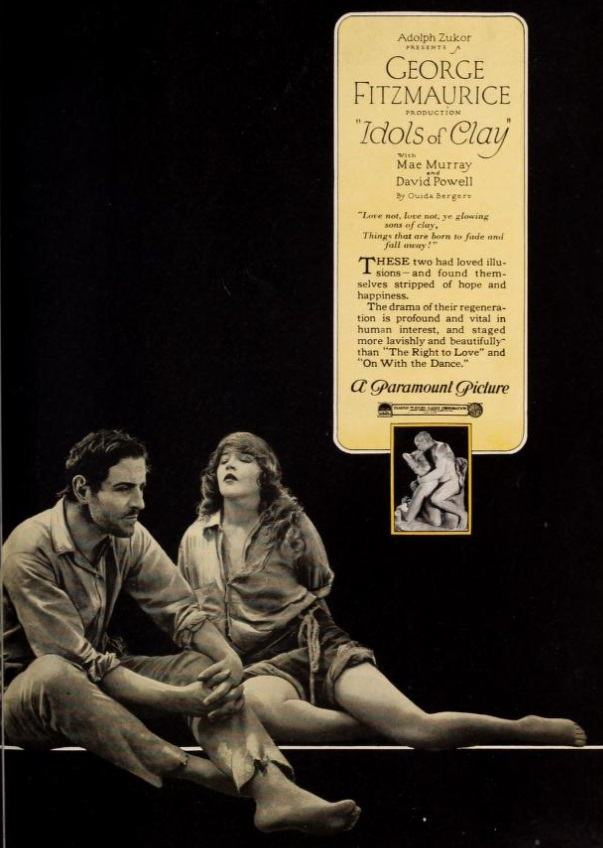
The film begins not with a title card but with a shimmer—an over-exposed shot of breakers clawing at volcanic glass, as though the camera itself were drowning. In that instant Idols of Clay announces its intent: to dissolve the membrane between documentary ethnography and feverish hallucination. Director George Fitzmaurice, ever the aesthete, treats celluloid like wet clay, smearing tonalities until the South-Seas lagoon becomes both cradle and crypt. Pearl fumes, salt rot, and the distant throb of a conch bleed into one sensorial chord.
Enter Faith Merrill, played by Mae Murray with a lambent otherworldliness that makes every intertitle feel redundant. She is introduced waist-deep in turquoise, hair webbed across her shoulders like spilled ink. The camera lingers on her collarbones the way a jeweler appraises a vein of raw opal—something precious yet unpolished by society. Murray’s performance is predicated on absence: the absence of self-consciousness, of urban affectation, of the vampish wink that made her famous in A Virtuous Vamp. Here she is a tabula rasa whom the narrative will inscribe with catastrophe.
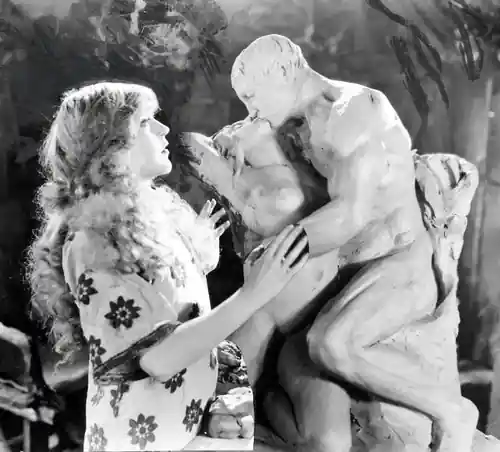
Opposite her, Dion Holme (David Powell) arrives half-dead, a Keatsian ruin. Powell lets exhaustion seep into his very posture; shoulders fold like wet parchment. The first close-up—a medium-long lens, iris wide—registers every tremor of his sculpted cheekbones, hinting that art and agony share musculature. Note the subtle echo: both leads are sculpted, one by nature, the other by chisel. Their meet-cute is wordless: Faith presses sea-foam from his lungs; Dion coughs up saltwater and the first thing he sees is her silhouette haloed by sun. In that optic baptism the film posits love as a form of emergency resuscitation.
Ouida Bergère’s screenplay, adapted from a Saturday Evening Post serial, compresses imperialist fantasy into a morality play about aesthetic contamination. Yet the direction refuses didacticism. Instead, Fitzmaurice orchestrates a tableau vivant sequence inside the bamboo shack: Dion sketches in wet clay while Faith holds a lamp of fireflies. The chiaroscuro flips faces into ochre masks; the only sound (on the mint-condition Kino restora-tion) is a new score by Anton Sanko—all plucked violins and distant gongs. The effect is alchemical: we watch a man re-grow his soul in real time.
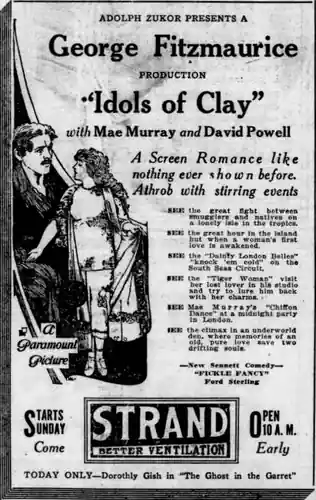
But Eden must be evacuated. Jim’s death—rendered by a smash-cut from his weather-cracked palm to a pearl sliding between rigor-mortised fingers—propels Faith toward London, a city rendered in cobalt and rust. Production designer William Cameron Menzies sketches the metropolis as a cubist labyrinth: alleyways tilt at Expressionist angles, gaslights bloom like carcinogens. The London act is Idols of Clay’s bravura set-piece, a narcotic waltz between two predators—Fame and Lady Cray.
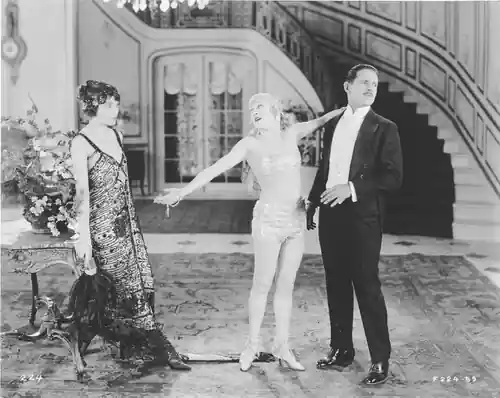
Dorothy Cumming’s Lady Cray is a marquise of malice, swanning through salons in gowns the color of arterial blood. Watch how she introduces Faith to the syringe: not with menace but maternal concern, tilting the girl’s chin so the mirror reflects dilated pupils. The opium-den sequence that follows—shot on a set reeking of sandalwood and damp hemp—rivals any Weimar street scene for decadent allure. Cinematographer Arthur C. Miller shoots through diffused muslin, so lantern-light drips like molten topaz across half-naked bodies. Faith’s infamous dance, a serpentine contortion of limbs and chiffon, becomes a danse macabre of lost innocence. Mae Murray performed the routine without a double, later claiming she “danced herself into a trance” until the camera’s crank blurred.
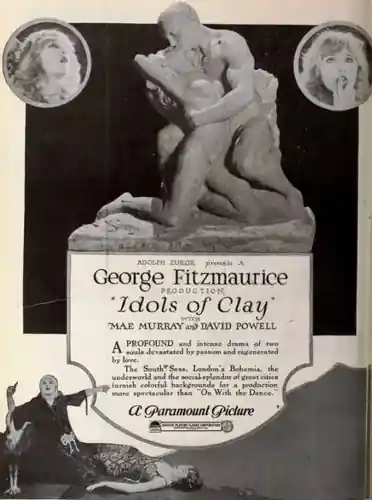
The banquet rupture is staged as a stroboscopic montage—quick cuts between silverware clatter, monocle reflections, and Dion’s horrified eyes. Fitzmaurice intercuts negative footage so faces become skull-like, a premonition of Lady Cray’s imminent suicide. When she swallows prussic acid, the camera tilts sideways, letting chandeliers slide across the frame like falling stars. Her death is not tragic; it’s bureaucratic, clearing the narrative for the lovers’ descent into London’s bowel: Limehouse.
Here the film pivots from decadence to ethnographic noir. Chinese lanterns smear vermilion onto rain-slick streets; a han-clad opium dealer counts silver dollars with the languor of a bored priest. Faith, wrapped in men’s trousers and a coolie hat, becomes a gender-bending chimney sweep of despair. Fitzmaurice borrows visual grammar from The Scarlet Woman but pushes further, letting the camera glide through dens where bodies lie stacked like cordwood. Dion’s rescue—executed via a stolen tugboat—plays like a pagan baptism: sooty water washes the metropolis off Faith’s skin, revealing the lagoon-child beneath.
The return voyage is shot in day-for-night, waves phosphorescent as liquid chrome. A final two-shot—Faith’s head on Dion’s shoulder—echoes the opening but with ontological inversion: innocence, once lost, cannot be restored; it can only be re-sculpted. The last intertitle, lettered in uncial script, reads: “And the sea, having tasted shame, gave back its unsullied child.” Fade to pearl.
Mae Murray navigates the arc from feral nymph to narcotized jezebel with feline elasticity. Note the micro-gesture when Faith first sniffs ether: her nostrils flare, pupils bloom, then a tiny smile—half infant, half succubus. It’s a 12-frame masterclass in moral disintegration. David Powell counters with minimalist stoicism; his Dion is less a lover than a witness, a man who sculpts because touch is the only language left when words succumb to hypocrisy. Their chemistry is not erotic—it’s tectonic, two continental selves drifting, colliding, reforming.
Shot on 35mm at 22 fps, the 2023 4K restoration by La Cineteca di Bologna harvests detail from a surviving Czech nitrate print. Grain structure resembles powdered nacre; cigarette smoke curls with sculptor-defined edges. Tinting follows archival notes: amber for island sequences, cobalt for London exteriors, rose-madder for interiors. The new Sanko score—available in 5.1 surround on the Kino Blu-ray—uses bowed vibraphone and breathy bamboo flutes to mimic tidal inhalation.
Beneath its baroque melodrama, the film interrogates colonial extraction. Jim’s pearl hoard, hidden inside a brass Buddha, literalizes the plunder of the Global South to lubricate metropolitan salons. Faith’s journey is that of resource turned refugee, her body the final commodity trafficked. Yet Bergère’s script complicates victimhood: Faith’s dance, though engineered by Lady Cray, is also her act, a moment of corporeal authorship in a world that scripts her as muse. Compare What 80 Million Women Want for its suffragette polemic; here the politics are subcutaneous, absorbed through skin like mercury.
Released in October 1920, Idols of Clay grossed $1.2 million domestically—staggering for a state-rights roadshow. Critics hailed it as “a phantasmagoria of moral vertigo” (Variety). Over the decades it slipped into orphan-film limbo until a 2023 restoration resurrected its chromatic fever. Modern cinephiles will detect DNA strands in everything from Sternberg’s Shanghai Gesture to Argento’s Suspiria. Its DNA even haunts Evangeline (1919), another tale of exilic devotion, albeit with a Christian patina instead of opium haze.
Idols of Clay is not a relic; it’s a wound that refuses scab. It asks whether art can salvage the desecrated, whether love can survive the glare of publicity, and—most unnerving—whether innocence, once commodified, can ever again be anything but performance. The answer arrives not via dialogue but through a final optical effect: waves superimposed over Faith’s smiling face, the sea literally within her. That image, equal parts benediction and brand, cements the film’s status as the silent era’s most ravaging parable of beauty’s cost. Seek it out, preferably at midnight, volume high, lights low, and let its iodine-scented hallucinations scour your own idols to dust.

IMDb 5.6
1923
Community
Log in to comment.