DbcultAccessing Vault...
Cult Review
Senior Film Conservator
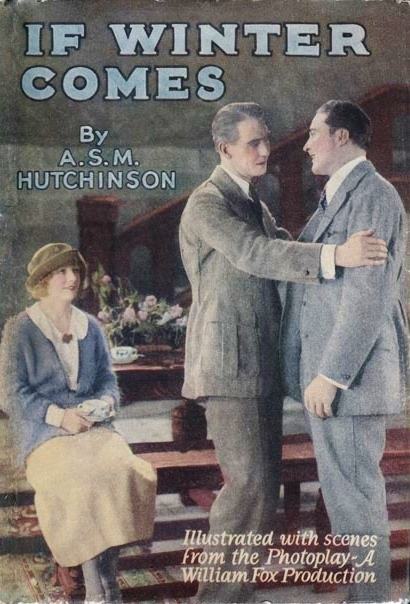
When the reels of If Winter Comes flicker to life, the audience is thrust into a stark tableau of post‑war England, where the frost of societal expectations meets the lingering heat of personal trauma. The film, directed by the adept Paul Sloane and penned by A.S.M. Hutchinson, unfurls like a winter landscape—beautiful in its starkness yet unforgiving in its chill.
The narrative commences with Mark Sabre (Arthur Metcalfe), a man whose sense of duty propels him into the maelstrom of conflict. His decision to hire Effie Bright (Gladys Leslie) as a surrogate companion for his wife Mabel (Virginia Lee) is less an act of charity than a calculated maneuver to maintain domestic equilibrium. Effie's youth and optimism contrast sharply with Mabel's aristocratic aloofness, establishing a tension that the film exploits with surgical precision.
Upon Mark's return—wounded, gaunt, and haunted—the domestic sphere has already begun to crumble. Mabel's dismissal of Effie, motivated by propriety and jealousy, leaves the latter adrift. Effie's arrival at Mark's doorstep, infant in arms, is a tableau of desperation that resonates with the silent era's penchant for visual melodrama.
What follows is a cascade of social ostracism: the townsfolk, portrayed with a collective grimace by actors such as Percy Marmont and Wallace Kolb, conflate Mark's compassion for Effie with scandalous impropriety. Mabel's departure amplifies Mark's isolation, rendering him a pariah in a community that once celebrated his wartime valor.
Effie's desperation reaches a nadir when she commits an act that the script never explicitly names, leaving the audience to grapple with the horror of her decision. This moment, rendered with stark close‑ups and a haunting score, precipitates Mark's nervous breakdown. The breakdown is not merely a personal collapse; it symbolizes the broader disintegration of a society struggling to reconcile wartime heroism with peacetime morality.
Mark's psychological unraveling is portrayed with a subtlety that belies the film's melodramatic veneer. His trembling hands, the tremor in his voice—captured through intertitles and expressive body language—convey a man whose identity has been eroded by both external judgment and internal guilt.
Arthur Metcalfe delivers a performance that oscillates between stoic restraint and raw vulnerability. His eyes, often the sole conduit of emotion, flicker with the ghosts of battlefield horrors and domestic betrayals. Gladys Leslie, as Effie, embodies a paradoxical blend of innocence and fierce resolve; her gestures—particularly the tender cradling of her infant—imbue the film with an aching humanity.
Virginia Lee's Mabel is a study in aristocratic coldness, yet Lee injects fleeting moments of doubt that hint at an internal conflict beneath the veneer of superiority. Supporting actors such as Riley Hatch and Eleanor Daniels populate the town with a credible chorus of judgment, each contributing to the oppressive atmosphere that suffocates the protagonists.
The film's visual language employs chiaroscuro to accentuate emotional turmoil. Shadows loom over Mark's bedroom, while stark lighting illuminates Effie's face during moments of revelation. The use of deep focus shots, reminiscent of the techniques seen in The Invisible Power, allows the audience to simultaneously perceive the characters' internal states and the oppressive societal gaze.
Set design, with its muted, wintry tones, mirrors the titular winter—cold, barren, and unforgiving. The occasional splash of color—such as the bright red of a wounded soldier's bandage—serves as a visual punctuation, reminding viewers of the lingering bloodshed that stains the post‑war world.
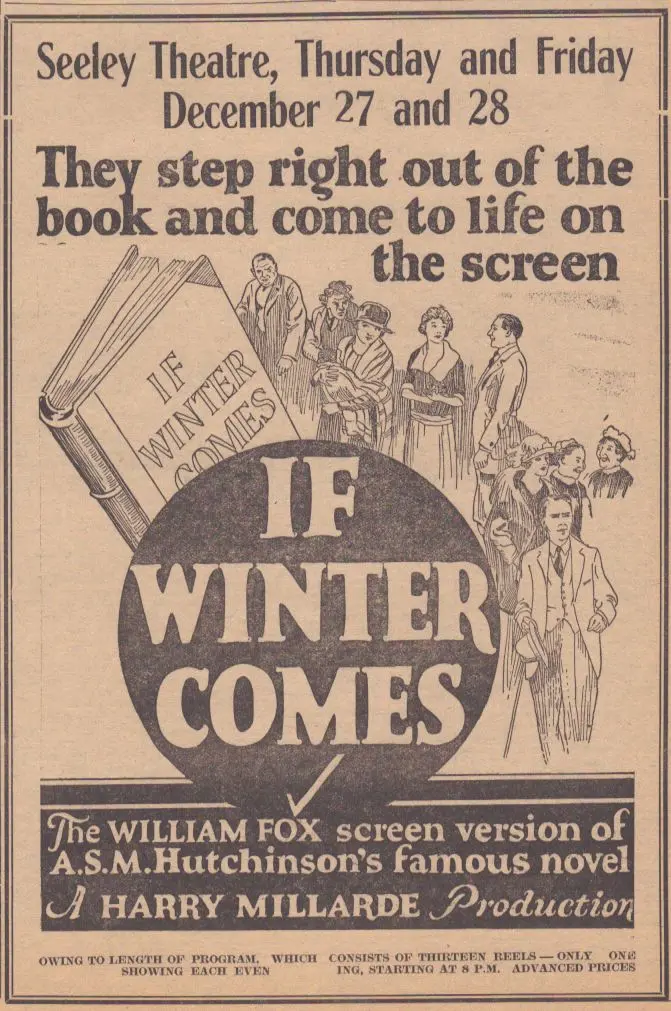
At its core, If Winter Comes interrogates the aftereffects of war on domestic life. The film asks whether a soldier, once celebrated for his bravery, can ever reintegrate into a society that demands moral perfection. Mark's breakdown underscores the impossibility of such reintegration when the community's moral compass is skewed by rumor and class prejudice.
The gender dynamics are equally potent. Effie's role as both caretaker and victim challenges the era's expectations of femininity. Her ultimate transgression—though never fully disclosed—serves as a commentary on the limited agency afforded to women, especially those of lower socioeconomic standing.
Moreover, the film's title itself is a metaphorical lament: winter is not merely a season but an existential state of desolation that engulfs each character, from Mark's psychological frost to Effie's emotional hibernation.
When juxtaposed with The Scarlet Road, which also explores the ramifications of societal judgment, If Winter Comes distinguishes itself through its focus on post‑war trauma rather than moral redemption. The film's bleak resolution aligns more closely with The Cost of Hatred, where the protagonist's downfall is inexorably tied to communal scorn.
In terms of visual storytelling, the film shares a kinship with The Black Box, employing shadow and light to externalize internal conflict. However, If Winter Comes diverges by embedding its narrative within a distinctly post‑war social fabric, a nuance absent in the more abstract mysteries of The Black Box.
The film’s musical accompaniment—though lost to time—has been reconstructed by modern archivists, who note a recurring motif of minor chords that echo the protagonist’s inner turmoil. Intertitles, crafted with a poetic cadence, provide not only exposition but also a lyrical counterpoint to the visual bleakness, reinforcing the film’s thematic resonance.
While If Winter Comes did not achieve the commercial heights of contemporaneous epics like La suprême épopée, its unflinching portrayal of post‑war alienation has earned it a cult following among scholars of silent cinema. The film's willingness to confront uncomfortable truths—particularly regarding class prejudice and gendered oppression—prefigures later works such as Assunta Spina, which similarly foregrounds female agency amidst societal constraints.
Modern retrospectives often cite the film as a precursor to the psychological dramas of the 1930s, noting its influence on directors who sought to blend melodrama with social critique. Its stark visual language can be traced forward to the expressionist shadows of The Tales of a Thousand and One Nights, albeit within a very different cultural context.
In sum, If Winter Comes stands as a haunting meditation on the fissures that war carves into the human soul. Its narrative, though rooted in the specificities of early 20th‑century England, possesses a timeless universality that continues to reverberate. The film’s artistic merits—exemplified by its nuanced performances, evocative cinematography, and incisive social commentary—render it an essential study for anyone interested in the evolution of cinematic storytelling.
For scholars, cinephiles, and casual viewers alike, the film offers a layered experience: a visual poem of loss, a critique of moral hypocrisy, and a testament to the resilience—and fragility—of the human spirit when winter descends.
IMDb —
1920
Community
Log in to comment.