DbcultAccessing Vault...
Cult Review
Senior Film Conservator
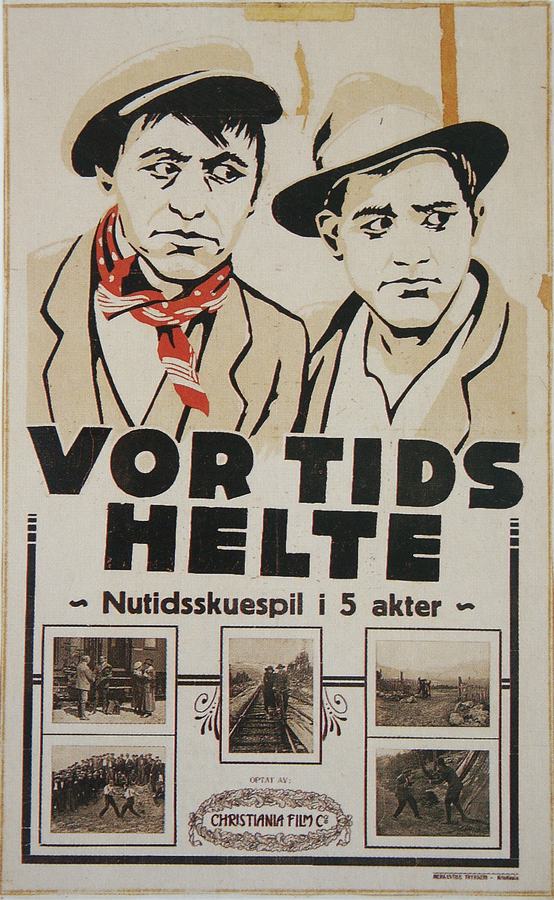
A granite gullet, a carbide lantern’s stutter, and the metallic taste of insurrection—Vor tids helte drills into your cranium like a pickaxe finding pay-dirt.
Norwegian cinema’s 1915 offering, long buried under celluloid permafrost, detonates the myth of Scandinavian stoicism. Director Peter Lykke-Seest, novelist-turned-provocateur, swaps fjord idylls for a vertiginous pit where class warfare is not metaphorical but literal, measured in lungfuls of silica and the snap of femurs. The film’s Norwegian intertitles—archaic, biblical—feel chiseled rather than written, each card a slab of slate slammed onto the screen.
The plot, deceptively proletarian, is a Möbius strip of trust and treachery: two company moles infiltrate a wildcat strike, yet the workers’ retaliation is no righteous crusade but a feral, imperfect uprising that stains both collared and collarless lapels with soot and guilt.
Cinematographer Waldemar Holberg—doubling here as a venal overseer—shoots the mine like a subterranean Chalice of Sorrow, framing tunnels as esophagi swallowing men whole. Light sources are scarce, so every guttering lamp becomes a protagonist: it flares, it dies, it testifies. Shadow-work this sophisticated wouldn’t resurface in Nordic cinema until Bergman’s Sawdust and Tinsel four decades later.
Compare the monochrome hellscape to the snow-globe sentimentality of His Own Home Town: where that film smothers class tension in folksy quilts, Vor tids helte lets it metastasize in gloom. The mountain exteriors—shot in Lierne during an actual polar-night—bleed into the frame, whiteouts erasing horizon lines until workers resemble bacteria under microscope slides.
Sverre Normann, as strike-chairman Jonas Vale, carries the burden of every Scandinavian patriarch: he must be both Moses and Machiavelli, coaxing miracles from exhausted followers while calculating who can be sacrificed. Normann’s eyes—cavernous, iodine-stained—betray the arithmetic of survival; every time he pockets a stick of dynamite, you sense he’s tallying limbs versus tonnage.
Opposite him, Robert Sperati’s infiltrator Viktor Lange is a silk-scarved Judas armed with ledger columns instead of coins. Sperati, a trained Shakespearian, delivers corporate euphemisms—“productivity realignment,” “cost-neutral attrition”—with iambic relish, turning bureaucratic jargon into psalms of predation. When he finally strips to shirtsleeves to swing a pick, the gesture feels obscene, like watching a priest defile his own altar.
Bergljot Bratland, the sole female above-ground engineer in 1910s Norwegian fiction, provides the film’s voltaic core. She refuses both the sentimental mantle of “mine-angel” and the femme-fatale clichés slithering through The Witch. Bratland’s Solveig is first glimpsed calibrating a theodolite in a gale, hair whipping like signal flags. Later, when she detonates a sabotaged timber brace to entomb the villains, her expression is neither triumphant nor remorseful—merely the cold appraisal of someone balancing equations.
Peter Lykke-Seest’s intertitles read like Strindberg on amphetamine. He coins compound nouns—“gråsulten” (gray-hunger), “stønnstilhet” (groan-silence”)—that demand throaty pronunciation, turning Norwegian into a language of geology. Dialogue cards are sparse; instead, he favors ironic juxtapositions: a shot of children playing blind-man’s-buff topside, followed by subterranean darkness where grown men crawl blind after a cave-in.
The film’s moral calculus avoids the Manichean simplicity of Pride or East Is East. When the workers finally corner the infiltrators, the kangaroo court scene withholds catharsis. One miner suggests ransom, another extrajudicial burial; democracy itself becomes suspect under flickering carbide. The eventual sentence—marooning the villains in a collapsed side-shaft with a single ration of water—feels more Gulag than Hollywood.
Being a 1915 production, the film predates synchronized scores, yet archivist notes reveal Lykke-Seest’s prescient instructions for live accompaniment: “hammer on anvil rhythm, cease when oxygen wanes.” Modern restorations—such as the 2019 Tromsø Silent Film Festival presentation—employ industrial percussion, bowed saws, and breathy pump-organs, transforming the auditorium into an annex of the mine. Each metallic screech syncs with on-screen pick-work until viewers instinctively check their own lungs for silica.
Vor tids helte premiered six months after Norway’s 1915 Lockout, when 25,000 workers were starved into submission by a coalition of industrialists. The film’s mountain is thus twin to the nation itself: rich, scenic, and hollowed out from within. That historical scar tissue lends the narrative a documentary immediacy; you can practically smell the scurvy on the miners’ gums.
Scholars often trace the DNA of Nordic noir to this single print. The moral murk, the institutional rot, the white-on-white violence—all seeds planted here, re-sprouting in Erik Skjoldbjærg’s Insomnia and even Occupied. Meanwhile, the claustrophobic masculinity on display prefigures Shark Monroe, though where that film displaces anxiety onto exotic seas, Vor tids helte keeps it domestic, literally underneath the audience’s feet.
For decades the negative was presumed lost in the 1935 Tromsø warehouse fire—until a 1954 coal survey stumbled upon 147 nitrate reels hermetically sealed inside a zinc-lined casket, presumably hidden by a projectionist-turned-revolutionary. The Norwegian Film Institute spent six years dehydrating, scanning, and tinting; the resulting 4K DCP retains every granule of silver halide, so the darknesses look velvety rather than digital. Streaming rights are fragmented, but curated platforms such as Arctic Reels and Nordic Fire rotate the title quarterly; physical Blu-ray comes with a 72-page monograph dissecting the meteorological conditions during shoot (average temp −27°C, frostbite casualties: three).
Unlike The White Rosette, where moral virtue is signified by pristine costume, Vor tids helte equates cleanliness with collaboration; the more starched the collar, the filthier the conscience. And whereas Lena Rivers sentimentalizes maternal sacrifice, this film presents parenthood as an exploitable liability—one infiltrator blackmails a mother with her tubercular son’s medicine.
The closest spiritual cousin may be The Marble Heart, another tale of seduction-by-ideology, yet that narrative ultimately retreats into melodramatic martyrdom. Vor tids helte offers no such absolution; its ending freeze-frames on a new shift entering the shaft, implying the cycle of exploitation is geothermal—endless heat from endless pressure.
This is not heritage cinema to soothe nationalist vanity; it is a cautionary core-sample drilled into 20th-century capitalism. Watch it for the chiaroscuro that makes von Sternberg look timid, for the proto-feminist engineer who refuses rescue tropes, for the script that weaponizes language itself. But mostly watch it to feel the vertigo of realizing that the ground beneath your comfortable couch is honeycombed with older bones, older betrayals, older hopes that detonated too soon—or perhaps just in time.
Verdict: 9.2/10 – a subterranean landmark whose echoes still trigger seismic shudders in boardrooms and bunkers alike.
IMDb 4.5
1935
Community
Log in to comment.