DbcultAccessing Vault...
Cult Review
Senior Film Conservator
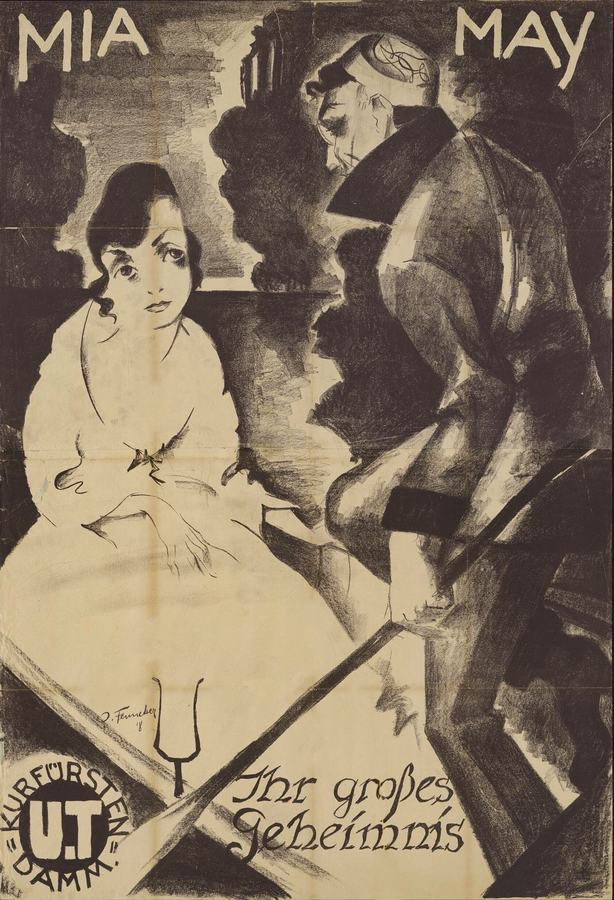
To gaze upon Joe May’s 1918 production, Ihr großes Geheimnis, is to witness the birth of the 'May-Movie' phenomenon in its most potent, concentrated form. While contemporary audiences might associate early German cinema primarily with the jagged geometry of Expressionism, this film operates within a different, perhaps more insidious, visual language. It is a cinema of interiors—both architectural and psychological. The film serves as a grand stage for Mia May, whose presence on screen was not merely a performance but a cultural event. In this narrative, she embodies the friction between individual desire and the rigid expectations of a society that demands transparency while rewarding deception.
The narrative trajectory of Ihr großes Geheimnis avoids the simplistic moralizing often found in its peers. Instead, it invites the viewer into a world of nuanced shadows. Mia May’s protagonist is a figure of tragic complexity, a woman whose past is not a discarded garment but a second skin. Unlike the overt theatricality found in The Rose of Blood, where political upheaval dictates the emotional stakes, May’s film finds its tension in the quiet corners of the drawing-room. The 'secret' itself is almost secondary to the psychological toll of its preservation. We see a woman who has mastered the art of the social mask, a theme that resonates deeply when compared to the performative identities in Miss Peasant.
The direction by Joe May, supported by the writing of Rudolf Baron and Mia May herself, showcases a sophisticated understanding of the camera’s ability to act as a voyeur. The framing often traps the characters within the heavy furniture and ornate decor of the period, suggesting that their social standing is as much a prison as a privilege. This visual claustrophobia is a hallmark of the era’s finest dramas, echoing the stylistic intensity seen in Il fuoco (la favilla - la vampa - la cenere), though Joe May trades Italian d'Annunzian fire for a cold, Germanic precision.
When we place Ihr großes Geheimnis alongside other works of the late 1910s, its sophistication becomes even more apparent. While A Child of Mystery relies on the tropes of the unknown to drive its plot, May’s film focuses on the known—the terrifying reality of a truth that refuses to stay buried. There is a kinship here with the narrative structures of Manon Lescaut, where the heroine’s fate is inextricably linked to her inability to reconcile her romantic impulses with societal demands. However, where Manon is often swept away by the winds of fortune, Mia May’s character in Ihr großes Geheimnis is an active, if doomed, participant in her own defense.
The supporting cast provides a sturdy framework for this emotional exploration. Johannes Riemann offers a performance of understated gravity, providing a foil to the escalating desperation of the lead. His presence brings to mind the stoic figures in The Girl by the Roadside, yet there is a specific urbanity to his role that anchors the film in its bourgeois setting. Käthe Haack, even in this early stage of her illustrious career, displays the sharp intellect that would make her a staple of German cinema for decades. The interplay between these characters creates a friction that is almost palpable, a far cry from the lighter, more whimsical deceptions found in Házasodik az uram.
Technically, the film is a marvel of its time. The use of lighting to delineate the boundaries between the public and private spheres is masterful. We see the protagonist bathed in the harsh, unforgiving light of the ballroom, only to retreat into the sea-blue shadows of her private chambers where the weight of her secret is most visible. This use of light as a narrative tool is something Joe May would continue to refine, eventually leading to the massive scale of his later epics. The pacing, too, is deliberate. It does not possess the frantic energy of Reporter Jimmie Intervenes or the pulp sensibilities of Manden med de ni Fingre IV. Instead, it breathes with the slow, rhythmic pulse of a tragedy unfolding in real-time.
The set design, likely influenced by the burgeoning Kammerspielfilm movement, uses every object to tell a story. A discarded letter, a lingering glance in a mirror, a door left slightly ajar—all of these are loaded with semiotic significance. This attention to detail elevates the film above mere entertainment, positioning it as a precursor to the psychological depth of the 1920s. It lacks the pastoral simplicity of Springtime or the rugged isolation of Vengeance of the Wilds, opting instead for a sophisticated urbanity that feels remarkably modern even over a century later.
As we deconstruct the final acts of Ihr großes Geheimnis, we are left with a profound sense of the ephemeral nature of security. The film suggests that the structures we build to protect ourselves—marriage, wealth, social standing—are fundamentally fragile. This cynical, or perhaps merely realistic, outlook was a reflection of the tumultuous year of 1918. While Betrayed dealt with the externalized consequences of disloyalty, Joe May’s work internalizes the betrayal, making the character both the victim and the perpetrator of her own undoing. It is a far more complex moral landscape than the adventurous spirit of Miss Robinson Crusoe or the archetypal seductions of Don Juan.
In conclusion, Ihr großes Geheimnis stands as a monumental achievement in early German cinema. It is a film that demands to be watched not as a historical curiosity, but as a living, breathing piece of art. Mia May’s performance remains a masterclass in silent acting, conveying a universe of emotion through the slightest inclination of the head or a momentary hesitation in her gait. Joe May’s direction ensures that the film’s themes of guilt and social artifice remain as relevant today as they were in the waning days of the Great War. It is a haunting, beautiful, and deeply intelligent exploration of the human condition, hidden behind the veil of a great secret.
For those who appreciate the intersection of high drama and meticulous craftsmanship, this film is an essential experience. It bypasses the crude slapstick of Peck o' Pickles and the melodrama of lesser directors to reach something approaching the sublime. Ihr großes Geheimnis is not just a title; it is an invitation to peer into the darkened rooms of the human soul and find the light that still manages to flicker within.

IMDb —
1921
Community
Log in to comment.