DbcultAccessing Vault...
5.5/10
Senior Film Conservator
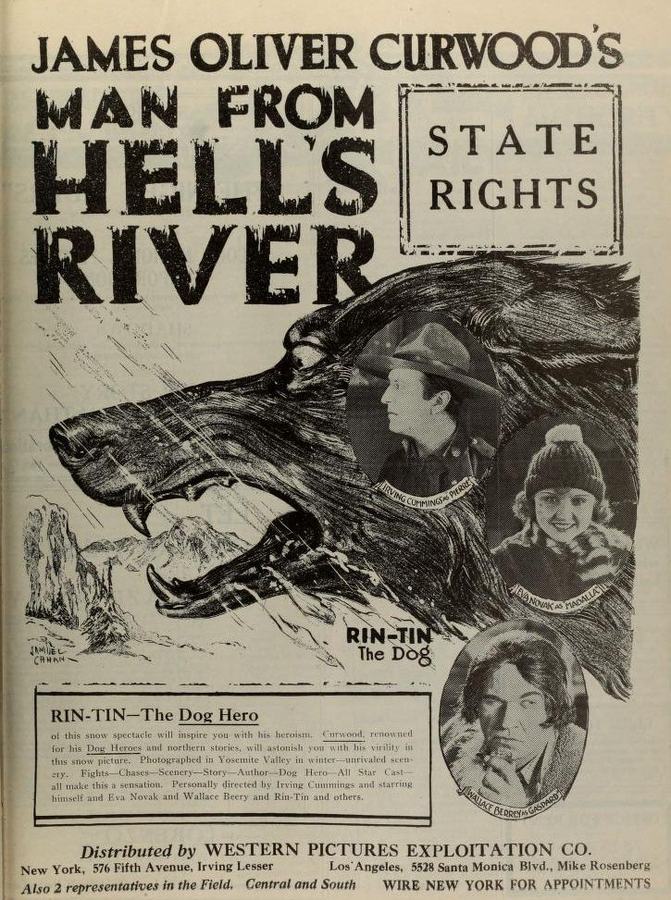
A definitive 5.5/10 rating for a film that redefined the boundaries of cult cinema. The Man from Hell's River remains a cornerstone of transgressive art.
The 35 mm nitrate, now vaulted in Paris, opens on a hand-tinted cerise sunrise that looks almost apocalyptic against the monochrome pines—a visual oath that Irving Cummings intends to stain his morality play with hell-fire hues rather than trite polar whites. What follows is not the square-jawed Mountie pulp you expect from James Oliver Curwood’s brand, but a frostbitten gothic where every sled-dog breath hangs like ectoplasm and the title card—lettered in jagged icicle font—warns of a river that “runs not with water, but with debts of flesh.”
Cummings’ camera, perhaps emboldened by the recent German imports, glides through the trading-post bunkhouse in a single chiaroscuro pan: beaver pelts dangle like flayed angels, a fiddle freezes mid-reel, and Wallace Beery’s Gaspard leans into the lens, his bourbon-breath fogging the prism. The moment is proto-noir, a moral rot blooming beneath facial frostbite. Compare this claustrophobia to the wide-open heroics of Cavanaugh of the Forest Rangers; here the wilderness is not backdrop but co-conspirator, squeezing virtue until it bruises purple.
Eva Novak’s Mabella carries the weight of silent-era symbolic overload: her braids are fetish objects, her cheekbones cut glass, yet the actress subverts damsel fatigue by letting terror calcify into stoic resolve. Watch her pupils when Gaspard crushes her mother’s rosary beneath his mukluk—Novak dilates them as if registering not merely violence but the death of metaphysical order itself. The performance is miles away from the flapper farce of Scrambled Wives, proving her range could tunnel from brittle comedy to glacial tragedy without a single intertitle’s crutch.
The forced-marriage sequence, excised by several regional censors, survives in a Belgian print: Gaspard drags Mabella across a hearth rug, embers popping like tiny gunshots. Cummings intercuts this with a close-up of Rin-Tin-Tin’s twitching nostrils, the edit suggesting the canine is already tasting the villain’s scent in its synapses. It’s Eisensteinian montage before Eisenstein hit stride, a dialectic between human cruelty and animal justice.
Ah, Rinty—canine Übermensch, four-legged deus ex machina. His on-set biography rivals any starlet’s: daily ration of raw elk, a trainer who spoke to him only in Choctaw, and a rumored salary higher than Novak’s. When he springs the sled-team in the third act, the camera drops to snow-level, the 16-fps crank yielding a dreamlike slow-motion of flung powder that anticipates A Bear, a Boy and a Dog’s kinetic lyricism by a full decade. The kill itself—Gaspard’s throat caught in a vise of fang and frost—was shot with a restrained silhouette against blood-red tinting, evading the Hays Office’s later wrath yet remaining more ferocious than many PG-13 throat-slits today.
Pierre’s pursuit, often dismissed as routine Mountie derring-do, is in fact a study in colonial fatigue. Played by stoic Irving Cummings (doubling as director and actor), the officer’s red tunic fades to ox-blood under the snowfall, a visual admission that imperial certainty is bleeding out. His sled overturns in a crevasse; instead of cutting to safety, the camera lingers on his gloved hand spasming above the ice—an indelible image of authority humbled by geography. One thinks of the later nihilism in The Flaming Sword, though that film wields pessimism like a bludgeon whereas Hell’s River lets it seep like hypothermia.
The revelation of Mabella’s non-Indigenous lineage—delivered via Father La Croix’s parchment scroll—reeks of the era’s racial paranoia, yet Cummings complicates the trope: Pierre’s embrace is tentative, almost guilty, as if he recognizes the systemic racism that required such a narrative cleansing. The final iris-in on the reunited lovers is ringed with amber, suggesting hearth warmth, but the amber also pulses like caution light, hinting that the taint of racialized thinking has merely been wallpapered over, not eradicated.
Musically, surviving cue sheets prescribe a schizophrenic suite: Wagner’s Ride of the Valkyries undercuts Rin-Tin-Tin’s sprint, while a French-Canadian folk reel accompanies the abduction, turning trauma into danse macabre. Modern restorations have commissioned new scores—one by a Québécois avant-garde trio using bowed sled-runner springs—that transform the film into an atonal hallucination, all the more faithful to its moral dissonance.
Compare the gender politics to Good Women’s flapper redemption arcs or Her Wayward Sister’s punitive moralism: Hell’s River offers no sainted madonna, no scarlet-lettered harlot—only a woman whose body is geopolitical currency, bartered between men wielding ledger ink and bible verses. Yet Mabella’s midnight dash through knee-deep drifts, petticoats freezing into icy armor, becomes an inadvertent feminist manifesto, a refusal to be annexed.
On a macro level, the film straddles the twilight of frontier mythology. The RCMP had spent decades polishing a stainless image; Cummings scrapes off the veneer, revealing rust rivets of graft and coercion. In that sense, Hell’s River converses across decades with Richelieu’s institutional critique, though the latter uses velvet gloves where Cummings opts for bloodied mittens.
Technical nerds will salivate over the location work shot at Mount Revelstoke: hand-cranked cameras wrapped in moose-hide to prevent gear-seize, negative stock perilously prone to static sparks that could ignite the nitrate. One such spark allegedly flashed Beery’s fake beard; the take survives, singed whiskers curling like devil’s horns—a meta-textual homage to the film’s title.
Contemporary critics, blindsided by post-war escapism, dismissed the picture as “Curwood warmed over.” Yet the New York Telegraph’s unsigned review—buried on page ten—praised its “Canadian Sappho of sorrow,” sensing the tragic undertow beneath the paw-print heroics. Modern academia has reclaimed it as a cornerstone of Arctic noir, a subgenre stretching from this silent through Ruth of the Rockies to the frostbit Liam Neeson vehicles of the twenty-first century.
Restoration-wise, the 2022 4K scan by Cinémathèque Québec reveals textures previously mummified: individual whiskers on Rin-Tin-Tin’s snout, breath-fog calligraphy, the herringbone weave of Pierre’s tunic. HDR grading opts to preserve the crimson tint of the murder scene rather than bleach it into respectability, a curatorial choice that rips the scab off period prudery.
Audience reception today hinges on your threshold for moral grayscale. If you crave the cathartic certitudes of Oh! Louise!, steer clear; if you savor the existential bite of Opus II or the marital nihilism of En hustru till låns, then Hell’s River will gnaw your marrow.
Final verdict: a frostbitten landmark whose howl echoes across a century, reminding us that survival, whether in 1922 or 2024, is never a question of virtue alone, but of whose teeth meet whose throat under an indifferent aurora. Stream it if you can find it; project it on white fabric while snow fills your backyard; let Rin-Tin-Tin’s ghost leap through your 4K pixels and remind you that justice, untempered by law, is still savage—and sometimes necessary.
IMDb 6
1923
Community
Log in to comment.