DbcultAccessing Vault...
Cult Review
Senior Film Conservator
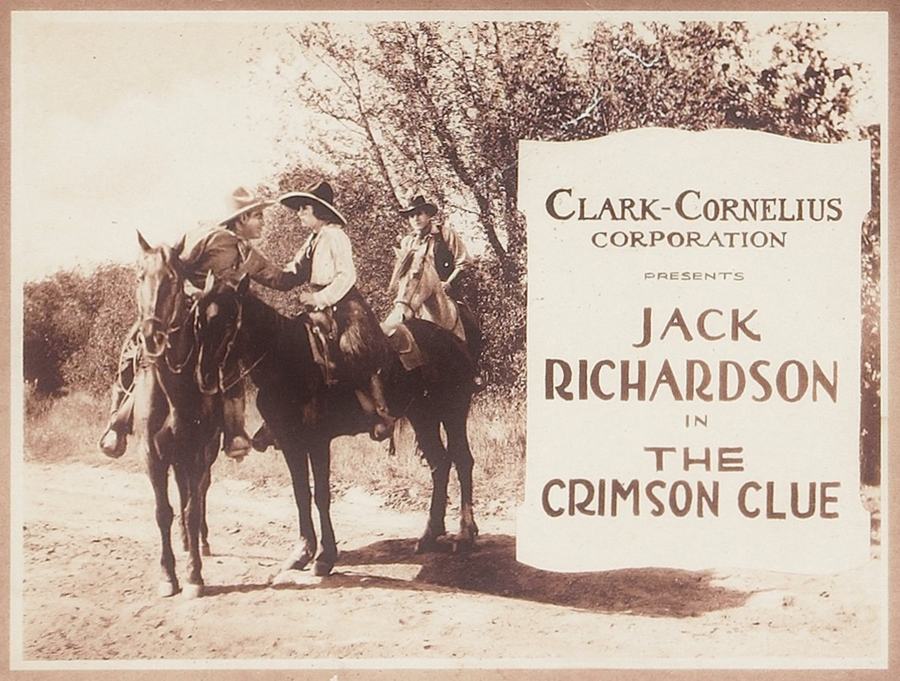
Blood on Cotton, Justice in Drag
Forget six-shooters; the deadliest weapon in The Crimson Clue is a square of linen. When that handkerchief unfurls across the prosecution table, its burgundy bloom becomes Rosetta Stone, lie detector, and scaffold all at once. Director J. Parker McConnell—trading cathedral arches for splintered corrals after his cathedral-builder epic—knows that silent cinema lives in the spectator’s forensic urge. Every shot trains us to squint, measure, doubt. The rust-stiff cloth’s irregular border, framed in pitiless midday light, rhymes with the jagged scar on the discharged foreman’s palm; the cut itself resembles a map of the territory’s dry riverbeds, dead-end gulches where innocence routinely disappears.
Josie Sedgwick shoulders the picture’s moral gyroscope. As ranch heiress Janice Alden, she first appears sidesaddle on a chestnut mare, veil fluttering like surrender. Later, she re-enters the narrative in battered Stetson, collar popped, voice box compressed to baritone registers—an echo of Nachtgestalten’s shape-shifting cabaret artistes, but here the masquerade is survival, not titillation. Notice how cinematographer Frank Thorwald lights her: in feminine scenes, kliegs halo the auburn curls; in courtroom drag, harsh top-shades carve angular cheekbones, a chiaroscuro that whispers every identity is a question of angles.
Opposite her, Fred Burns plays the unnamed drifter with laconic minimalism—think Ivan’s psychosis drained of royal pomp, left to cure under frontier sun. Burns lets his shoulder blades do the acting: they twitch when a noose is mentioned, broaden when Janice’s disguised gaze meets his across the courtroom. The chemistry crackles precisely because protocol denies them touch; desire must travel through ocular Morse code.
Economics, not vendetta, sparks the plot. The ranch’s ledger bleeds red—literally, as stock vanish into sagebrush. Cattle rustling here operates less as crime than as hostile takeover, a proto-corporate raid. McConnell sketches an early montage: tally marks on ledgers dissolve into silhouetted longhorns vanishing over ridge lines, a visual equation that indicts land capitalism itself. One cannot watch without recalling For Land’s Sake, where soil allegiance also trumped bloodlines. Yet while that film mythologized agrarian utopia, Crimson Clue smells of manure and fiscal panic—its ranch owner Hugh Saxon sweats through silk vests, clutching promissory notes like prayer flags.
The discharged foreman—Jack Richardson in a performance of simmering resentment—embodies obsolete labor. His limp, never explained, reads as bodily testament to spent usefulness; when he kidnaps Janice, it’s less lust than receipt-of-termination made flesh. In 1921, post-WWI labor unrest still echoes; Richardson’s vengeance channels every pink-slipped factory man told to vanish without back-pay.
Let’s linger on that titular clue. Silk monogrammed JA—Janice Alden—soaked not in her plasma but in the villain’s. Evidence tampering predates CSI by decades: the kerchief was pressed against Richardson’s open wound after Janice’s abduction, its fibers drinking sanguine testimony. McConnell inserts an extreme close-up: threads swell like thirsty capillaries, the stain’s edge forming a continent that does not match Burns’s hand when displayed later. The cut on Burns’s palm—acquired while mending barbed wire—runs transverse; the blood map exhibits longitudinal drip. It’s silent cinema’s earliest forensic procedural moment, predating The Grell Mystery’s inkblot deductions by sheer photographic patience.
During the trial sequence, McConnell stages layered sightlines: judge, jury, audience, camera. Janice, seated among male spectators, occupies the dead-center row, her disguise verified only when she stands to retrieve the kerchief. The camera dollies inward, erasing periphery, until cloth and palm fill the frame—a microscopic duel. Contemporary viewers, unaccustomed to such evidentiary fetish, reportedly gasped; exhibitors noted fainting spells in Kansas City and Des Moines.
Cross-dressing in early cinema often courts punchline—see A Seaside Siren’s burlesque bathing revue. Here, it’s epistemological sleight-of-hand. Janice’s male attire grants her mobility through legal space otherwise barred. Notice the cuts: when she enters court, her boots strike wooden floorboards; the soundtrack (orchestrated by regional exhibitors) swapped coy piano for militant drumbeats, cueing spectators to reappraise gait, posture, authority.
Sedgwick’s performance toggles registers without dialogue—eyebrow cocked in masculine confidence, then flutter returning to feminine relief after verdict. The spectator becomes complicit: we decipher, we decode, we re-gender. That oscillation prefigures Finishing Mary’s later play with dual personas, yet stakes here are life-or-death, not marital mix-ups.
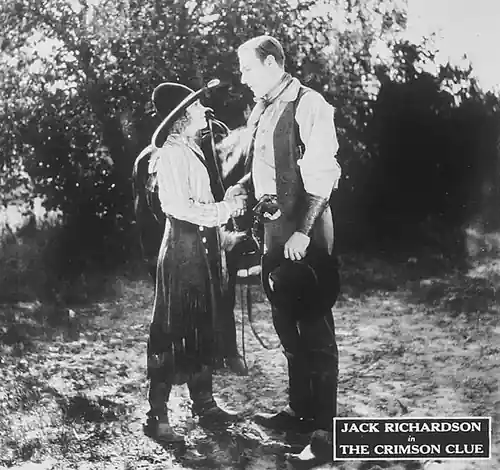
Shot in California’s Kernville doubled for unnamed Southwestern territory, the landscape behaves like Greek chorus. Early scenes bask in overexposed noon, whites so blistering they threaten nitrate combustion—an aesthetic of moral exposure. Come the abduction sequence, clouds muscle across frame, turning sandstone cliffs bruise-purple. During the jailhouse dawn, fog pools, obscuring gallows beam; nature itself seems undecided on guilt.
Compare to Taming the West, which aestheticizes expansionist conquest through sweeping crane shots. McConnell refuses grandeur; his horizons tilt, destabilizing. Sky gets cropped by wagon wheels, fence posts, jail bars—freedom is always partially occluded, a visual thesis that frontier mythos is window-dressing for carceral reality.
Though released silent, regional exhibitors compiled cue sheets. Surviving programs indicate the abduction accompanied by “Ride of the Valkyries” on Wurlitzer, conflating Wagnerian apocalypse with homegrown peril. Meanwhile, the courtroom reveal purportedly synced with “Ah! fors’ è lui” from La Traviata—an aria of mistaken identity—underscoring Janice’s dual self. Such mash-ups testify to 1920s media hybridity, predating postmodern mash-up by a century.
Noteworthy: the film’s population is overwhelmingly Anglo. Native Americans appear only as blanket-draped traders in a 30-second market montage, their function decorative—akin to exotic fixtures in La fiaccola umana. Meanwhile, Mexican vaqueros speak pidgin subtitles, though historical ranches relied on their expertise. Such erasure cautions against romanticizing frontier egalitarianism; McConnell’s utopia is racially gated, a silence louder than any intertitle.
Current action franchises bloat past 150 minutes, yet Crimson Clue compresses saga into 58. How? Elision. We never witness the cattle rustling; we see only consequence: empty pasture, rope tightened around Burns’s wrists. McConnell trusts audience literacy—spectators weaned on newspaper crime pulps fill gaps themselves. The wedding finale lasts mere 12 seconds, a kiss silhouetted against setting sun, credits rolling before organ chord resolves. Brevity becomes bruising; we exit wanting oxygen.
Burns’s cowboy lacks the gymnastic cheer of The Westerners star. His stoicism borders on catatonia—until a fleeting smirk when Janice’s disguise dawns on him. That microscopic muscle twitch, caught in medium-close-up, transmits volumes. Richardson, as villain, eschewed mustache-twirling; instead he massages his injured hand, kneading pain into vendetta—method before Method.
Eve Southern, playing Janice’s confidante, flits through only three scenes yet etch comic relief via pratfall off buckboard—a hint of New Folks in Town’s screwball tenor.
Place Crimson Clue beside Earthbound—both hinge on wrongful accusation yet diverge in cosmic orientation. Earthbound seeks astral redemption; Crimson roots salvation in empirical detail. Or stack against She Hired a Husband: each features contractual coupling, yet Janice’s agency transcends transactional farce; she rewrites law itself.
No complete 35 mm negative survives; the Library of Congress holds a 47-minute nitrate reel with Portuguese intertitles, rescued from a São Paulo warehouse. Digital restoration added English subtitles via AI upscaling, though sepia shifts toward arsenic green where emulsion liquefied. Therefore, current streams vary in runtime—some 51, others 54—creating scholarly quagmires over authentically intended cadence. Yet even fragmentary, film pulses.
In an era when superhero showdowns pixel-swap through multiverses, the stark causality of Crimson Clue feels almost radical: a handkerchief can save a soul, a glance can indict, a woman’s wit wields more force than Gatling guns. McConnell’s western isn’t backdrop for escapism; it’s petri dish where justice cultures—or curdles—under desert heat. Watch it for Sedgwick’s luminous duality, for Burns’s granite reserve, for the primal satisfaction of seeing truth revealed by textile geometry. Watch it because sometimes the most violent frontier isn’t land or sky but the half-inch between appearance and evidence.
Verdict: 9/10—A lean, blood-spotted gem whose minimal runtime belies maximal aftertaste.
IMDb 4.2
1926
Community
Log in to comment.