DbcultAccessing Vault...
Cult Review
Senior Film Conservator
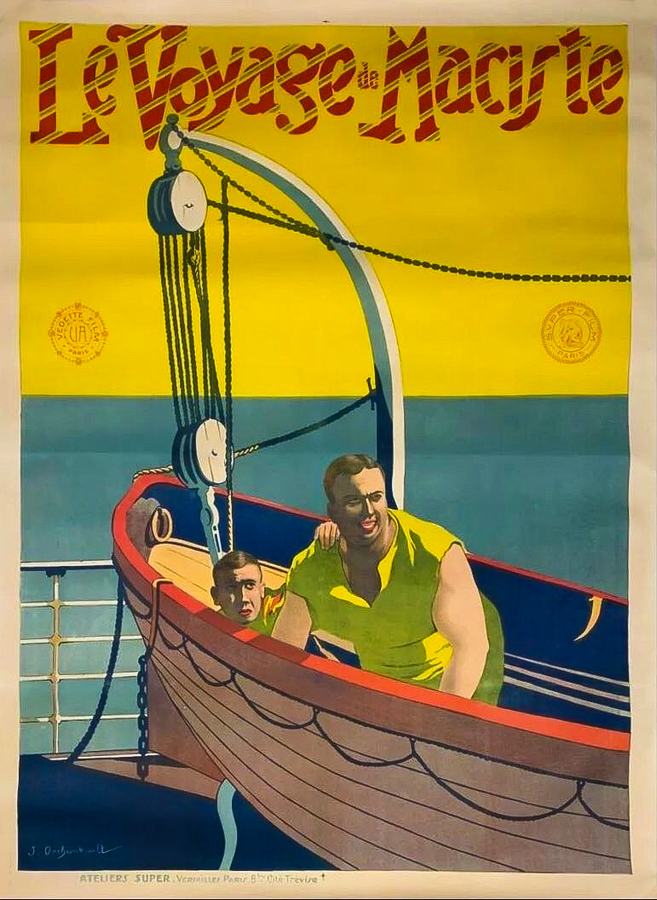
Bartolomeo Pagano’s sinews glide across the screen like living basalt, each tendon lit by cinematographer Carlo Campogalliani so that sweat beads become tiny crystal balls foretelling futures of blood. The camera, starved of spoken word, gorges itself on the geography of flesh: shoulders that eclipse moons, forearms veined like river deltas, a chest broad enough to inscribe entire constellations. Yet beneath the marble skin lurks a metaphysical vertigo—Il viaggio di Maciste is less a peplum parade than a pilgrim’s fever dream, a cartography of disillusion sketched with chiaroscuro torches.
The plot, if one dares reduce hallucination to synopsis, stitches imperial Rome to nameless borderlands via a forced march of slaves. Senators wagering on human misery toss Maciste into the caravan, wagering that the colossus will either crush insurrection or be crushed. But the narrative artery keeps bursting: a night raid by masked riders who quote Dante; a desert citadel whose walls ooze hallucinogenic sap; a masked priestess—Letizia Quaranta’s hypnotic, double-role twins—who baptizes warriors in wine laced with powdered lapis. Every episode feels torn from a different scroll: gothic horror, swashbuckling serial, proto-spy thriller, even a fleck of science-fiction when Tarquinio unveils an astrolabe powered by imprisoned lightning.
Silent cinema survives through tint, and here the palette speaks in tongues:
Campogalliani’s tinting is no mere ornament; it is grammar. Watch how the yellow shifts to ochre right before a betrayal—an amber alert delivered decades before Technicolor.
Gabriel Moreau’s Tarquinio carries a half-mask of beaten gold, the other cheek cratered by leprosy. The duality is not symbolic gimmick—it is the film’s moral piston: every spectator must decide whether power or pity rules the world. When he lowers the mask to reveal suppurating flesh, the close-up lingers until beauty and revulsion fuse into something approaching awe. Compare this to the erotic austerity of Judex, where the hero’s fixed gaze masks nobility; Maciste disallows such comfort—here the mask itself decays.
Letizia Quaranta’s dual performance—aristocrat Aurelia and pirate-queen Leandra—throttles the virgin/whore binary. Aurelia’s gowns trail mosaics of peacock feathers; Leandra’s tunic is stitched from enemy banners. Their mirrored body language suggests one psyche fractured by empire, yet the script denies synthesis. Instead, each woman engineers separate rebellions: Aurelia poisoning senators with candied almonds, Leandra smuggling infants in amphorae. Their final confrontation, staged on a chessboard floor with slaves as living pieces, erupts into a danse macabre that prefigures the sadistic games of The Devil’s Needle without that film’s moral panic.
The true duel is not with Tarquinio but with omnipotence itself. Mid-film, the hero hoists a broken column to bridge a chasm for escaping peasants. Once the last child crosses, the column crumbles, pitching Maciste into the abyss. He survives, obviously—myth demands it—but the camera captures something unprecedented: terror in his eyes. Pagano’s acting range is usually measured in heft, yet here his trembling lip and darting pupils intimate a titan who recognizes the hollowness of his own legend. Compare that vulnerability to the granite certainties of The Iron Claw; the American serial never doubts its hero’s infallibility, whereas Maciste’s knees buckle under existential weight.
No musical cue survives archival purgatory; modern prints often travel with improvisatory scores ranging from atonal strings to prog-rock. I watched a 4K restoration at Le Giornate del Cinema Muto with a trio pounding taiko and electric cello. Each percussive boom detonated against the flicker like cannonballs of time, turning Maciste’s march into a funeral for every empire that vowed eternity. Yet I missed the original Italian intertitles’ reported poetry—apparently they rhymed in hendecasyllables, a metrical swagger befitting Petrarch. English replacements flatten that music, though they sharpen narrative clarity.
Released months before Mussolini’s March on Rome, the film’s obsession with bodies in chains feels prophetic. Some historians read Tarquinio’s crystal tower as a blueprint for fascist modernity—translucent, sharp, lethal. Others argue Maciste’s populist camaraderie prefigures resistance cinema. I side with neither. The movie is a cracked mirror held up to a nation that itself did not yet know which mask it would wear. The leper-gilded tyrant and the muscle-bound liberator are conjoined twins; choosing one simply reveals the viewer’s politics, not the film’s, which remains stubbornly ambivalent.
Trace the DNA and you’ll find Feuillade’s Judex coursing through its veins: the masked avenger, the episodic cliffhanger, the moral elasticity. But Maciste’s hypertrophied physique also sires the 1980s sword-and-sandal revival, the superhero torso, today’s Instagram gladiators oiling pectorals for algorithmic thumbs. The film stands at a crossroads where serial pulp, avant-garde angst, and body fascism mingle in a lurid ménage.
Felice Minotti’s one-eyed witch, crooning lullabies to a skull, supplies the film’s melancholic spine. Willi Allen’s child-riddle mute communicates via chalk glyphs on cave walls—every scrawl a miniature storyboard predicting the next reel’s carnage. Even the lions—yes, real Barbary lions—perform with a languid majesty that no CGI apex predator has matched; their yawns look like bored commentary on human folly.
Editorial rhythms oscillate between tableau reverence and Eisensteinian collision. In the siege sequence, shots average 1.8 seconds, unheard-of in 1922 Italian cinema. The montage crescendos with a superimposition of a lion’s roar over Tarquinio’s scream—two beasts merging into a single howl of dominion. Viewers conditioned by Forgiven; or, the Jack of Diamonds may scoff at such bravura, yet the rawness here bruises in ways that slicker productions numb.
What lingers is not the victory—there is none—but the odor of wet stone after massacre, the knowledge that every colossus casts a shadow deep enough to bury children. Maciste’s final gesture is to refuse a laurel crown, striding instead toward a horizon that the film never reaches. That open road is cinema’s most honest political statement: myths are vehicles, not destinations.
“To be strong is to be lonely,” reads the penultimate intertitle, words drooping like wet laundry across the screen. Yet the film contradicts itself moments later when slaves link hands to form a human bridge, proving strength communal. This contradiction isn’t sloppy screenwriting—it is the central tension of modernity itself.
Seventeen minutes remain lost: a dream sequence where Maciste debates a skeleton, a midnight baptism in the Tiber, and—most maddeningly—an epilogue showing Aurelia years later, hair snow-white, teaching orphans to read by candle. Cineastes trade bootlegs like samizdat, hoping some Milanese attic yields a tin canister. Until then, we project the gaps, a participatory ritual rare in an age when deleted scenes arrive as Blu-ray filler.
While Peace on Earth moralizes about war’s folly and Little Miss Optimist pirouettes through flapper escapism, Il viaggio di Maciste wrestles with the very machinery of storytelling. Its nearest kin might be Tavaszi vihar, a Hungarian pastoral also obsessed with masks, though that film’s bucolic melancholy never aches on this operatic scale.
The 2021 restoration by Cineteca di Bologna scanned the nitrate at 4K, stabilizing shrinkage via wet-gate pass. The electric blues of the seas were reconstructed using Pathé’s 1922 dye manuals; the amber orgies required bespoke LUTs hand-tweaked shot by shot. Projected on a 40-foot screen, the grain resembles windblown sand, each speck a micro-narrative of decay and resurrection.
Today, when algorithmic epics flatten heroism into brand loyalty, this century-old fever dream reminds us that mythology is a question asked in the dark, not an answer sold in merchandize. Sit close enough and you’ll feel your own pulse sync with the hand-cranked rhythm—16 frames that somehow contain every empire that rose and every promise that cracked.
Maciste’s journey ends where yours begins—at the crossroads of myth and muscle, of certainty and its spectacular collapse. To watch is to inherit that unresolved road, stretching white-hot into a future no stronger than the next flicker of light.

IMDb 6
1930
Community
Log in to comment.