DbcultAccessing Vault...
6/10
Senior Film Conservator
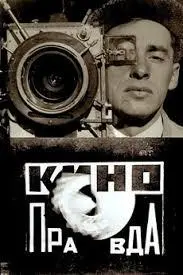
A definitive 6/10 rating for a film that redefined the boundaries of cult cinema. Kino-pravda no. 20 - Pionerskaia pravda remains a cornerstone of transgressive art.
To watch Kino-pravda no. 20 - Pionerskaia pravda is to witness the birth of a visual language that refuses to sit still. In the early 1920s, while the rest of the world was largely preoccupied with the theatricality of the silent era—films like The Honor of His House or the escapist charm of Be a Little Sport—Dziga Vertov was busy dismantling the very concept of the 'story.' He wasn't interested in the melodrama of The Faded Flower; he wanted the raw, unadulterated pulse of a nation in flux. This twentieth installment of his 'Film-Truth' series is a startlingly modern exploration of youth as a political engine.
Vertov’s 'Kino-Glaz' theory wasn't just a technical approach; it was an epistemological revolution. He believed the camera lens was superior to the human eye because it could be anywhere, see anything, and—most importantly—organize reality into a higher truth through montage. In Pionerskaia pravda, this philosophy manifests as a relentless series of jumps, cuts, and overlays. Unlike the linear progression found in Alias Mary Brown, Vertov’s structure is associative. He links the movement of a child’s hand to the turning of a gear, suggesting a symbiotic relationship between the individual and the state machinery.
The collaboration with Elizaveta Svilova cannot be overstated. Her editing provides the rhythmic backbone that prevents the film from devolving into chaos. While many contemporary films, such as The City of Masks, used editing to serve a pre-existing plot, Svilova uses it to generate meaning ex nihilo. The way she juxtaposes the Young Pioneers’ activities with the broader industrial landscape of the USSR creates a sense of inevitable progress. It is a far cry from the staged suspense of The White Masks; here, the tension arises from the sheer friction of the images themselves.
The subject matter—the Young Pioneers—is handled with a mixture of reverence and clinical observation. We see children engaged in various activities: exercising, reading, marching, and participating in the rituals of their organization. There is a palpable energy in these frames, a sense of a world being rebuilt from the ground up. This isn't the bourgeois leisure depicted in Queens Are Trumps; this is leisure as a form of preparation for labor. Vertov captures the earnestness of these children without the cloying sentimentality that often plagued Western films like Somebody Lied.
Mikhail Kaufman’s cinematography is equally revolutionary. He finds angles that defy the standard eye-level perspective of the era. By looking up at the children or down from dizzying heights, he grants the subjects a monumental quality. Even in a simple newsreel, the composition rivals the most expensive productions of the time, such as Der Mann ohne Namen - 1. Der Millionendieb. Kaufman’s lens doesn't just record; it interrogates. It seeks out the texture of the uniforms, the grit of the soil, and the clarity of the Russian sky.
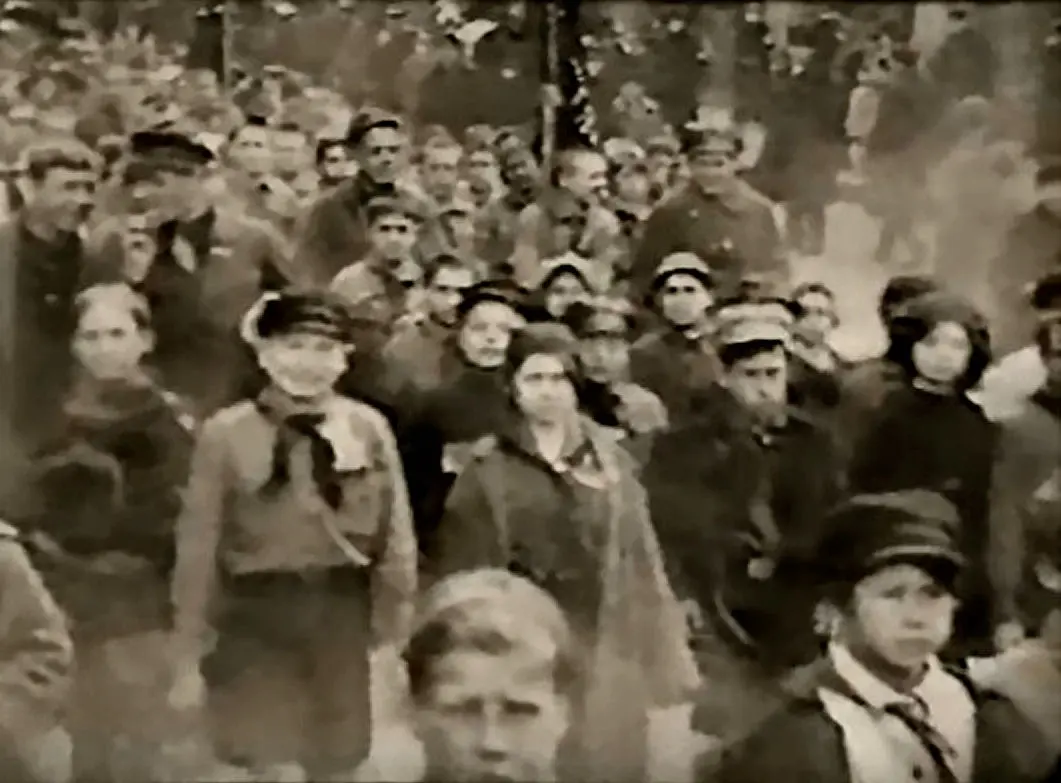
To appreciate Kino-pravda no. 20, one must contrast it with the global cinematic output of 1924. While Vertov was experimenting with the very fabric of time and space, other filmmakers were still perfecting the art of the gag or the drawing-room drama. Consider Once a Mason or Boman på utställningen; these films operate within a safe, established framework of entertainment. Vertov, conversely, is dangerous. He is attempting to reprogram the viewer’s brain, to make them see the 'truth' behind the veil of capitalist illusion. Even a film like The Torch Bearer, which carries its own weight of symbolism, feels static when compared to the hyper-kineticism of Kino-pravda.
There is also a fascinating dialogue to be had between Vertov’s work and the more somber, atmospheric pieces of the era. If During the Plague captures a sense of existential dread and stasis, Kino-pravda no. 20 is its antithesis—it is a film of movement, of 'becoming.' Similarly, while Winter Has Came might focus on the seasonal cycles of nature, Vertov focuses on the artificial, human-made cycles of the revolution. He is less interested in the natural world than in the world that humanity is building for itself.
One of the most striking elements of this specific newsreel is its obsession with mechanical precision. The Young Pioneers are often shown in formations that mimic the interlocking parts of a machine. This isn't a coincidence. Vertov was a proponent of the idea that humans should emulate the efficiency and reliability of technology. This aesthetic choice sets it apart from the more fluid, organic storytelling of La luz, tríptico de la vida moderna. Where La luz looks at modern life through a triptych of human experience, Vertov looks at it through a singular, mechanical lens.
The film’s use of intertitles is also noteworthy. They aren't just dialogue substitutes; they are graphic elements that interrupt the visual flow to hammer home a point. They function like slogans on a poster, reinforcing the film’s role as a tool for agitation and propaganda. Yet, even as propaganda, the artistry is undeniable. The sheer audacity of the camera placement and the speed of the cuts would influence everything from the French New Wave to modern music videos. It is a masterclass in how to use the medium to its fullest potential, regardless of the ideological baggage it carries.
Looking back at Kino-pravda no. 20 from a century’s distance, it remains a staggering achievement. It is a reminder that cinema was once a frontier, a place where the rules were being written in real-time. Vertov, Svilova, and Kaufman were not just documenting history; they were inventing a new way to perceive it. While the political structures they championed have long since crumbled or evolved beyond recognition, the 'Film-Eye' remains as sharp as ever. This is not a relic to be kept in a dusty archive; it is a living, breathing piece of art that continues to challenge our understanding of what a 'documentary' can be.
In a world now saturated with mindless digital content, the intentionality of Kino-pravda is refreshing. Every frame has a purpose. Every cut is a choice. It lacks the polish of a modern blockbuster, but it possesses a soul that is missing from much of today’s output. It is a testament to the power of the camera to not just mirror the world, but to change it. Whether you are a student of film history or simply a lover of visual storytelling, this film is essential viewing. It is the point where the camera stopped being a passive observer and became an active participant in the creation of reality.
IMDb 7.3
1925
Community
Log in to comment.