DbcultAccessing Vault...
7.4/10
Senior Film Conservator
A definitive 7.4/10 rating for a film that redefined the boundaries of cult cinema. In the Good Old Summer Time remains a cornerstone of transgressive art.
Is In the Good Old Summer Time worth watching today? Short answer: yes, but with significant caveats. This isn't a film you 'watch' in the conventional sense; it's a historical document, a pivotal moment in the evolution of cinema, and a foundational piece of interactive entertainment.
It is unequivocally for cinephiles, animation historians, and anyone fascinated by the nascent stages of sound film and audience engagement. Conversely, it is decidedly not for those seeking narrative depth, character development, or contemporary entertainment value. Approach it as an archaeological dig into film history, not a blockbuster.
Dave Fleischer's In the Good Old Summer Time exists less as a traditional film and more as a singular, audacious experiment. Released at a time when cinema was rapidly evolving from silent spectacle to synchronized sound sensation, this short stands as a testament to the Fleischer Brothers' relentless innovation. Their work, often overshadowed by their contemporaries, consistently pushed boundaries, and here, they didn't just add sound; they invited participation. It's a bold move, almost revolutionary in its simplicity, to turn the audience from passive observers into active participants.
The film's core concept — the 'follow-the-bouncing-ball' sing-along — is not merely a gimmick; it's a profound leap in understanding the potential of the cinematic medium. Before this, film was largely a one-way street. With Ko-Ko the Clown and Fitz the Dog, Fleischer introduced a communal, almost theatrical element that harked back to vaudeville but projected forward into an interactive future. This seemingly trivial innovation laid groundwork for everything from karaoke to modern video game quick-time events.
One could argue that the film's 'plot' is its very instruction. Ko-Ko and Fitz aren't characters in a story; they are facilitators, animated maestros conducting an unseen choir. Their movements, while simple by today's standards, are precisely timed to guide the audience, making them early examples of performance-driven animation designed for a specific, interactive purpose. It's an unconventional approach to storytelling, where the story is the shared experience itself.
Yes, absolutely, but understand its context. This film offers a unique window into early 20th-century entertainment and technological prowess. It’s a foundational piece, a historical curio that showcases ingenuity over narrative.
It works as an educational tool, illustrating the very beginnings of sound synchronization and audience interaction in cinema. It fails to engage modern audiences looking for complex narratives or high-definition visuals.
The direction by Dave Fleischer, while seemingly straightforward, is remarkably focused. Every frame serves the singular purpose of facilitating the sing-along. There are no superfluous shots, no lingering gazes; the camera is a direct conduit to the bouncing ball and the instructing characters. This laser focus, while limiting in scope, is precisely what makes the film effective in its intended goal. It’s a masterclass in functional filmmaking, prioritizing engagement above all else.
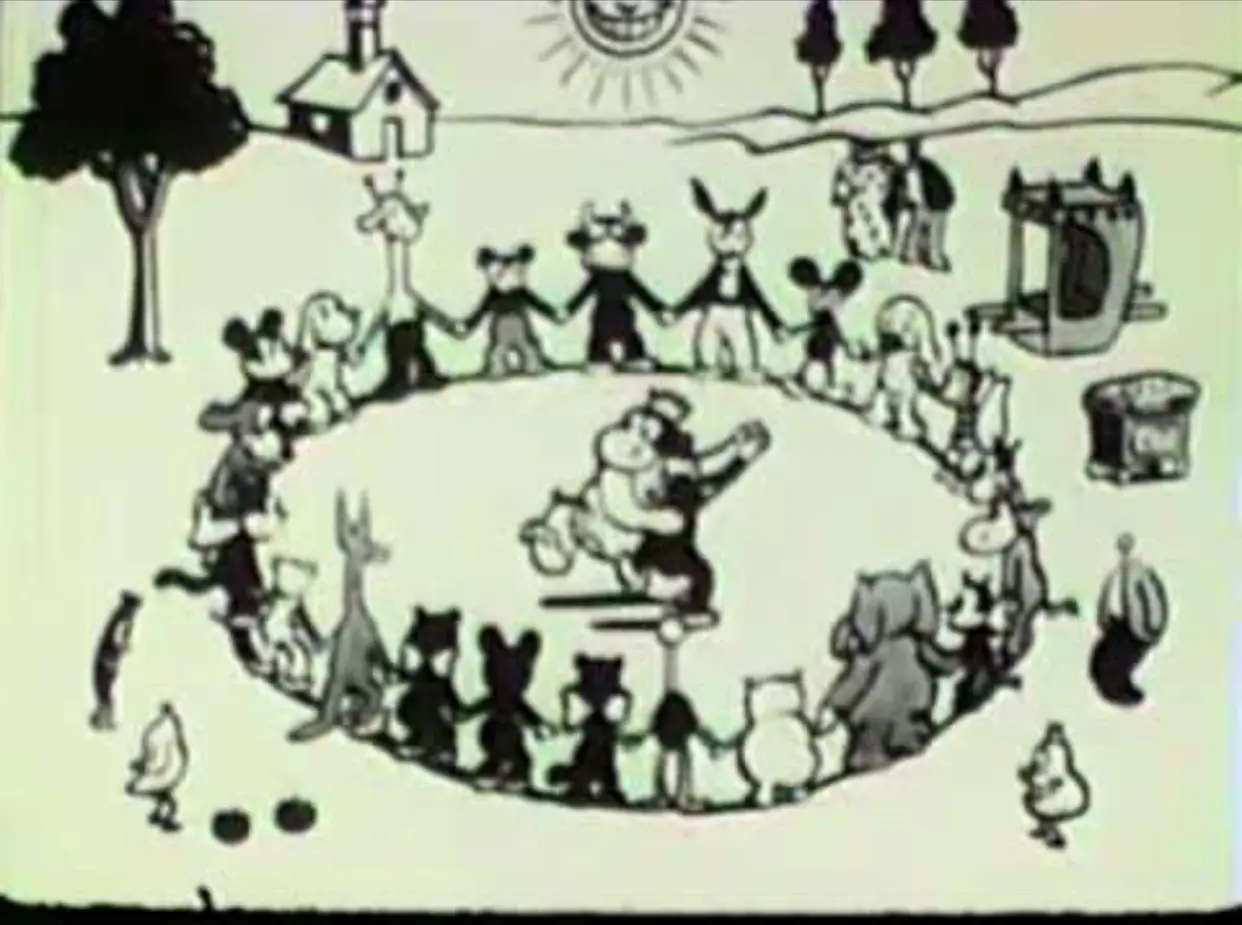
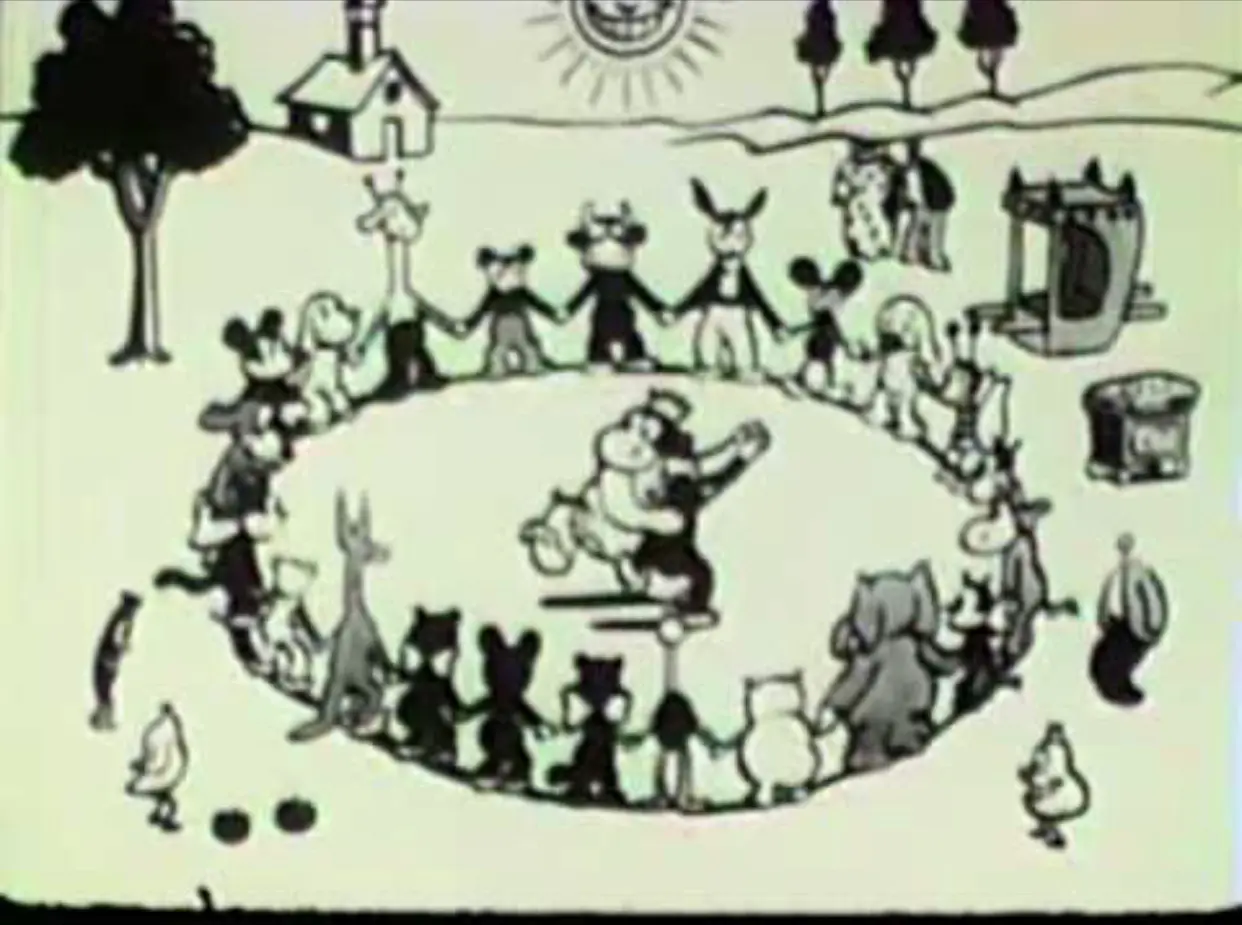
The animation itself, characteristic of the Fleischer style, possesses a unique charm. Ko-Ko, with his rubber-hose limbs and expressive face, is immediately engaging. Fitz the Dog, though less central, adds a layer of endearing companionship. These aren't just drawings; they are performers, their exaggerated movements and clear gestures acting as visual cues for the audience. The simplicity of their design belies the technical challenge of animating them in sync with a musical track, a feat that was groundbreaking for its time.
One might be tempted to dismiss the pacing as rudimentary, but it is, in fact, perfectly calibrated for its purpose. The song unfolds at a deliberate, sing-along friendly tempo, giving audiences ample time to read the lyrics and follow the ball. There's no rush, no frantic cuts; it's a comfortable, steady rhythm designed for collective participation. This intentional slowness, which might feel alien to a modern viewer accustomed to rapid-fire editing, is a deliberate choice that enhances the film's interactive nature.
The tone is undeniably lighthearted and inviting. There's an inherent warmth in Ko-Ko's guidance, a gentle encouragement that makes the audience feel welcomed into the experience. This isn't a challenging film; it's a comforting one, a communal hug delivered through the nascent technology of sound film. The very premise exudes an innocent joy, a stark contrast to the often dramatic or comedic narratives dominating cinema even then.
When discussing the writing for In the Good Old Summer Time, one quickly realizes its absence in a traditional sense. There's no script with dialogue, no intricate character arcs. The 'writing' here is the conceptualization of the interactive experience itself – the choice of a popular song, the strategic placement of the lyrics on screen, and the design of the bouncing ball's trajectory. It’s a form of functional writing, focused on utility and engagement rather than narrative flourish. This simplicity, far from being a flaw, is its strength, allowing the innovation to shine through unimpeded.
Similarly, the performances are entirely visual. Dave Fleischer, credited as the cast, embodies Ko-Ko and Fitz through his animation. He is the puppeteer, the voice, the actor. The 'acting' comes through the expressiveness of the animated characters, their ability to convey instruction and encouragement without uttering a word. Ko-Ko's subtle head tilts, his pointing finger, the way he seems to 'look' at the audience — these are all deliberate performance choices made by the animator. It's a fascinating early example of animation as performance, where the animator's hand is the actor's body.
Comparing it to a more narrative-driven Fleischer short, like parts of A Ghostly Night, highlights this difference. While both feature Ko-Ko, In the Good Old Summer Time strips away everything but the core interactive premise, proving that sometimes, less truly is more when pioneering a new format.
The cinematography, though rudimentary by today's standards, is critical to the film's success. The static, frontal shots are not a limitation but a deliberate choice to maximize clarity. The focus is always on the lyrics and the bouncing ball, ensuring that the audience's attention is guided precisely where it needs to be. There are no fancy camera movements or complex angles; instead, there's an unwavering commitment to legibility and direct communication. This pragmatic approach underscores the film's function over its form, prioritizing accessibility above visual flair.
The art direction, while minimalist, is effective. The simple backgrounds ensure that Ko-Ko, Fitz, and the lyrics remain the focal point. The choice of a clear, readable font for the lyrics and a highly visible bouncing ball (often a simple circle) demonstrates a deep understanding of audience engagement. It's a masterclass in design for purpose, where every visual element serves a clear, interactive function. There’s no attempt at realism, but rather a focus on functional abstraction, allowing the audience to project their own imagination onto the experience.
This film, much like early experiments with other interactive media such as the rudimentary choice-based narratives in The Wild Wild West, demonstrates a nascent understanding of how to break the fourth wall, even if it's just to get people to sing along. It's an early precursor to the immersive experiences we now take for granted.
Pros:
- Revolutionary for its time, establishing a new form of audience interaction.
- Offers invaluable insight into the early days of sound animation and cinema.
- Features the charming, iconic Fleischer animation style with Ko-Ko and Fitz.
- Demonstrates focused, functional direction and design.
- Its simplicity is its strength, making its innovation crystal clear.
Cons:
- Virtually no narrative or character development.
- May feel incredibly slow and uneventful to modern viewers.
- Its entertainment value is almost entirely historical, not contemporary.
- Repetitive by design, as it's a single song sing-along.
- Limited rewatchability for general audiences.
The true impact of In the Good Old Summer Time isn't in its ability to entertain a 21st-century audience on its own merits, but in its colossal influence. This film, and others like it from the Fleischer Brothers, didn't just add sound to moving pictures; they explored what sound could *do* in moving pictures. They saw beyond mere dialogue and sound effects, envisioning a world where film could actively solicit a response from its viewers. This is a profound, almost philosophical stance on the medium.
It's a foundational text for understanding the evolution of media. Without these early, seemingly simplistic experiments, the complex interactive experiences we enjoy today — from video games to virtual reality — might have taken a very different path. The bouncing ball, in its gentle, rhythmic descent, wasn't just guiding a song; it was charting a course for future engagement.
My unconventional observation: This film is arguably more 'interactive' than many modern blockbusters that merely demand passive consumption. It forces you to engage, to participate, to become a part of the cinematic event. In an age saturated with content, its demand for active involvement feels surprisingly fresh, a stark reminder of cinema's original, communal power.
I firmly believe its historical significance dramatically outweighs its entertainment value in a contemporary context. To judge it purely on modern metrics is to miss the point entirely. It's a time capsule, a blueprint, a moment of genius.
While In the Good Old Summer Time offers little in the way of traditional narrative or character-driven drama, its place in cinematic history is undeniable. It's a groundbreaking piece that pioneered interactive film, showcasing the Fleischer Brothers' innovative spirit and their understanding of the burgeoning power of synchronized sound. It works. But it’s flawed by modern standards.
For those who appreciate the evolution of film and the courage of early pioneers, this short is an essential viewing experience. It's a testament to the idea that even the simplest concepts can have the most profound and lasting impact. Don't expect to be enthralled by a gripping plot, but prepare to be fascinated by a pivotal moment in the story of cinema.
IMDb —
1933
Community
Log in to comment.