DbcultAccessing Vault...
Cult Review
Senior Film Conservator
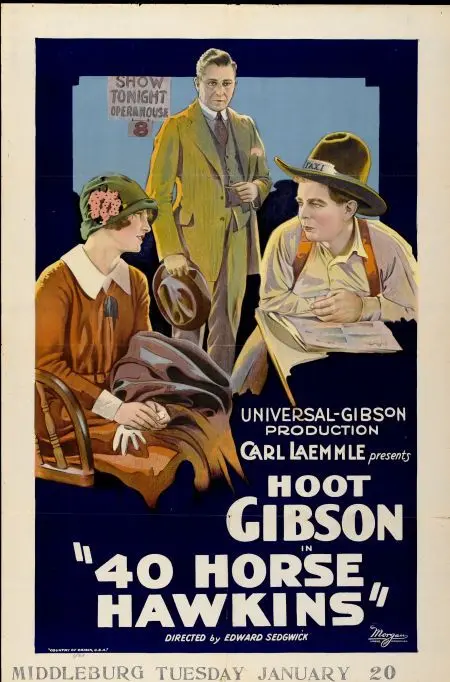
In the pantheon of silent cinema, the year 1924 stands as a testament to the medium's burgeoning maturity, a period where the raw kinetic energy of the early Western began to coalesce with the sophisticated narrative structures of urban drama. 40-Horse Hawkins, directed by the versatile Edward Sedgwick, serves as a fascinating specimen of this transitional era. It is a film that refuses to be pigeonholed, oscillating between the dusty verisimilitude of a frontier town and the high-stakes artifice of the New York stage. At its core, the film is an exploration of the 'honest man' archetype—a character whose fundamental decency remains uncorrupted even when thrust into the cynical machinery of metropolitan life.
The story introduces us to Luke Hawkins, portrayed with a characteristic blend of athletic grace and comedic timing by Hoot Gibson. Unlike the brooding outlaws seen in The Arizona Cat Claw, Luke is a 'jack-of-all-trades,' a man whose utility to the community of Lariat is matched only by his unassuming nature. This bucolic existence is shattered by the arrival of a traveling theatrical troupe, a group specializing in the 'mortgage melodrama'—a genre that was already becoming a nostalgic relic by the mid-1920s. The film uses this troupe as a meta-commentary on the nature of performance itself. Mary Darling, played with an effervescent charm by Anne Cornwall, represents the siren call of the wider world.
Luke’s infatuation is not merely romantic; it is an existential awakening. When he follows Mary to New York, the film shifts gears, adopting the 'fish-out-of-water' tropes that would later define much of American comedy. However, Sedgwick avoids the pitfalls of easy caricature. New York is not depicted as a den of iniquity, but as a complex, indifferent machine where Luke’s frontier skills are rendered both obsolete and uniquely valuable. This thematic tension is far more nuanced than the straightforward morality found in Not Guilty or the maritime adventures of Wonders of the Sea.
Hoot Gibson’s performance in 40-Horse Hawkins demands a re-evaluation of his status in film history. Often overshadowed by the stoicism of William S. Hart or the flamboyant acrobatics of Tom Mix, Gibson brought a relatable, almost modern sensibility to his roles. In this film, his physicality is redirected from the horse to the urban landscape. His tenure as a New York extra is a masterclass in subtle physical comedy. He isn't playing a clown; he is playing a man trying desperately to fit into a world whose rules are written in a language he doesn't speak. This performance shares a certain DNA with the character-driven stakes of Racing Hearts, where the protagonist's identity is inextricably linked to their environment.
The supporting cast, including the likes of Helen Holmes and Richard Tucker, provides a solid foundation for Gibson’s antics. Holmes, in particular, brings a gravity that anchors the more whimsical elements of the plot. The screenplay, co-written by Sedgwick and Raymond L. Schrock, displays a keen understanding of pacing. The transition from the slow-burn romance in Lariat to the frantic energy of the New York theater scene is handled with a dexterity that prevents the film from feeling disjointed.
The film’s resolution is perhaps its most poignant and structurally daring element. Luke, working as an extra in Mary’s failing new play, forgets the distinction between the stage and reality. When he sees Mary in distress—within the context of the play’s narrative—he rushes to her aid. This disruption, which should have been a catastrophic failure, is interpreted by the audience as a revolutionary piece of naturalistic acting. It is a moment of profound irony: the only way the 'fake' world of the theater can achieve success is through the intrusion of 'real' emotion.
This 'accidental hit' trope is a clever subversion of the typical success story. It suggests that the sophisticated audiences of the city are, in their own way, just as susceptible to the charms of the frontier as Luke was to the charms of the theater. This thematic resonance is missing from more conventional genre entries like Keith of the Border or the melodrama of The Crimson Gardenia. By making the climax about a misunderstanding of art, Sedgwick elevates the film from a simple romance to a sophisticated satire of the entertainment industry.
Visually, 40-Horse Hawkins utilizes the high-contrast lighting typical of the mid-20s, but with a specific focus on depth of field during the theater sequences. The camera captures the cavernous nature of the backstage area, making Luke look small and insignificant, a sharp contrast to the wide-open vistas of the Lariat scenes. The set design for the 'mortgage melodrama' within the film is intentionally garish, highlighting the gap between Mary’s professional world and Luke’s reality. It’s a visual strategy that reminds one of the atmospheric depths explored in Girl of the Sea or the psychological weight of Mortmain.
Furthermore, the editing during the final play sequence is remarkably modern. The cross-cutting between the oblivious actors, the confused director, and the increasingly enthusiastic audience creates a sense of tension that is rare for comedies of this period. It lacks the surrealist edge of Seein' Things, but it replaces it with a grounded, humanistic energy that is ultimately more satisfying.
While primarily a comedy, 40-Horse Hawkins touches upon the economic realities of the 1920s. The struggle of the theatrical troupe mirrors the real-world decline of vaudeville and touring theater in the face of the burgeoning motion picture industry. There is a sweet irony in a film depicting the salvation of a stage play, as the very medium of film was responsible for the theater's existential crisis. This layer of meaning adds a touch of melancholy to the proceedings, similar to the tonal shifts in Polly Ann or the social critiques found in Sauce for the Goose.
The film also addresses the concept of 'work' in a way that feels surprisingly contemporary. Luke’s willingness to take any job—from handyman to extra—reflects a blue-collar work ethic that was a staple of the American identity. His success isn't born of ambition, but of competence and heart. This stands in contrast to the more psychological or supernatural motivations seen in films like Ipnosi or the gritty realism of Outcast.
To watch 40-Horse Hawkins today is to witness a moment where cinema was discovering its power to bridge disparate worlds. It is a film that celebrates the sincerity of the provincial while acknowledging the magnetic pull of the cosmopolitan. Hoot Gibson’s Luke Hawkins is a hero for any age—a man who isn't afraid to look foolish if it means being true to his feelings. The film avoids the heavy-handedness of Love and Hate or the dark cynicism of Through the Dark, opting instead for a luminous, hopeful conclusion.
In the final analysis, Edward Sedgwick crafted more than just a Western-comedy hybrid; he created a timeless narrative about the transformative power of authenticity. 40-Horse Hawkins remains a vital, if under-appreciated, chapter in the story of American film, proving that sometimes, the best way to save the show is to simply be yourself.
IMDb 6.6
1934
Community
Log in to comment.