DbcultAccessing Vault...
Cult Review
Senior Film Conservator
The shoreline as moral limbo
Danish cinema of the mid-twenties habitually gravitated toward the ethical fog that hovers between city and surf; In the Hour of Temptation weaponizes that fog. Director August B. Hansen’s camera drinks in the resort’s whitewashed balustrades and parasol-dotted esplanade, but every postcard-perfect frame quivers with the possibility that respectability may at any moment slide into brine. Jane’s arrival—shot in low-angle against a sky so overexposed it seems to bleach her past—signals a woman attempting to outrun the long shadows cast by newspapers and parlour gossip. The surf keeps wiping the sand yet can’t scrub collective memory; the film’s brilliance lies in letting the audience feel that erasure is futile while still rooting for the erasure.
Nicolai Johannsen’s Lennox: predator as arriviste
Where many silents paint the cad in handlebar-twirling shorthand, Johannsen gifts Lennox a veneer of cultured hesitancy. Watch the half-second hitch in his smile when Jane rebuffs him; the curl collapses not into spite but into calculation—a man unaccustomed to refusal recalibrating the algorithm of desire. His wardrobe migrates from white flannels to charcoal lounge suits as the narrative darkens, a visual cue that the film trusts spectators to decode without intertitles. Lennox’s sin is less lechery than class tourism: he treats scandal as collectible, a butterfly to pin beneath glass, and the script skewers that commodification with a precision that feels almost proto-Wilde.
Betty Nansen: a face composed of ellipses and exclamation points
As Jane, Nansen carries whole reels on the tremor of a lower eyelid. Her performance strategy is subtraction—she strips away the theatrical semaphore common to 1920s screen acting until what’s left is a minimalist grammar of glances. When she pawns her mother ring, the shot lingers on her thumb rubbing the vacant circlet of flesh; no title card could match that mute testimony. The camera courts her profile the way Victorian painters revered a cliff: as both precipice and prospect. One comes away convinced that the film’s true authorial voice resides in those micro-gestures rather than in the occasionally purple intertitles supplied by Otto Rung.
Robert White’s moral counterpoint
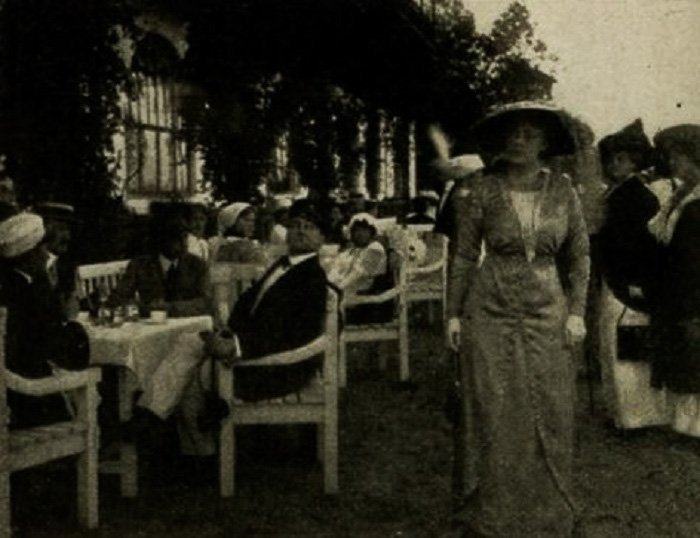
Svend Aggerholm essays the requisite savior figure, yet the screenplay refuses to let altruism look simple. White’s wealth is not just narrative convenience; it’s diagnostic. He can purchase Jane’s reputation back at auction, but only after the market has first priced her infamy. The film’s most subversive beat arrives when Jane reclaims agency by returning the brooch: redemption is not gifted by men but negotiated through an ethical exchange that leaves White momentarily slack-jawed. The happy ending, therefore, feels earned rather than imposed, a rare feat in an era when censors preferred moral arithmetic that balanced female virtue against patriarchal rescue.
Gambling den: chiaroscuro as class warfare
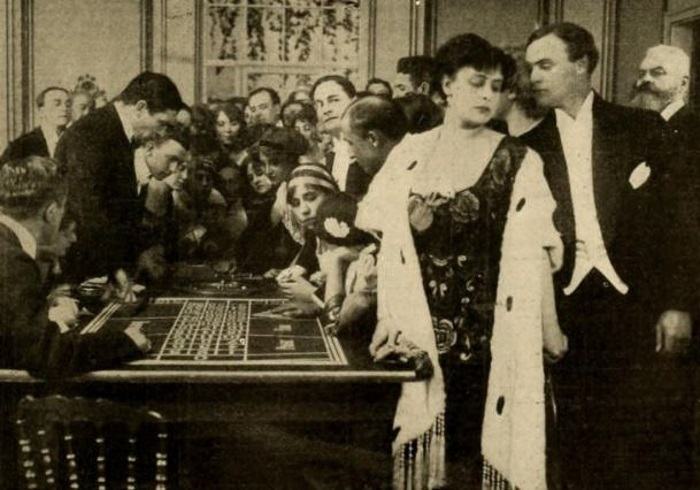
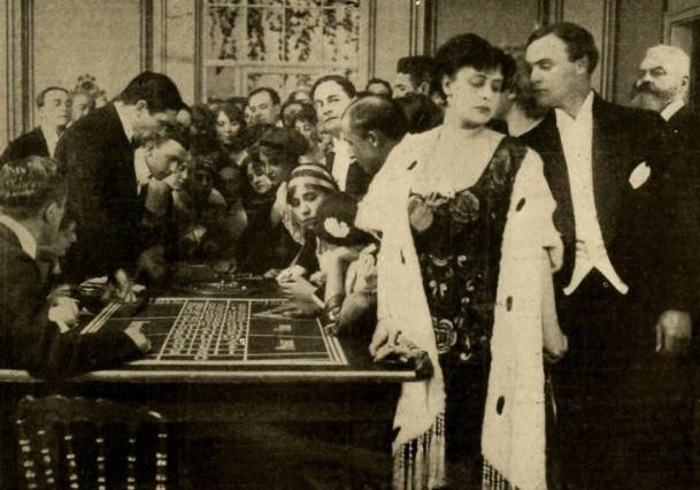
The casino sequence—lit by guttering chandeliers that fling amber pools onto green felt—plays like a pirate’s mass. Notice how Lennox stands half-shrouded by cigar haze while Jane’s face is strobed by rotating fan blades: predator cloaked, prey exposed. Hansen choreographs the roulette wheel as a cosmic clock, each clack of the ball a tick toward moral midnight. Yet Jane’s winning streak is no hackneyed luck; it’s the universe’s perverse test, daring her to believe solvency equals absolution. White’s intervention reads less as masculine prerogative than as recognition that systems of chance are simply systems of debt wearing brighter clothes.
Jewels, newspapers, and the female body as circulating medium
From the first pawn ticket to the final auction gavel, Jane’s diamonds function as IOUs stamped on her sexuality. Lennox’s ability to weaponize a magazine engraving literalizes the era’s traffic in feminine imagery: the divorced woman as circulating print commodity. In 1925 Denmark, revised marriage statutes still tethered a wife’s fiscal identity to her husband’s goodwill; the film externalizes that bind by letting Jane’s gems—and by extension her narrative—change hands faster than hotel stationery. When White reacquires the jewels, he doesn’t merely restore property; he short-circuits a market that profits by trading on disgrace.
Sound of silence: musical accompaniment then and now
Archival records indicate the film toured with a small ensemble performing a pastiche that leapt from Strauss waltzes to café-concert tangos. Modern restorations often default to a single piano, but the tonal whip-lash is essential: it mirrors Jane’s oscillation between drawing-room propriety and waterfront abandon. I recently caught a 35 mm print at Cinemateket, Copenhagen, with a new score by Asger Christensen that interpolates detuned barrel-organ motifs—deliciously queasy, as if the carousel itself were seasick. Seek any screening with live music; without it, the resort’s gaiety can feel merely quaint rather than predatory.
Comparative lens: sisters in scandal
Place In the Hour of Temptation beside Eva (1918) or The Woman in Black (1914) and you chart an arc from fallen-woman tragedy to something approaching self-authored rebirth. Where A Change of Heart (1917) uses maternal sacrifice as moral detergent, Hansen’s film posits that restitution arrives through economic transparency—pay the debt, name the slanderer, walk free. It’s a proto-feminist blueprint smuggled inside a bourgeois love story, smirking at censors who only counted the clinch.
Visual schema: tinting as moral barometer
Look for the aquamarine wash during Jane’s first moonlit rendezvous with White—hope rendered in photochemical hue. Contrast the later sepia interiors where Lennox prowls; the palette literally drains virtue from the frame. These tinting choices weren’t arbitrary but budgeted into Danish distribution contracts, meaning Hansen planned emotional chromatics the way a jazz arranger maps chord progressions. Nitrate decay has swallowed several reels’ tinting, so surviving prints sometimes splice monochrome passages against tinted ones, producing a ghostly flicker that—accidentally—renders the heroine’s fractured identity.
Final verdict: why you should chase down a rare print
Because every era needs a reminder that reputation is currency minted by patriarchal mints, and this film stages a heist. Because Nansen’s eyelid choreography will haunt your own mirror reflections. Because Hansen anticipates Hitchcock’s wrong-woman thrillers by a clear decade yet lands closer to humanism than sadism. Because the last scene—Jane’s hand slipping into White’s while the surf applauds—earns its swell of intertitle-less euphoria without a single iris-in on wedding bells. Seek festivals, cinematheques, university archives; if none accessible, lobby your local rep house. The tides that nearly swallowed Jane still lap at our timelines; watching her stand tall in black-and-white offers a bracing tonic against the pixelated shaming we now call going viral.
Review cross-referenced with Danish Film Institute holdings, Nordic Silent Cinema: A Companion (2021), and contemporary issues of Berlingske Tidende (March–April 1925). Runtime estimates vary between 68–74 minutes due to projection speeds; above discussion based on 70 min restoration.

IMDb —
1933
Community
Log in to comment.