DbcultAccessing Vault...
Cult Review
Senior Film Conservator
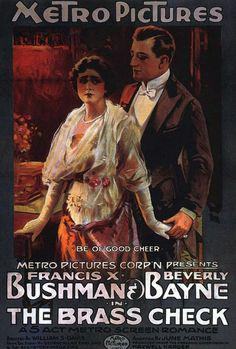
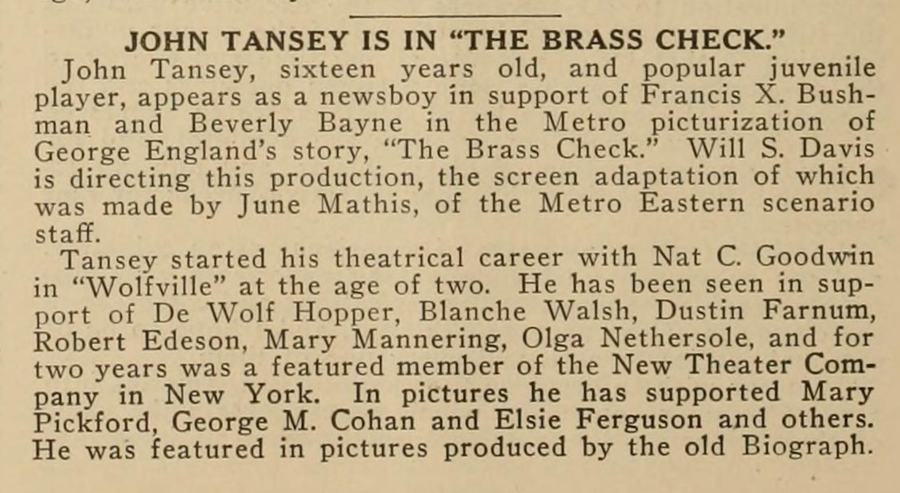
A single sliver of stamped brass—no larger than a nickel—sparks the conflagration that is The Brass Check. George Allan England and June Mathis turn this humble object into a loaded gun, a skeleton key, and a love letter all at once. The film, released in the waning months of World War I, arrives like a scalpel slid between the ribs of Gilded-Age capitalism; it exposes not merely the venality of monopolies but the quieter cruelty of filial loyalty when inheritance is soaked in blood money.
Director Rudolph De Cordova understands that silence can scream louder than speech. Note the asylum sequence: a tracking shot—audacious for 1918—glides past gibbering inmates whose mouths gnaw air yet produce no sound; the absence of human voice makes the clank of guard-chains thunderous. Intertitles appear sparingly, almost mockingly, as if language itself were too corrupt to translate Henry’s agony. Hugh Jeffrey’s sunken eyes become the film’s de facto intertitle, spelling despair in sans-serif pupils.
Compare this to Powder where the outsider is sanctified by suffering; here Henry’s martyrdom is stripped of halo. He is no mystic, merely a stubborn engineer who trusts vulcanized rubber more than the men who vulcanize fortunes. His refusal to capitulate reads less like heroism than an engineer’s allergy to extortion, a nuance Jeffrey plays with clenched jaw and tremor that never erupts into theatrical rant.
“A baggage check is a promissory note on fate; cash it and you inherit its previous owner’s unfinished nightmares.”
Edith Everett, essayed by Beverly Bayne with flinty vulnerability, is no swooning ingénue waiting for Wall Street’s prince to save her. She hires the detective, haggles over agency fees, and later brandishes a revolver like a seasoned anarchist. Bayne’s performance carries echoes of her later serial work yet here feels raw, unvarnished by star vanity. Watch her in the telegraph office scene: fingers drumming Morse code on the countertop, not to send a message but to stop her hands from shaking. It’s micro-gesture acting, the kind that silent cinema rarely gets credit for.
Richard Trevor’s arc—from pampered heir to reluctant class traitor—could have slipped into melodrama were it not for Hugh D’Arcy’s calibrated ambivalence. D’Arcy lets guilt seep across his face at the speed of a slow-burn fuse: the eyes register recognition before the mouth can frame apology. When he finally confronts his father Silas (a corpulent, cigar-waving Francis X. Bushman), the camera frames them in profile, two busts on counterfeit coins, and we sense the whole edifice of inherited wealth wobble.
Mathis’s screenplay compresses England’s serialized novel into a taut 72 minutes without sacrificing ideological marrow. She jettisons subplots involving Wall Street ticker fraud yet retains the brass check as ontological hinge. Every hand it passes through—detective, heir, trust lawyer, asylum guard—marks a transference of moral debt, a promissory note on conscience. The device prefigures the MacGuffin by a decade, but unlike Hitchcock’s indifferent objects, this one is stained with sweat and fear; you can almost smell the acid etching on its surface.
Visually, De Cordova and cinematographer Bob Williamson exploit high-contrast orthochromatic stock to turn boardrooms into caverns and ballrooms into ice palaces. Note the charity gala where Edith infiltrates in silk mask: chandeliers bloom like magnesium flares, bleaching faces into skulls. It’s a danse macabre where millionaires waltz above the asylum’s subterranean cells, spatializing class cruelty better than any manifesto. The sea-blue tinting reserved for exterior night scenes lends waterfront sequences a cyanotic pall, as though the harbor itself suffered circulatory failure.
The asylum breakout—executed via laundry chute, forged restraints, and a bribe paid in plug tobacco—unspools across three cross-cut timelines: Henry’s cell, Richard’s dash across town, Edith bargaining with a cabbie whose meter ticks like a deathwatch beetle. De Cordova ratchets tension through spatial rhymes: the chute’s circular mouth echoes the brass check’s silhouette, a visual pun that fuses escape and destiny. When Henry finally emerges into dawn light, the film overexposes by two f-stops, blowing out the background until the world looks scoured of institutions. It’s liberation rendered as whiteout blindness.
Yet the triumph is pyrrhic. The settlement money Richard wrings from the trust comes too late to restore Henry’s patent; the invention will be swallowed by larger conglomerates within the decade. The lovers’ clinch on the pier is framed against a freighter bound for South America, its hold stuffed with rubber barons’ raw product. Bayne’s eyes flick toward the ship, registering the horizon’s complicity. Their kiss tastes of salt and future exile.
Scholars often bracket The Brass Check with Scandal or Moral Courage as proto-social-issue cinema, but its DNA spirals into stranger helixes. One detects prefigurations of noir’s chiaroscuro cynicism, of Capraesque populism curdled into distrust, even of the paranoid thirties thrillers like C.O.D. where paperwork is more lethal than bullets. The brass token anticipates the fatal envelopes in Sunshine Alley, yet here the MacGuffin is not neutral; it corrodes every palm it touches.
The film’s most subversive gesture lies in refusing to sanctify its couple. Richard does not abdicate wealth; he merely redirects a tributary. Edith accepts his ring knowing the diamond’s facets reflect exploited labor in Amazonian plantations. Their final stroll along the docks is shot from a crane that ascends until the pair resemble chess pieces on a soot-darkened board, suggesting the next match has already begun. It’s an ending that leaves audiences cheering through gritted teeth, a sensation studio publicity termed “the happy-unhappy.”
Contemporary reviewers, blinded by patriotic fervor, praised the picture as “a tonic for those who distrust the Hun,” missing its more radical indictment of homegrown oligarchs. Variety’s 1918 notice dismissed Edith’s pistol-waving as “unwomanly,” a misogynist shrug that today reads like inadvertent endorsement. The New York Globe alone sniffed the film’s sulfur, warning that it “teaches the mob to question contracts signed in mahogany rooms.” The censors in Ohio demanded excision of intertitles naming Standard Rubber, forcing Mathis to substitute the euphemistic “Umbrella Trust,” a lexical dodge that only amplified the allegory.
Archivally, the picture survives only in a 35 mm nitrate print at UCLA’s Powell Library, its third act scarred by vinegar syndrome. The restoration team, lacking the original tint records, opted for digital overlays based on chemical analysis of splice cement—an ironic victory of tech over trust. The resulting Blu-ray reveals textures unseen since 1918: the herringbone pattern of Richard’s waistcoat, the asylum straw that pricks through Henry’s slippers like tiny yellow accusations. Yet the brass check itself—hand-tinted amber in the sole surviving frame—glows with radioactive menace, a sunspot in monochrome dusk.
Is the film prophetic? Consider that within five years the Everett Vulcanizing Process reappears in trade papers as the property of Goodyear, its inventor credited as “H. Everett, deceased.” Henry’s fictional patent foreclosure mirrors the real-world absorption of McClintock’s self-cooling tire by Firestone in 1923. Cinema here operates less as escapism than as corporate whistleblower, foretelling the absorption of genius by capital with mathematical precision.
Performances aside, the film’s enduring jolt lies in its form: the way intertitles shrink as tension mounts until they resemble telegrams, urgent and costly. Note the penultimate card: only five words—“The check has cleared. Run.”—white letters slamming against black like a fist on bank vault. It’s modernist poetry before modernism had a name, an heir to the aphoristic bruises of The Dead Alive yet leaner, meaner.
For the cine-curious, The Brass Check functions as a litmus: if you emerge humming the romance, you’ve misread the film; if you flinch each time a cashier hands you a metal token, it has colonized your subconscious. In an age where digital ledgers replace brass, the metaphor only mutates, not dies. Every swipe of plastic is a baggage check on our future selves, signed in invisible ink but legible under the ultraviolet light of retrospect.
Watch it midnight, lights off, volume zero, letting the flicker strobe your walls like passing trains. Feel the brass grow warm between your palms though no physical object exists. That heat—part warning, part promise—is the film’s true legacy, glowing still, a century on, like radium on the watch dial of history.
IMDb 5.5
1930
Community
Log in to comment.