DbcultAccessing Vault...
Cult Review
Senior Film Conservator
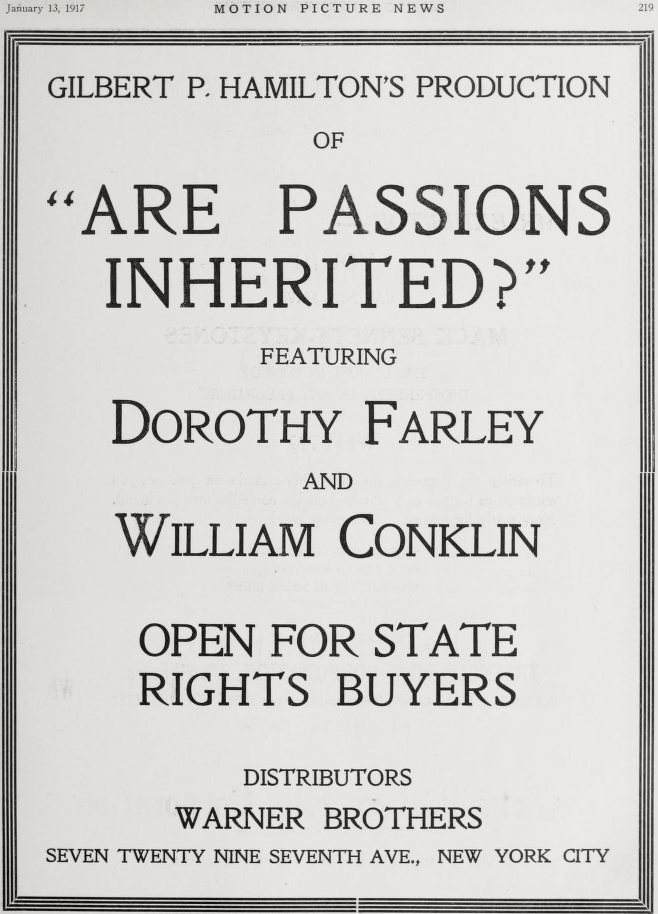
To witness Inherited Passions (1916) is to step into a temporal rift where the burgeoning language of cinema was still wrestling with its theatrical and literary ancestors. This isn't merely a relic of the silent era; it is a visceral, often startling exploration of the invisible threads that bind us to our lineage. While many modern viewers might associate Dot Farley with the slapstick antics of the Keystone comedies, here she undergoes a metamorphosis that rivals the best dramatic transitions of the decade. This film, directed with a keen eye for atmospheric tension, serves as a bridge between the simplistic morality plays of the early 1910s and the psychological complexity that would define the mid-silent period.
The involvement of Ella Wheeler Wilcox as a writer provides the film with a lyrical backbone that distinguishes it from contemporary potboilers like The Lost Express. Wilcox, known for her "Poems of Passion," infuses the narrative with a sense of fatalism that feels both romantic and terrifying. The script doesn't just present a sequence of events; it poses a philosophical question: can one truly outrun their blood? Unlike the more action-oriented Arizona, Inherited Passions focuses on the internal landscape of its protagonist. The collaboration between Farley, Wilcox, and Jack Wolf creates a synergy where the dialogue—conveyed through ornate intertitles—feels like an extension of the character’s soul rather than mere exposition.
Farley’s performance is a masterclass in silent-era subtlety. In an age where over-gesticulation was the norm, she utilizes her eyes to convey a haunting sense of displacement. She plays May not as a victim, but as a person under siege by her own history. We see echoes of this thematic struggle in The Red, Red Heart, yet Farley brings a specific, grounded vulnerability that feels strikingly modern. Her chemistry with William Conklin provides the film with its emotional anchor. Conklin, who often played the stoic patriarch or the refined gentleman, offers a performance of quiet dignity that contrasts sharply with the chaotic forces threatening to dismantle May’s world.
Technically, the film utilizes the limited resources of 1916 to create a claustrophobic atmosphere. The use of shadow and light—though primitive compared to the German Expressionism that would follow—nonetheless hints at the dual nature of the characters. The interiors are cluttered with Victorian remnants, symbolizing the weight of the past that the characters cannot escape. This visual density is reminiscent of Environment, where the setting functions as a character itself, dictating the moral boundaries of the inhabitants. The cinematography captures the texture of the era, from the heavy fabrics of the costumes to the dusty streets that represent the harsh reality outside the domestic sphere.
When we look at Inherited Passions alongside The Might of Gold, we see a fascinating dialogue about the corruption of the American dream. While the latter focuses on the external corruptive power of wealth, the former looks at the internal rot of reputation and lineage. Both films explore the fragility of social standing, but Inherited Passions is more concerned with the biological inevitability of character. It suggests that even the most pristine environment cannot fully insulate a person from the "passions" they have inherited. This thematic depth is what elevates the film above the standard melodrama of its time.
Beatrice Van and Marie Kiernan provide essential support, fleshing out a world that feels inhabited and lived-in. Van, in particular, delivers a performance that highlights the secondary tragedy of the film: the way women were often the collateral damage of patriarchal failures. The narrative doesn't shy away from the harshness of this reality. It shares a certain DNA with The Chorus Lady in its depiction of women navigating treacherous social waters, though it trades the stage-door glamor for a more somber, domestic grit. Frank Newburg also deserves mention for his role in the film's climax, providing a counterpoint to the deterministic gloom that pervades the first two acts.
As we dissect the film today, it serves as a fascinating sociological document. In 1916, the debate over "nature vs. nurture" was reaching a fever pitch in the public consciousness. Inherited Passions doesn't offer easy answers. By the time the final reel spins to its conclusion, the audience is left not with a sense of total resolution, but with a lingering question about their own autonomy. It lacks the simplistic optimism found in Cheerful Givers, opting instead for a bittersweet recognition of the scars we carry. The film's pacing, while slow by modern standards, allows the weight of the drama to accumulate, much like the way a family secret festers over generations.
One cannot help but compare the narrative tension here to The Fatal Ring, though where that film relies on serial thrills, Inherited Passions relies on the slow-burn of emotional reckoning. It is a film that demands the viewer's full attention, rewarding them with a rich, albeit dark, cinematic experience. The collaborative writing effort between Farley, Wilcox, and Wolf ensures that every scene is saturated with meaning, every glance heavy with the history of the characters.
For those who find themselves lost in the digital sheen of contemporary cinema, returning to the grainy, nitrate-soaked world of Inherited Passions is a necessary recalibration. It reminds us that the core of cinema has always been the human face and the eternal struggle between who we are and who we are expected to be. The film stands as a testament to Dot Farley’s versatility and Ella Wheeler Wilcox’s enduring influence on early American narrative structure. It is a somber, beautiful, and intellectually stimulating piece of art that deserves its place in the pantheon of early dramatic cinema. Whether you are a scholar of the silent era or a casual fan of historical drama, this film offers a profound look at the ghosts that haunt our DNA.
Note: This film provides a stark contrast to the procedural elements of Detective Brown and the urban isolation depicted in Alone in London, showcasing the breadth of storytelling available to audiences in the mid-1910s.
IMDb —
1927
Community
Log in to comment.