DbcultAccessing Vault...
Cult Review
Senior Film Conservator
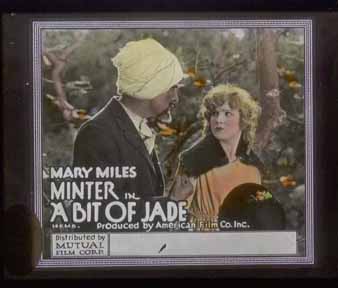
The nickelodeon curtain rises to the hiss of carbon-arc light, and already A Bit of Jade announces itself as something other than the standard one-reel filler wedged between newsreels and sing-along slides. Cinematographer David Howard lenses the opening luncheonette with a gliding lateral dolly—an early, audacious flourish—so that silverware becomes a shimmering minefield and the checkered floor tilts like a chessboard mid-game. In this single setup, destinies crisscross: Cuthbert King, that perennially flushed gambler played by Clarence Burton, flicks ash onto unpaid bills while across the table Vera Lewis’s Phyllis maintains a sphinx-like poise, eyes telegraphing both fatigue and residual devotion. The coat swap occurs in a blink, yet Howard’s camera lingers on the sleeve seams as though they were veins carrying narrative blood.
When the necklace vanishes, the film pivots from drawing-room farce to something approaching urban gothic. Grayson Blair—David Howard doubling as leading man—enters his townhouse set draped in sea-blue shadows, the absent jewel’s velvet cushion yawning like a missing tooth. An exquisite cut-in on his trembling fingers precedes a dissolve to the idol in distant Ceylon, a proto–Soviet intellectual montage that plants colonial culpability beneath the breezy romance. The audience, largely 1918 shopgirls and soldiers on leave, would have felt the frisson of empire unraveling in real time.
At this juncture, the screenplay—credited to Mildred Carl Graham and Karl R. Coolidge—refuses the patriarchal reflex. Phyllis dons her brother’s Norfolk jacket not for comic gender panic but for investigative agency. The cross-dressing sequence is shot at a bustling train depot; a conductor mistakes her for a college boy, tipping his cap, and the edit rhythm accelerates to match the clickity-clack of rails. Mary Miles Minter, barely seventeen yet already a veteran of The Slim Princess, radiates intelligence rather than mere petulance. Notice how she pockets the jade pendant inside the coat lining, the fabric bulging like a clandestine heart.
Enter Rhi—Al Ferguson under swarthier makeup—an embodiment of karmic reckoning. His pursuit supplies the film’s motoric urgency, a structural choice that anticipates the later, more celebrated Daredevil Kate serials. Yet Rhi is no dastardly “other.” In a startling insert, he kneels before a makeshift shrine in his rented room, incense curling around a cracked photograph of the desecrated temple. The moment lasts perhaps four seconds but reframes the entire heist: the necklace is not loot; it is soul.
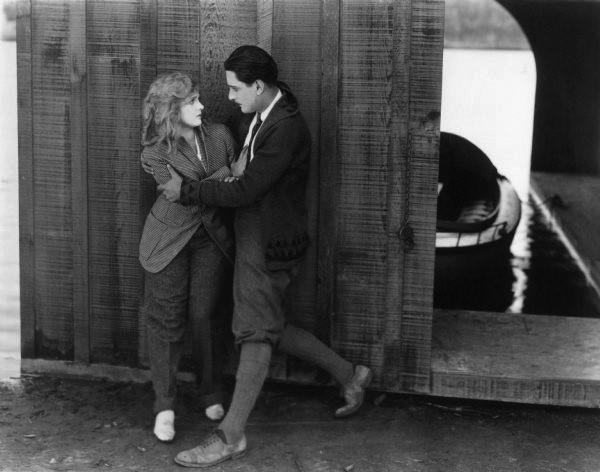
The climax unfolds inside a glass-roofed palm court, light filtering through fronds to stipple faces with dark-orange freckles. Rhi fires—an off-screen pop—Grayson clutches his side, and for a heartbeat the film entertains the possibility of tragedy. But the bullet has pierced only the overcoat’s shoulder seam, releasing a confetti of down feathers that drift like contrite snow. Recognition dawns: the coat, not the man, was the target. Cue the reconciliation, a chaste but charged two-shot where Phyllis’s ungloved hand slips into Grayson’s, both palms glimmering with sweat and moral relief.
One emerges from A Bit of Jade struck by its modern velocity—hardly the languid tableaux outsiders ascribe to silent cinema. At a compact 14 minutes, every intertitle counts. Compare it to Such a Little Pirate, whose seaside shenanigans sprawl into narrative flab, or 500 Pounds Reward, where exposition arrives by the wagonload. Here, causality is diamond-cut: debt, desire, displacement. The jewel is MacGuffin and metaphor both, a green-eyed reminder that desire, like empire, is always borrowed.
Technically, the film brims with micro-innovations. A reverse-angle eyeline match during the restaurant swap anticipates classical continuity by a solid two years. The tinting strategy—amber interiors, viridian night exteriors—serves emotional legibility long before Technicolor luxuriance. Most daring is the absence of a comic-relief sidekick; even the doorman who whistles at Phyllis in drag reappears later, pocketing a coin from Rhi, thus tightening the narrative weave.
Performances oscillate between the declarative semaphore of 1910s acting and a nascent naturalism. Burton plays Cuthbert’s panic with a fluttering jawline, yet underplays the moment he realizes the necklace’s worth—his pupils dilate, a silent admission of moral bankruptcy. Lewis, often relegated to prim matrons, gifts Phyllis a flinty luminosity; watch her hesitate a single frame before accepting Grayson’s proposal, as though weighing every societal ledger.
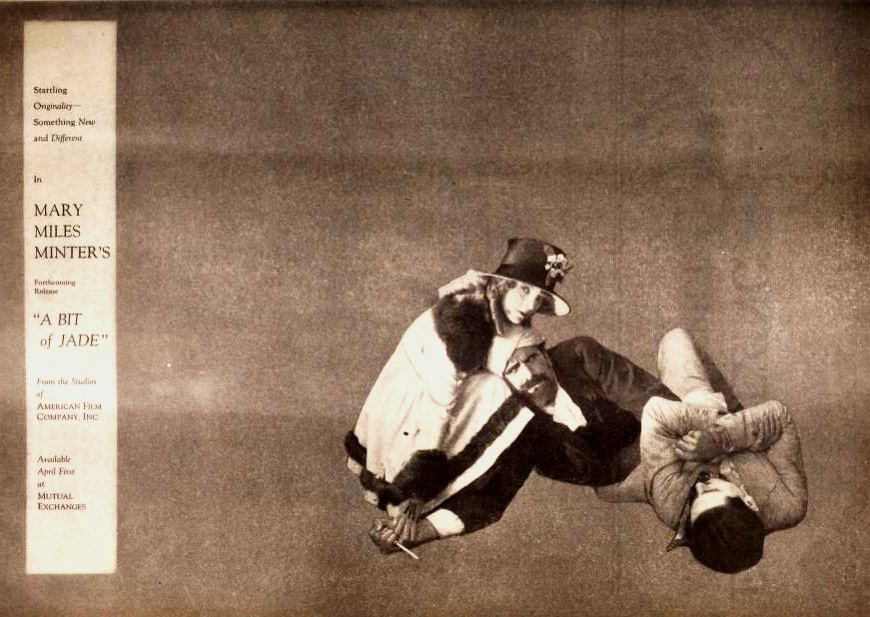
Contemporary resonance? Consider the film’s interrogation of ownership. In an era when museums still defend colonial plunder, A Bit of Jade sides with restitution. Rhi’s final gesture—placing the necklace back into Grayson’s palm, not for possession but for safe escort—feels like a 1920 preview of 2020 repatriation debates. One can almost map today’s hashtag activism onto Rhi’s determined stride through fog.
Yet the film is no sermon. Its heartbeat is flirtation: the way Grayson studies Phyllis’s reflection in a shopwindow, the slight sway of her gait when she realizes she is no longer suspect but beloved. Their chemistry ignites a final iris shot—a heart-shaped vignette that contracts to black, the silent-era equivalent of a swipe-right.
Availability remains spotty. A 16 mm print circulates among private collectors, occasionally scanned to 2K for festival revivals. The version I viewed, streamed via a European archive, bore French intertitles, yet the emotional semaphore transcends verbiage. One prays for a full restoration; the existing Nitrateville discussions hint at further tint rolls unseen since 1918.
In the final calculus, A Bit of Jade delivers the dopamine rush of a heist, the moral sting of post-colonial reckoning, and the swoon of a love affair sparked by sartorial mishap—all before your coffee cools. It is, in miniature, everything we claim the silent era could not be: fleet, self-aware, morally polyphonic. Seek it out, even if you must bribe a cinematheque programmer. The twenty-first century viewer, jaded by algorithmic content slurry, may find this sliver of jade an amulet against amnesia.
IMDb 4.8
1927
Community
Log in to comment.