DbcultAccessing Vault...
4.9/10
Senior Film Conservator
A definitive 4.9/10 rating for a film that redefined the boundaries of cult cinema. Introductory Speech by Will H. Hays remains a cornerstone of transgressive art.
Is a nearly century-old introductory speech, devoid of narrative or dramatic arc, worth watching today? Short answer: absolutely, but not for the reasons you might think. This isn't entertainment in the conventional sense; it's a profound historical document, a direct portal to the moment cinema found its voice. It’s a vital piece for anyone fascinated by the mechanics of artistic evolution, but utterly unsuitable for those seeking a traditional cinematic experience.
This film works because it captures the precise inflection point where an entire art form pivoted. It fails because, as a standalone piece, it offers little in terms of dramatic engagement or visual artistry. You should watch it if you possess a deep appreciation for film history, technological innovation, or the sheer audacity of an industry leader heralding a paradigm shift.
To truly appreciate the Introductory Speech by Will H. Hays, one must first understand the cinematic landscape of 1926. For three decades, film had been a silent art, a universal language communicated through gesture, expression, and intertitles. The industry, by and large, was comfortable in its quietude, having perfected the visual narrative to an astonishing degree. Yet, beneath this placid surface, a technological tremor was brewing: sound was coming, and it promised to upend everything.
Will H. Hays, as President of the Motion Picture Producers and Distributors of America (MPPDA), was more than just a figurehead; he was the industry's public face, its moral compass (self-appointed, perhaps), and its chief strategist. His role in this short film, therefore, transcends that of a mere speaker. He is the herald of a new era, tasked with convincing a skeptical public and an even more skeptical industry that sound was not a gimmick, but the future.
The significance of this moment cannot be overstated. It wasn't just about adding sound; it was about fundamentally altering the creative process, the distribution model, and the very experience of moviegoing. The introduction of Vitaphone, accompanying the premiere of Don Juan (1926), wasn't just a technical demonstration; it was a declaration of intent from Warner Bros. and, through Hays, the wider industry. It signaled a willingness, however reluctant for some, to embrace the unknown.
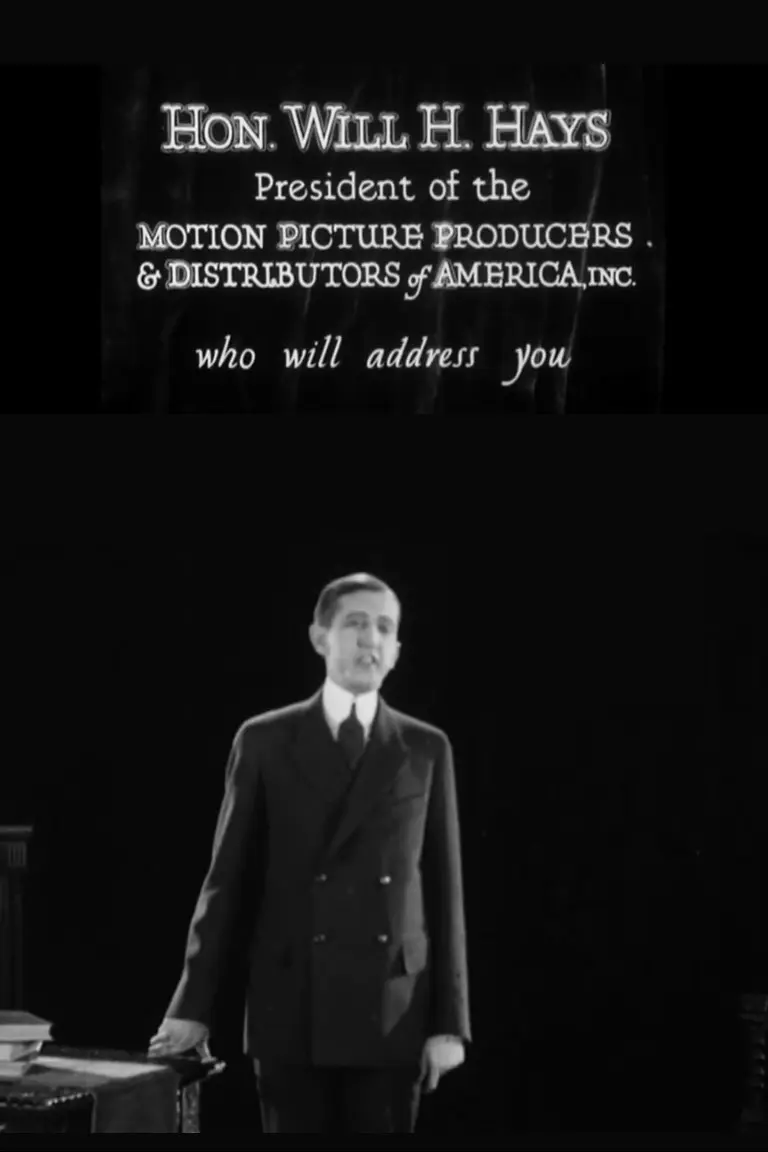
While not an actor in the traditional sense, Hays delivers a performance here that is crucial to the film's historical weight. His presence is authoritative, his voice clear and measured, projecting an air of unwavering confidence. This isn't the bombast of a showman; it's the gravitas of a statesman introducing a new policy, a new world order.
His delivery is surprisingly natural for the time, avoiding the theatrical over-articulation often associated with early sound recordings. He speaks directly to the audience, making eye contact with the camera, a technique that immediately establishes an intimate connection. This was vital. For audiences accustomed to the silent film aesthetic, hearing a disembodied voice from the screen was a novel and potentially jarring experience. Hays’s calm, reassuring tone served to bridge this gap, normalizing the miraculous.
One could even argue that Hays's 'acting' here is a masterclass in public relations. He doesn't just explain Vitaphone; he sells the dream of it, positioning sound as a natural evolution rather than a radical departure. His rhetoric is carefully chosen, emphasizing continuity and enhancement rather than outright revolution, which was a clever psychological play to ease anxieties within the industry and among purist cinephiles.
The Vitaphone system itself, a synchronized sound-on-disc technology, was a marvel of its age. For the first time, audiences could hear music, sound effects, and, crucially, spoken dialogue emanating directly from the screen. This short provides a raw, unfiltered look at the technology's nascent capabilities. The sound quality, while primitive by modern standards, was revolutionary for 1926. It was a cacophony of clarity after decades of silence.
The immediate impact was visceral. Imagine sitting in a darkened theater, accustomed to the gentle rustle of a live orchestra or the clatter of a piano, suddenly hearing a human voice, amplified and perfectly synchronized with the moving image. It must have been nothing short of electrifying. This wasn't just a gimmick; it was the unlocking of a new dimension for storytelling, a promise of deeper immersion and richer character development.
Yet, the peril was equally apparent. The industry faced immense challenges: converting theaters, retraining personnel, adapting storytelling techniques, and overcoming the inherent limitations of early sound recording. Vitaphone, despite its initial success, eventually gave way to sound-on-film technologies like Movietone and Photophone due to synchronization issues and wear and tear on discs. This short, therefore, captures not just the dawn of sound, but also the brief, shining moment of a specific, pioneering technology.
The introduction of sound, as heralded by Hays, fundamentally reshaped the aesthetics of cinema. Directors could no longer rely solely on visual cues; they had to learn to compose for the ear as well as the eye. Actors, many of whom had perfected their craft in the silent era, faced the daunting task of adapting their highly expressive, often exaggerated, performances to the more naturalistic demands of spoken dialogue. Many careers were made, and many were irrevocably broken, by this shift.
My unconventional observation here is that Hays's speech, in its very static nature, inadvertently highlighted the initial awkwardness of early sound cinema. The camera is fixed, capturing a talking head. This early limitation, born of cumbersome equipment and a nascent understanding of sound mixing, would ironically define the 'talkies' for several years, leading to a temporary regression in visual dynamism compared to the fluid camera work of late silent films like The Last Laugh. It was a step forward in one dimension, and a step back in another, for a time.
This short is a testament to that complex transition. It’s a snapshot of a moment where the industry, represented by Hays, was trying to navigate uncharted waters, promising a future that was both thrilling and terrifying. The very act of watching this speech reminds us that technological progress in art is rarely a smooth, linear ascent; it's a series of bold experiments, sometimes clumsy, often brilliant.
Yes, for specific audiences. It is an indispensable historical artifact.
This 'film' offers a direct, unvarnished look at a pivotal moment in film history.
It's a testament to the courage and foresight of early cinema pioneers.
However, it provides no narrative entertainment or traditional cinematic pleasure.
It serves as a primary source for understanding the transition from silent to sound.
This is not a film to enjoy; it is a film to study.
The 'pacing' of this short is dictated entirely by Hays's speech, which is deliberate and measured. There are no frantic cuts, no dramatic shifts in perspective. The camera remains static, framing Hays in a medium shot, allowing his words and his dignified demeanor to take center stage. This choice, while seemingly simplistic, was strategic. It placed the emphasis squarely on the novelty of synchronized sound, rather than distracting with complex visuals.
The 'directing,' if one can call it that, is minimalist. The focus is on clarity and fidelity of sound transmission. The visual composition is clean, functional, and serves the primary purpose of presenting Hays as a credible, trustworthy figure. The lighting is straightforward, illuminating Hays without dramatic flair, underscoring the serious, business-like nature of the announcement. It’s a presentation designed for information, not artistic flourish.
The tone is one of measured optimism. Hays acknowledges the past achievements of silent film while confidently pointing towards a future enriched by sound. It’s a delicate balance, avoiding both triumphalism and condescension towards the silent era. This rhetorical balancing act was crucial for an industry still grappling with the implications of such a radical shift. It works. But it’s flawed in its visual ambition, or lack thereof.
The true legacy of this short film extends far beyond its immediate impact. It’s a powerful reminder that innovation often begins with a single, clear declaration. Without Hays's confident introduction, without the technological leap represented by Vitaphone, the cinematic landscape we know today would be fundamentally different. It's a foundational text in the history of media, teaching us about the intersection of technology, business, and art.
It also offers a fascinating insight into the power of public relations in shaping cultural shifts. Hays wasn't just a spokesman; he was an advocate, a persuader, using the nascent power of sound film to champion sound film itself. This meta-narrative — a film about film, using new technology to announce new technology — is an often-overlooked aspect of its brilliance. It’s a self-referential moment that perfectly encapsulates the industry's self-awareness and its drive for progress.
My strong, debatable opinion is that this short is more significant than many critically acclaimed feature films of its era, simply due to its profound historical consequence. While films like The Test of Honor or The Prince Chap offered entertainment, Hays’s speech offered a blueprint for the future. It’s a historical cornerstone that continues to resonate, even if its immediate viewing experience is academic rather than entertaining.
The Introductory Speech by Will H. Hays is not a film to be enjoyed in the conventional sense, but a crucial document to be studied and revered. It’s a static, yet profoundly dynamic, moment frozen in time, capturing the industry's pivot from silence to sound. While it offers no thrills or tears, its historical weight is immeasurable. It’s the sound of a revolution beginning. Essential viewing for anyone serious about cinema's past.

IMDb 6.2
1931
Community
Log in to comment.