DbcultAccessing Vault...
Cult Review
Senior Film Conservator
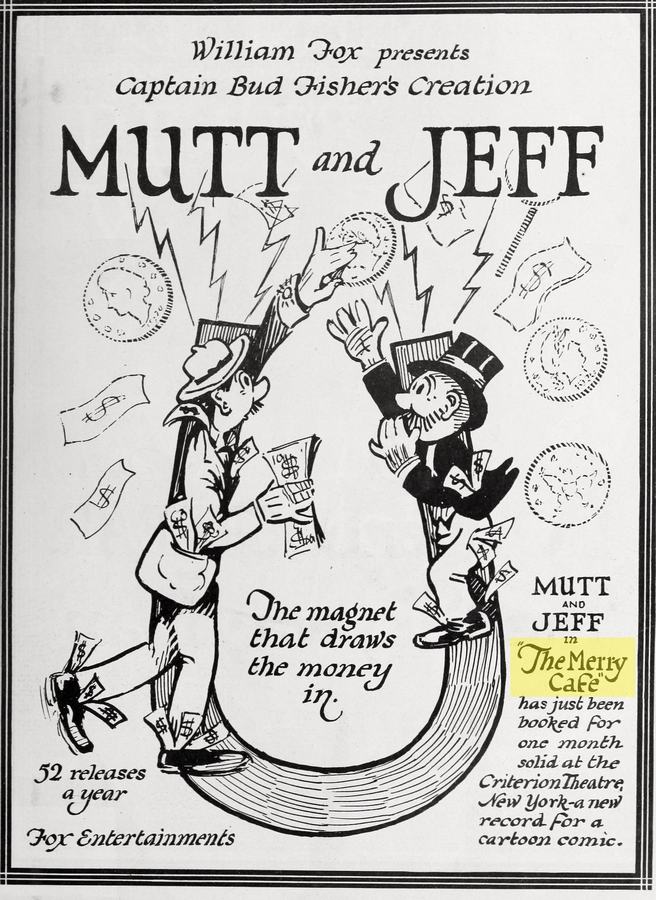
Bud Fisher’s The Merry Cafe is less a narrative than a caffeine trance committed to nitrate, a nickelodeon striptease that peels away the pretense of Edwardian propriety until nothing remains but the jittery id of a nation discovering both jazz and jitters.”
Few one-reelers dare to be this drunk on their own carbonation. Fisher, better known for Mutt & Jeff’s newspaper mischief, tosses sequential art’s panel logic into the espresso steamer, letting time itself foam and overflow. The result is a film that refuses to behave: frames stutter, characters pirouette out of their own silhouettes, and intertitles arrive like telegrams from a prankster deity who lost his train of thought halfway through typing.
Forget plot curves; Fisher doodles spirals. A nameless waiter—all elbows and unrequited sighs—skids across checkerboard linoleum, clutching a silver pot whose spout leaks not coffee but liquid yearning. Each splash crystallizes into tiny, shimmering hearts that evaporate before they hit the floor, a visual pun on the ephemerality of desire. Meanwhile, the flapper at table three splits into triple-exposure doppelgängers who blow bubblegum universes at the camera lens. One bubble bursts and out tumbles a microscopic Keystone Kop, forever chasing a criminal who is also himself. Surreal? Sure. Yet Fisher grounds the hallucination in tactile detail: a flypaper strip twitching with captive gnats, the sour clank of spoons, the way starched collars wilt under café steam.
Comparative minds might recall Charge It to Me with its department-store delirium, but where that film treats consumerism as slapstick symptom, The Merry Cafe diagnoses caffeine as America’s new civic religion. The titular café is a proto-Starbucks stained by the percolating anxieties of 1915: war jitters, women’s suffrage, the death of local saloons under temperance zeal. Fisher doesn’t moralize; he percolates. Every gag is a burlesque referendum on modernity, and the audience is both electorate and punchline.
Mid-film, Fisher stages a set-piece that ought to be studied in physics departments. The espresso machine, hitherto background artillery, begins to inhale—first steam, then sound, then the very photons composing the frame. A vortex of black-and-white grains swirls toward its brass belly until the café becomes an inverted cosmos: the machine’s boiler a white dwarf, the counter a spiraling galaxy of napkins. Our waiter plunges his arm into this maelstrom and retrieves—what else?—a tiny porcelain cup containing a perfect, unrippled surface of coffee. He presents it to the flapper; she attempts to sip; the liquid leaps out and slaps her suitor across the cheek with a wet, comic crack that you can almost hear even in silent projection. The entire gag lasts maybe four seconds yet distills cinema’s core promise: matter transformed into metaphor, physics into farce.
Acting in 1915 shorts is usually semaphore: eyebrows semaphore panic, mustaches semaphore villainy. Fisher’s troupe, however, performs like jazz soloists who’ve memorized each other’s riffs only to misplace them on purpose. The waiter's knees operate on a private contract with gravity; his co-worker, a portly cook sporting a chef’s toque the size of a baptismal font, uses his belly as a sliding surface for plates, launching them airborne with the nonchalance of a card shark. The flapper—played by an uncredited comedienne whose kohl-smudged eyes rival Theda Bara’s—delivers eye acting worthy of a Dreyer close-up: one wink can fracture the fourth wall, two winks can birth a subplot, three and the camera itself seems to blush.
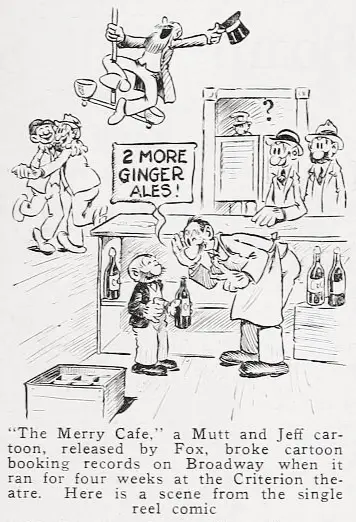
This is performance as kinetic typography: bodies form exclamation points, collapse into ellipses, pirouette into parentheses. The result feels closer to contemporary TikTok absurdism than to, say, The Red Viper’s melodramatic moral algebra. Yet the anarchy is rigorously timed; every pratfall lands on a downbeat that the orchestra of unseen piano would envy.
Surviving prints—mostly 9.5 mm Pathé collections—carry the scars of a century: water stains bloom like brown mountains, emulsion scratches swirl like cream. Rather than marring the film, these blemishes collaborate with Fisher’s caffeinated surrealism. The scratches become the ghosts of last night’s grounds, the stains a cartography of spilled addiction. One reel I viewed at MoMA had a section where the image warped vertically, elongating the actors into Giacometti shadows; the effect turned a simple gag (a collapsing stack of cups) into a metaphysical plunge. Nitrate decay as auteur? Perhaps. But Fisher’s comic velocity is so relentless that decay itself becomes another performer—an aging clown stumbling through the spotlight, milking applause from catastrophe.
Silent cinema denies us the hiss of espresso, the clink of spoon against porcelain. Yet Fisher’s montage rhythms conjure phantom audio: the percussive thwack of a falling tray, the whoosh of steam, the pop of bubblegum universes. During private screenings I find myself involuntarily supplying foley—tongue-clicks for clattering saucers, breathy whistles for steam. This participatory synesthesia is the film’s secret addiction; it colonizes the viewer’s body like caffeine metabolizing into jitters. You leave the screening room ears ringing with sounds that never existed.
While other 1915 shorts—see The Bride of Hate—treat women as stoic martyrs or femme fatales, Fisher’s flapper is caffeine incarnate: restless, effervescent, politically slippery. She commandeers the waiter’s tray, repurposes it as impromptu skateboard, and grinds a rail of counter-edge before any 1990s skate punk could claim invention. Her sexuality is not a commodity to be bartered but a propulsive force that unmakes the café’s patriarchal geometry. When the waiter finally proposes—via a cream heart drawn on saucer—she responds by sipping the cream, belching out a smoke ring shaped like a question mark, and exiting through the window, leaving both him and the film in caffeinated ellipsis.
The film’s governing trope is that no one ever drinks the damn coffee. Cups are flung, sipped, slapped, vaporized, yet the ideal brew remains perpetually deferred—an object of desire always already spilling. Call it commodity Marxism in a demitasse, or call it the human condition jitterbugging in a grease-spangled apron. Fisher anticipates both Beckett and Crime and Punishment’s guilty conscience: the longer we wait for the sip that will deliver us, the more we drown in the foam of our own anticipation. The final shot literalizes this: the camera dollies back to reveal the café is itself perched on a colossal cup that begins to tilt. Fade to black before we tumble in. No moral, only the aftertaste.
Streaming: Criterion Channel occasionally rotates Fisher restorations under the "Caffeinated Silents" playlist. Physical: Kino’s "Slapshot Espresso" Blu includes a 2K scan and commentary by a barista-historian. Academics cite the film in discussions of modernity & metabolism; hip coffee shops from Portland to Seoul loop it on CRTs above their pour-over stations. Compare its caffeinated surrealism to Tájfun’s maritime mania or the consumer satire of Charge It to Me. Quote it when your latte art flops: "My cup runneth over—because Fisher said I can’t have one."
One hundred years on, The Merry Cafe still percolates because it understands comedy as caffeine: legal stimulant, communal ritual, daily reminder that reality is a paper cup we’re all afraid to squeeze too hard lest the contents scald. Fisher’s only message is the jitter: embrace it, laugh at it, let it keep you awake long enough to realize the joke is on biology itself. Then, like the flapper’s exit, vanish through the nearest window and leave the audience buzzing in the dark, ears phantom-hissing with steam, veins coursing with ink-black laughter.
IMDb —
1923
Community
Log in to comment.