DbcultAccessing Vault...
Cult Review
Senior Film Conservator
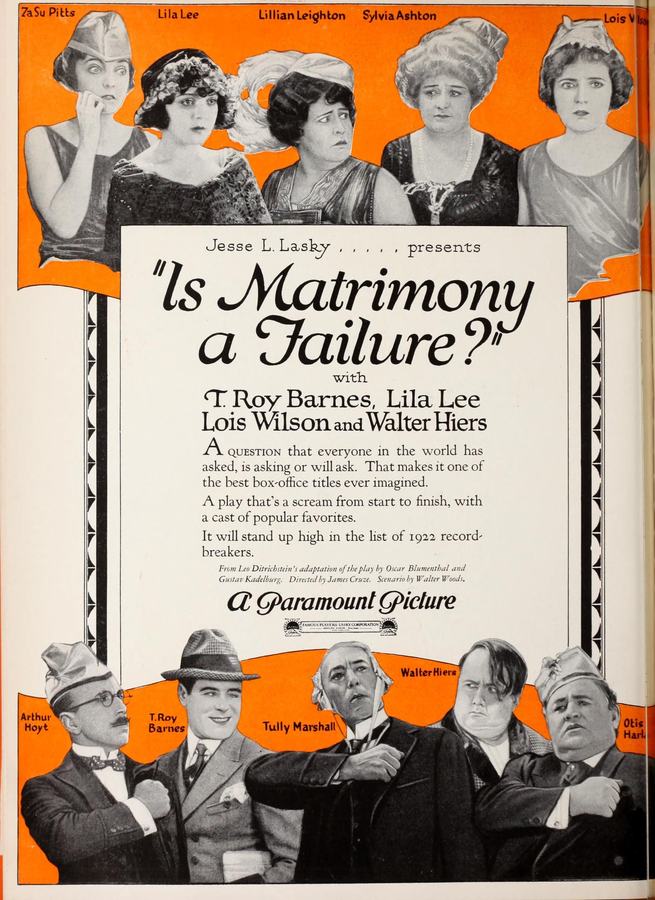
Picture, if you will, a mahogany table groaning under the weight of crystal, lace, and the brittle smiles of a couple who have spent a quarter-century rehearsing the same breakfast conversation. The Saxbys’ silver-anniversary soirée is staged like a Dutch still-life—every object polished to a moral sheen—until their daughter Margaret ricochets down the staircase with a suitcase in one hand and a shy bank clerk on the other. In that instant, the still-life tilts; the fruit tumbles; the painter’s meticulous chiaroscuro is splattered with anarchic gouache.
Director Walter Woods, working from a continental boulevardier source by Blumenthal and Ditrichstein, refuses to treat the elopement as mere comic detour. Instead he lets it rupture the film’s very fabric: chandeliers swing like metronomes counting down social collapse, and the camera—unusually mobile for 1922—tracks Margaret’s flight as though it were chasing a fugitive revolution. The joke, we soon learn, is cosmic. One missing oath, one vacationing functionary, and every November wedding since McKinley’s first term evaporates into legal ether. The town’s marital ledger becomes a palimpsest of erasures, a bureaucratic vanitas reminding us that even the most solemn vows rest on the frailest of signatures.
The Comedy of Repudiation
Silent-era audiences, still tipsy on post-war liberation, greeted the premise like a flask passed in a speakeasy. Here were paragons of propriety—shopkeepers, deacons, matrons—suddenly unhanded from the anchor of legality. Woods milks the moment for all its topsy-turvy delight: a haberdasher discovers his wife has become a “guest,” not a spouse; a judge wakes to find himself cohabiting without portfolio. The intertitles, lettered in arch Deco swashes, crow that “marriage is but a clerk’s initials away from mirage.”
Yet beneath the japery lies a shiver of existential vertigo. Adolphe Menjou, razor-profiled and wax-mustached as Dudley King, embodies the film’s mischievous id. He is both Puck and Prospero, brandishing statute books like spell books, gleeful at the havoc he can wreak with a single telegram. Menjou’s performance—equal parts boulevardier and barracuda—reminds us that every legal system is only as sturdy as the human whim that operates it.
Eros in the Time of Paperwork
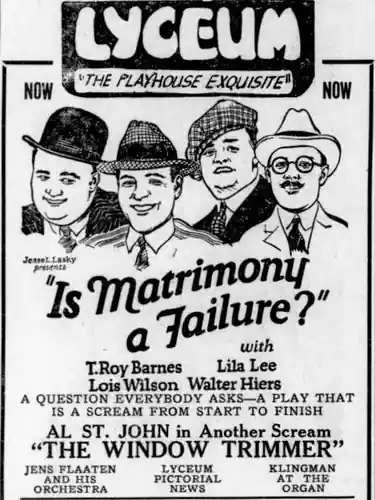
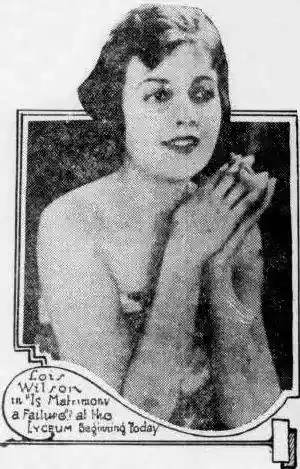
Margaret, played by Lois Wilson with the darting eyes of a finch testing the breadth of its cage, is less a damsel than a test case. When her honeymoon is annulled by telegram, her indignation is not romantic but epistemological: “I was certain I was married; now I am certain of nothing.” Wilson lets the line shimmer on her face without the aid of spoken dialogue—her shoulders sink, her pupils dilate, and for a second the film’s screwball tempo yields to something rawer. She stands on the lodge porch, luggage at her feet, watching rain smear the ink of her own signature. It is a portrait of modernity itself: identity reduced to a stamp that can be voided by a civil servant’s oversight.
Arthur Haviland, the bank clerk turned inadvertent bachelor, is essayed by T. Roy Barnes as a man perpetually one beat behind the music. His panic is not the florid hysteria of Sennett slapstick but the dawning horror of a clerk who realizes the world’s columns do not foot to ledger. Even his attempt to re-propose—kneeling on a rug that now symbolically belongs to neither household—has the pathos of a man clutching at vapor. The film’s genius is to let that pathos coexist with pratfall: Arthur’s boutonnière wilts as he scrambles for a marriage license that the county cannot produce until the sworn clerk returns from his fishing trip.
Domestic Apocalypse, Then Restoration
At midpoint the narrative widens its aperture. We tour a town metamorphosed into a bazaar of self-reassessment. Husbands, suddenly “single,” don straw boaters and prowl porches like adolescents on early release. Wives, too, taste the brine of liberty: one flirts with a dance instructor, another contemplates a job in the city. The camera, no longer content with proscenium tableaux, glides through streets where bunting flaps like surrender flags. For a reel or two the film verges on utopian anarchism—until the men, confronted with the abyss of their own making, scurry back to the status quo like toddlers to a night-light.
Zasu Pitts, as a spinster aunt whose neurasthenic twittering masks a scalpel-sharp mind, delivers the film’s thesis in an intertitle worthy of Oscar Wilde: “Man craves freedom until he earns it; then he barters it for breakfast.” Her line lands like a gong, and the film pivots toward reconciliation with almost indecent haste. The returning clerk, a bespectacled gnome who could pass for Tolstay’s Ivan Ilyich, signs a retroactive oath, and—presto—every bedroom reverts to its prior jurisdiction.
Visual Wit and Architectural Farce
Cinematographer Karl Brown (who cameos as a jittery groomsman) lenses the Saxby manse in cavernous chiaroscuro: hallways yawn like tribunal corridors, mirrors double and redouble faces until identity itself seems negotiable. When the scandal erupts, he racks focus so that the anniversary cake—25 candles blazing—slides into soft blur while the telegraph wire in the garden snaps into razory clarity. The visual pun is unmistakable: celebration dissolves, infrastructure endures.
Contrast this with the lodge scenes, shot in shimmering two-strip Technicolor tests that survive only in fragments. The forest around the honeymoon cottage pulses an arsenic green, as though nature itself were holding its breath. Margaret’s silk negligee, champagne-colored, picks up the hue and seems to glow with radioactive indecision. One wishes the entire film had been tinted in this queasy palette; the return to monochrome courthouse interiors feels like a descent into purgatorial paperwork.
Comparative Glances Across 1922
While When the Clouds Roll by toyed with dream logic and The Fortune Teller trafficked in gyish exoticism, Is Matrimony a Failure? rooted its surrealism in the banality of civic procedure. Its nearest cousin might be Hearts Are Trumps, where card-game chance steers amour, yet that film never questioned the juridical bedrock of marriage itself. Woods’ picture, by contrast, anticipates the bureaucratic absurdities of a Brazil or a Good Bye, Lenin!—only it arrived a century early, wearing spats.
Ethel Wales, as the matriarch, anchors the chaos with a face like a cameo brooch—serene, immutable. Watch her in the penultimate scene: learning that her own marriage was technically void, she neither flinks nor rejoices. Instead she pours tea with the same measured gravity, as if to say civilization, like porcelain, survives only through deliberate balance. It is a moment of stoic grace that keeps the farce from capsizing into burlesque.
Gender, Power, and the Last Laugh
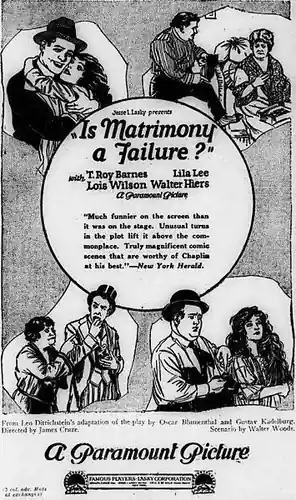
Conservative critics of the day sniffed that the film “makes light of the most sacred covenant.” Yet the joke is ultimately on the men. They flail, scheme, and bluster, but it is the women who navigate the crisis with cannibal efficiency. Margaret negotiates her own re-marriage contract, inserting clauses about Arthur’s savings account and his weekly night out. Sylvia Ashton, as a neighbor suddenly freed from her domineering spouse, purchases a motorcar and names it after the mythic Amazon queen Penthesilea. Even Lila Lee’s bit-part stenographer gets a sly revenge, altering a husband’s property deed while he’s busy swearing renewed vows.
The closing gag—Arthur carrying Margaret across the threshold a second time, only to trip over the threshold carpet—lands as both slapstick and symbolic ouroboros. Marriage, the film suggests, is a routine we re-enact until the rug literally trips us. Yet we dust ourselves off, adjust our cuffs, and re-enter the parlor because the alternative is an echoing hallway without another voice.
Modern Resonance: Voided Licenses and Digital Unweddings
A century on, the premise feels less antique than prophetic. Today a single clerical typo in an online form can stall a passport, a tax return, a green-card petition. Is Matrimony a Failure? merely inflates such snafus to operatic scale. Stream it after binge-watching a divorce-court reality show and you’ll sense the same tremor: the dread that our identities rest on someone clicking “Save.”
Restoration efforts by EYE Filmmuseum have salvaged about 72 % of the original 6-reel print; the gaps are bridged with stills and translated intertitles. The Dutch tinting hypothesis—green for uncertainty, amber for reconciliation—has been replicated via AI-assisted colorization that stops short of looking like a greeting card. Seek out the YouTube upload (search “Is Matrimony a Failure 1922 HD”) or the Blu-ray from Kino Lorber’s Slapsticks & Suffragettes box.
Verdict? A fizzy, corrosive little masterpiece that asks whether wedlock is a sacrament, a contract, or merely a habit we renew like a magazine subscription. It answers with a shrug, a grin, and a custard pie hurled at the courthouse clock. Watch it with your spouse, your partner, your Tinder date, or your right hand—just don’t forget to swear your clerk in first.
IMDb 6.9
1920
Community
Log in to comment.