DbcultAccessing Vault...
Cult Review
Senior Film Conservator
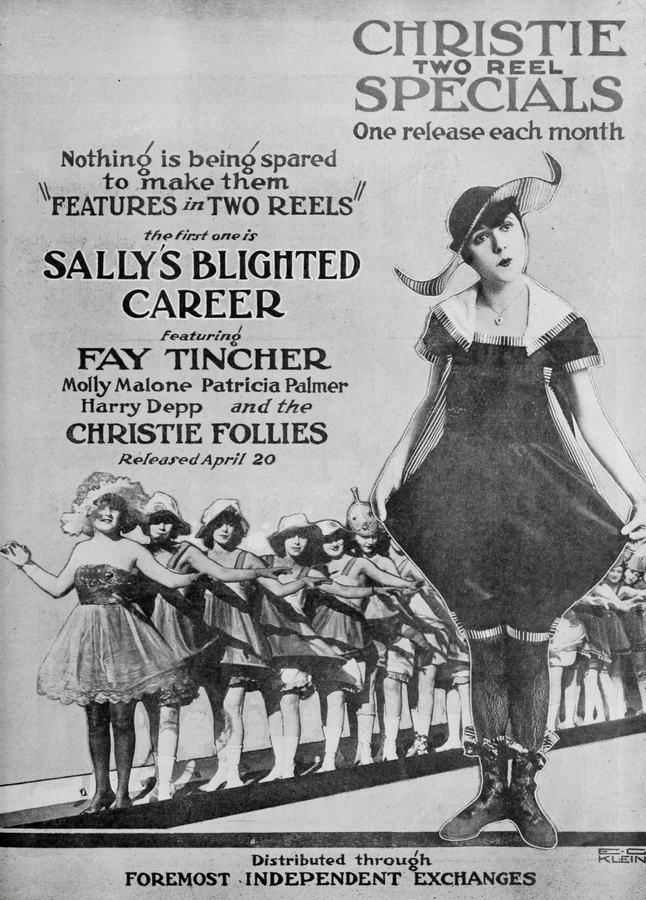
The 1919 cinematic landscape was often a battleground between agrarian idealism and the creeping cynicism of the burgeoning metropolis. In Sally's Blighted Career, director Harry Edwards crafts a narrative that serves as both a cautionary tale and a biting satire of the American Dream's more predatory aspects. While films like The Test of Womanhood explored the moral fortitude of the feminine spirit in more dramatic light, Edwards chooses the path of the 'rube comedy' to dissect the vanity of the stage.
The film opens with a visual symphony of rural life, a stark contrast to the grit we see in contemporary works like The Hard Rock Breed. Sally, played with a delightful, albeit exaggerated, sincerity, is introduced not just as a character, but as a symbol of the pre-industrial soul. Her voice, which the audience must imagine through the rhythmic pulsing of the silent frame, is the catalyst for her undoing. When the traveling show people arrive, they aren't merely characters; they are the harbingers of a modern, deceptive age. Their trickery is not just a plot point—it is a critique of the way the urban elite viewed the interior of the country as a reservoir of gullibility.
The term 'boob' in early 20th-century parlance carried a weight that is somewhat lost on modern audiences. It wasn't just an insult regarding intelligence; it was a socio-economic marker. Molly Malone and Helen Darling navigate this space with a physical comedy that is surprisingly nuanced. Unlike the stoic heroism found in Maciste atleta, the performances here are built on the fragility of expectation. Sally’s journey to the city is filmed with a frantic energy, mirroring the overwhelming sensory input of Broadway.
Once Sally enters the theater, the film shifts from a pastoral comedy to a claustrophobic backstage drama. The 'chorus' is depicted as a machine, one that demands a level of synchronization Sally simply cannot provide. Her failure is not a lack of effort, but a lack of artifice. She is too 'real' for the fake world of the opera, a theme that echoes through the more somber Souls in Bondage. The rejection she faces is visceral. When she is ejected from the theater, the camera lingers on her isolation amidst the towering architecture of the city—a visual trope that emphasizes her insignificance in the face of institutionalized glamour.
The screenplay by Walter Graham and Scott Darling avoids the easy sentimentality of the era. They could have written a story where Sally discovers her true talent and conquers the city, much like the aspirational arcs in His Royal Highness. Instead, they opt for a brutal, comedic realism. The dialogue—delivered via intertitles—is sharp, weaponizing the show people's flattery against Sally's earnestness. This creates a tension that makes the eventual 'blight' of her career feel inevitable rather than accidental.
In comparing this to Boston Blackie's Little Pal, we see a different side of the urban jungle. While the latter focuses on the criminal underworld, Sally's Blighted Career focuses on the professional underworld—the theater. Both films suggest that the city is a place where identity is stolen or manufactured, and where the innocent are merely collateral damage.
Harry Edwards utilizes a specific visual grammar to differentiate between the two worlds. The farm scenes are shot with wide lenses, capturing the horizon and a sense of infinite, albeit boring, possibility. The city, however, is a series of tight shots, crowded frames, and harsh shadows. This visual dichotomy reinforces Sally's displacement. She is a creature of the wide-open spaces, and the theater is a cage. This use of space is reminiscent of the stylistic choices in Charley Out West, where the environment itself becomes a character in the protagonist's struggle.
The climax of the film, where Sally is 'returned to the cows and chickens,' is often misinterpreted as a defeat. However, from an art critic's perspective, it is a restoration. The city had stripped her of her dignity by making her a 'boob,' but the farm restores her to her rightful place in the natural order. Unlike the tragic trajectories of Inherited Passions or the psychological weight of The Unborn, Sally’s story ends with a return to the status quo that feels like a relief. There is a profound honesty in acknowledging that not everyone is meant for the 'grand opera' of life.
When we look at Sally's Blighted Career alongside its contemporaries, its unique position in the silent comedy canon becomes clear. It lacks the overt slapstick of some, opting instead for a character-driven irony. For instance, while Ave Caesar! plays with historical grandeur, Sally stays rooted in the mundane. The film shares a certain thematic DNA with Princess of the Dark in its exploration of perception versus reality, though Sally’s 'blindness' is purely metaphorical—a blindness to her own limitations and the cruelty of others.
The inclusion of Roscoe Karns and Fay Tincher in the cast adds a layer of professional polish to the comedic timing. Tincher, in particular, was a master of the 'working girl' persona, and her presence here serves as a foil to Sally's naivety. The ensemble works to create a world that feels inhabited and lived-in, a necessary component for the satire to land. Without the grounded performances of the supporting cast, the film might have devolved into a mere caricature of rural life, similar to the risks taken in Æresgjesten or Redenzione.
In the final sequence, Sally stands among her livestock. The cows do not judge her; the chickens do not care for her operatic aspirations. There is a cosmic indifference to nature that stands in stark contrast to the judgmental eyes of the Broadway audience. This conclusion is more than just a plot resolution; it is a philosophical statement on the nature of happiness. While The Price of Silence deals with the repercussions of hidden truths, Sally finds her truth in the open air. The 'price' of her ambition was her dignity, and she buys it back with her return to the soil.
Even the title, Sally's Blighted Career, is a masterstroke of irony. Her 'career' was never real; it was a blight from the moment it was conceived in the minds of the show people. The film suggests that the true 'blight' is the ambition that pulls a person away from their essence. This sentiment is echoed in Jalousiens Magt, where internal desires lead to external ruin, though in Sally's case, the ruin is temporary and ultimately redemptive.
Sally's Blighted Career is a sophisticated artifact of early cinema that deserves more than a cursory glance. It manages to balance the broad humor required of the era with a poignant subtext regarding the American identity. It is a film about the theater that hates the theater, a film about the city that loves the farm, and a film about a 'boob' who is perhaps the most honest person in the frame. Harry Edwards and his team have created a work that is as relevant today as it was in 1919, reminding us that the bright lights of the stage are often just a distraction from the quiet truths of the home.
A masterclass in silent irony, Sally's journey is a rhythmic, hilarious, and ultimately touching exploration of where we belong versus where we are told we should be.
IMDb —
1917
Community
Log in to comment.