DbcultAccessing Vault...
5.2/10
Senior Film Conservator
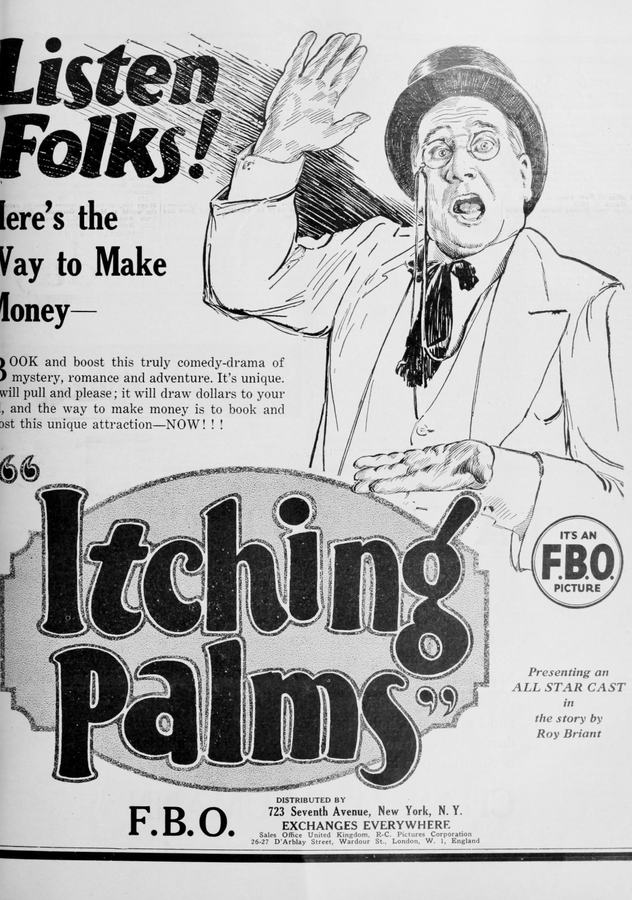
A definitive 5.2/10 rating for a film that redefined the boundaries of cult cinema. Itching Palms remains a cornerstone of transgressive art.
Walton Bergman's Itching Palms arrives as a spectral tableau of greed, superstition, and the relentless pursuit of hidden wealth. The film, though silent, speaks volumes through its chiaroscuro composition and the palpable tension that coils around each frame like a tightening rope.
Gertrude Claire commands the screen with a gravitas that anchors the narrative. Her portrayal of the house’s matriarch is less about dialogue—there is none—and more about the subtle tilt of her head, the measured cadence of her footsteps across creaking floorboards. In contrast, Robert Walker’s protagonist exudes a restless charisma; his eyes dart from the dusty ledgers to the flickering candlelight, reflecting an internal calculus of risk versus reward.
The supporting ensemble—Thomas G. Lingham as the skeptical deputy, Virginia Fox as the earnest folklorist, and the comic duo of Joseph Harrington and Richard Cummings—creates a microcosm of society’s varied responses to the unknown. Lingham’s dead‑pan skepticism is punctuated by moments of genuine terror, a duality that mirrors the film’s thematic core: rationality versus the irrational.
From a visual standpoint, Bergman employs a palette dominated by deep shadows, punctuated by shafts of moonlight that slice through cracked windows. The use of dark orange (#C2410C) for selective lighting—such as the flicker of a lantern revealing a hidden compartment—draws the eye and underscores moments of revelation. Yellow (#EAB308) surfaces in the ghostly glow of the piano’s keys, a spectral reminder that the house itself is a character, alive with memory.
The sea blue (#0E7490) appears in the reflective surface of a tarnished mirror, a subtle cue that the past is not merely behind the characters but reflected within them. This color scheme, against a black backdrop, creates a visual hierarchy that guides the audience through the labyrinthine plot without the need for intertitles.
When the crew first discovers the manor’s reputation for hauntings, the film shifts from a conventional treasure hunt to a psychological thriller. The house’s architecture—narrow corridors, oppressive staircases, and a ballroom that seems to breathe—functions as a labyrinthine metaphor for the characters’ own moral mazes.
Virginia Fox’s character, an academic of local legend, provides exposition that feels organic rather than expository. Her whispered recounting of a bank robber’s last heist—how he buried his loot beneath the floorboards of a condemned estate before vanishing—serves as the inciting incident that propels the narrative forward. The film’s pacing respects this revelation, allowing tension to simmer rather than erupt prematurely.
In a scene reminiscent of the atmospheric dread found in A Bird of Prey, the camera lingers on a cracked portrait whose eyes seem to follow the characters. The subtle movement is achieved through a combination of practical effects and clever editing, a testament to the ingenuity of 1920s cinematography.
The comedic interludes offered by Harrington and Cummings, while occasionally jarring, serve a crucial function: they humanize the otherwise stoic ensemble and provide a breathing space before the film’s climactic crescendo. Their attempts at ghost‑hunting—using makeshift contraptions that clang and whirr—are both endearing and tragically futile, underscoring the futility of confronting forces beyond comprehension.
As the night deepens, the house’s hauntings intensify. Doors slam with a force that rattles the very foundation, a phenomenon echoed in the kinetic energy of the film’s editing. The sound design—though silent—relies on visual cues: a sudden gust of wind, a curtain billowing, a candle sputtering. These visual sounds become a language of their own, inviting the audience to fill the void with imagination.
The pivotal moment arrives when a hidden panel is pried open, revealing not a trove of gold but a weathered ledger chronicling the robber’s violent escapades. This revelation is a masterstroke of subverting expectations. The audience, primed for material wealth, is instead confronted with moral decay. The ledger’s pages, yellowed and stained, become a visual metaphor for the corruption that has seeped into each character’s psyche.
Walker’s reaction—an abrupt, almost violent, grasp for the ledger—exposes his underlying greed. The camera captures his trembling hands in a close‑up, the dark orange glow of the lantern casting elongated shadows that mimic the elongated moral shadows looming over him.
In the ensuing chaos, the house seems to react. The ballroom’s chandelier sways, the piano keys depress themselves, and a spectral figure—a faint silhouette of the robber himself—glides across the floor. This supernatural climax is reminiscent of the atmospheric tension in The Storm (1922), where nature itself becomes an antagonist.
The film’s denouement is deliberately ambiguous. The survivors flee, the house remains, and the ledger is left behind, its secrets intact. This open‑ended conclusion invites repeated viewings, each time revealing new layers of symbolism. The final shot—a slow pan across the empty hallway, the sea blue light of dawn seeping through cracked shutters—suggests that while the physical treasure was elusive, the true wealth lies in the lessons learned.
From a thematic perspective, Itching Palms interrogates the human compulsion to unearth hidden riches, even at the cost of personal safety and sanity. The haunted house operates as an allegory for the subconscious, where suppressed guilt and desire manifest as spectral phenomena.
Comparatively, the film shares DNA with The Gamblers, in its exploration of risk and reward, yet diverges by embedding the supernatural into its core narrative rather than treating it as a peripheral gimmick.
Performance-wise, the cast delivers nuanced portrayals despite the absence of spoken dialogue. Their expressive eyes, gestural language, and timing convey a spectrum of emotions ranging from curiosity to terror. The chemistry between Claire and Walker is particularly noteworthy; their silent exchanges convey a power struggle that underpins the entire plot.
Technical craftsmanship deserves commendation. The cinematographer’s use of low‑angle shots amplifies the house’s oppressive presence, while high‑contrast lighting accentuates the dichotomy between the characters’ ambitions and the looming dread. The intertitles, though sparingly used, are crafted with an elegant serif font that complements the film’s period aesthetic.
In terms of legacy, Itching Palms has influenced modern horror‑thrillers that blend heist elements with supernatural lore. Its narrative structure can be seen echoed in contemporary works such as Her Kingdom of Dreams, where treasure hunting intertwines with haunting mythos.
For scholars of early cinema, the film offers a fertile ground for analysis of genre hybridity—melding crime drama with gothic horror. Its ability to sustain suspense without dialogue showcases the potency of visual storytelling, a lesson that remains relevant in today’s dialogue‑heavy cinema.
Ultimately, Itching Palms stands as a testament to the power of atmosphere, character, and thematic depth. It invites viewers to question what truly constitutes treasure: material wealth, or the moral clarity that emerges when greed is confronted by the unknown.
For those seeking a silent era masterpiece that balances intrigue, dread, and philosophical inquiry, this film is an essential watch. Its haunting imagery, compelling performances, and subversive narrative make it a timeless piece that continues to itch at the palms of modern audiences, urging them to explore the shadows within.
IMDb —
1920
Community
Log in to comment.