DbcultAccessing Vault...
Cult Review
Senior Film Conservator
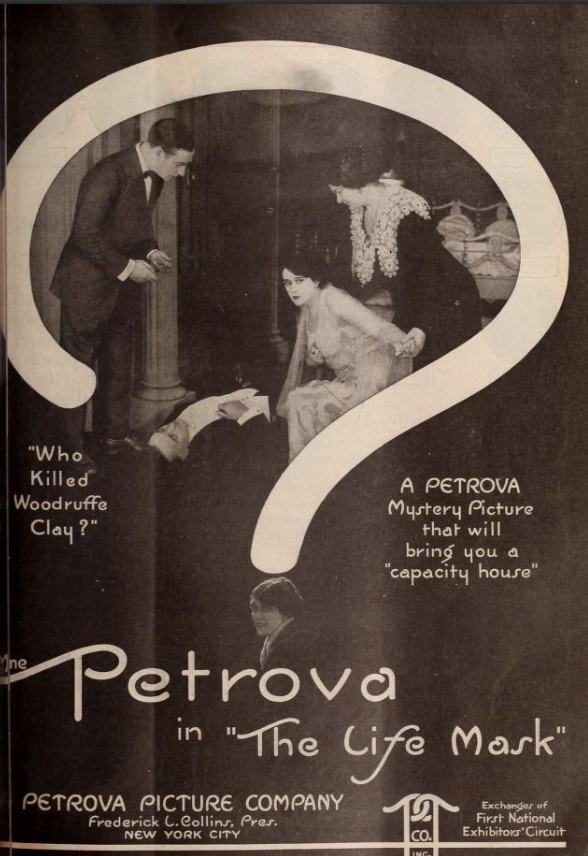
There is a moment—wordless, razor-thin—when Olga Petrova’s face, framed by the argent square of a nocturnal window, seems to calcify into porcelain. The camera holds, breathless, as if afraid a single twitch might detonate the narrative. That micro-instant is The Life Mask in miniature: a film that distrusts its own surfaces, forever suspecting that every smile is forged currency and every kiss a post-dated check.
Strip away the flappers and the Legionnaire epaulettes and what remains is a savage ledger of exchange. Helen Courtland’s embezzlement is less a crime than an IPO: she monetizes her daughter’s desirability, floats shares in virginity, and watches the market soar. Director Thomas Holding stages the forgery sequence like Eucharistic rite: the check passed left-to-right across a slab of obsidian tabletop, candlelight dribbling wax onto the signature line, the ink still wet as blood. The resulting marriage contract feels pre-Copernican: Anita becomes satellite, Clay the dead sun whose gravity she must orbit even while her heart spins outward toward Hugh’s desert constellations.
Modern viewers will detect the pre-echo of The Moral Fabric and Transgression, yet where those titles sermonize, The Life Mask chooses to marinate in moral tar.
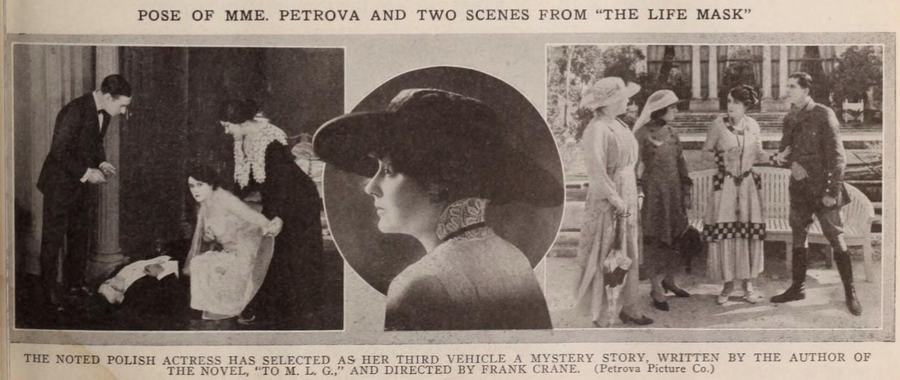
Olga Petrova’s Anita is a masterclass in recursive despair—every gesture loops back on itself, a Möbius strip of self-incrimination. Watch the way her fingers flutter post-poisoning dream: she’s conducting an invisible orchestra of guilt, the baton trembling like a dowsing rod over her husband’s corpse. Opposite her, Wyndham Standing’s Woodruffe Clay exudes the rubbery affability of a man who has never heard the word no, until the moment he becomes a paraplegic puppetmaster jerking on the strings of his own impotence. The wedding-night tumble is filmed from the chandelier’s vantage: Clay’s body folds, origami-like, the camera lingering on his silk slippers still twitching—half crucifixion, half vaudeville pratfall.
And then there is Lucille La Verne as Sarah Harden, the nurse whose face could advertise laudanum. La Verne weaponizes stillness; she stands at the perimeter of frames like a fate that has already been decided, her confession arriving not as catharsis but as rug-yank. The film’s single intertitle I jotted verbatim: “I freed you the only way the world allows a woman to be freed—by making death look like your nightmare.” The line detonates an entire symposium on feminist ethics without ever raising its voice.
Cinematographer Edmund Burns treats light like a guilty conscience. Interiors are Caravaggio-drenched: umber corridors, chiaroscuro doorways, the sickle moon of a bedside lamp carving Anita’s insomnia into existence. Exterior scenes—especially the Foreign Legion flashbacks—are over-exposed until the desert becomes a white-hot tabula rasa upon which desire can inscribe itself. Note the match-cut from Clay’s bandaged skull to the bleached Algerian sun: both orbs, both blinding, both harbingers of moral erasure.
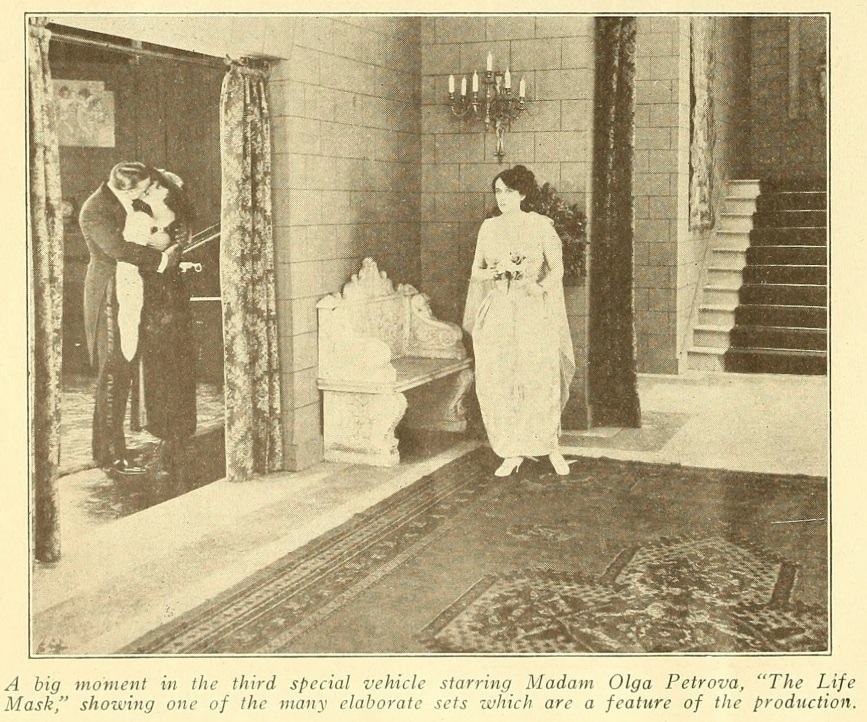
The film’s most audacious visual coup arrives via double-exposure: Anita’s sleepwalking body glides across the frame while a semi-transparent silhouette of her dreaming self leans over to pour poison. The spectral split anticipates Marionetten by a full decade, yet here the gimmick feels less trick than ontological fracture—identity literally divided against itself.
Though technically mute, the picture was originally accompanied by a “musique noire” score—cello motifs descending in minor thirds, punctuated by xylophone tinkles that mimic the rattling of a morphine bottle. Archival notes suggest violinists were instructed to loosen their bow hairs for the poisoning dream, producing a rasp akin to human exhalation. Contemporary restorations often substitute generic piano, so if you catch a rare print with live quartet, prioritise it—your nerves will thank you later.
Critics frequently slot The Life Mask beside Carmen or A Rich Man’s Plaything because of Petrova’s vamp reputation, but the closer kinship is with Through the Valley of Shadows—both films weaponize female guilt as narrative propellant, both stage Europe as purgatorial waystation. Yet where Valley ultimately spiritualizes its angst, Mask remains secular, almost bacterial: guilt multiplies cell-by-cell until it bursts the host organism.
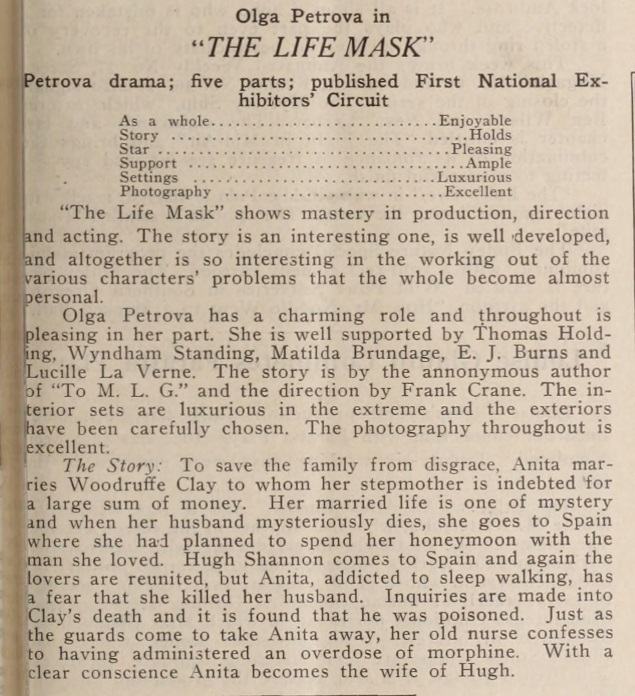
1. Sleepwalking as proto-#MeToo metaphor: Anita’s body moves through space without consent, her autonomy hijacked by patriarchal nightmares. The film dares to ask: if society pathologizes your trauma, might you not wake up with blood on your hands?
2. The matriarchal villain: Helen Courtland’s crime is financial, not maternal; she sells maternity itself. Cinema rarely grants mothers such nakedly capitalist agency without pivoting into camp, yet here the performance stays ice-cold, a brokerage of flesh.
3. The queer undertow: Sarah’s devotion carries the erotic charge of unrequited sapphic loyalty—her murderous mercy a perverse wedding gift. The way she cradles Anita’s handkerchief to her cheek in close-up is less nurse than lover, less confession than proposal.
For all its chiaroscuro brilliance, the picture stumbles over colonial décor: Algerian extras are treated as movable scenery, and Hugh’s Legionnaire glamour feels cribbed from a Boy’s Own serial. Likewise, the final pier sequence is undermined by a studio-lit fog that looks less existential than somebody left the dry-ice machine running. These are blemishes, yes, but perhaps also evidence of a film so feverish it can no longer police its own excesses.
If your taste runs toward The Hawk’s brisk amorality or the small-town satire of The Small Town Guy, be warned—The Life Mask offers no moral GPS. It is a fever dream that ends with the camera staring at the audience, as though passing sentence. Yet for viewers who crave silent cinema that gnaws long after credits, who relish seeing the era’s gender politics dissected with a scalpel dipped in arsenic, this obscurity deserves resurrection.
Stream it whenever the archive gods smile. Watch with headphones and a glass of something that tastes like regret. Then, come sunrise, inspect your own face in the bathroom mirror—if you can still tell where the mask ends and skin begins, you weren’t paying attention.
IMDb —
1924
Community
Log in to comment.