DbcultAccessing Vault...
7.3/10
Senior Film Conservator
A definitive 7.3/10 rating for a film that redefined the boundaries of cult cinema. It's a Bird remains a cornerstone of transgressive art.
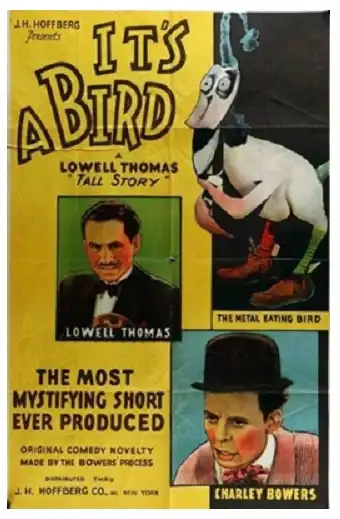
Okay, so 'It's a Bird' from 1930. Is it worth tracking down today? Well, *yes*, if you have a soft spot for really old, really bizarre cinema. If you're someone who likes to see where silent-era gags tried to stretch into talkies, or just appreciate pure, unadulterated absurdity, you might actually get a kick out of this. But if you need polished storytelling, modern pacing, or anything that makes logical sense, honestly, just skip it. You'll probably be bored stiff.
Charles R. Bowers, our junk man, is the star here. He lives in this amazing pile of... everything. He's got all sorts of contraptions, and he just seems to *love* his stuff. It’s kinda sweet, really. Then he hears about this legendary metal-eating bird in Africa. 🐦
A metal-eating bird! I mean, what even is that? The sheer audacity of the premise is what makes it. He decides, naturally, that he needs to go find it. His reasoning? Not super clear, but hey, it's 1930s comedy, you just roll with it.
The journey itself is pretty quick. He's suddenly in Africa, and it's all very much what you'd expect from a studio backlot trying to look like Africa in 1930. Lots of painted backdrops and maybe some guys in animal costumes, who knows. The focus isn't realism, that's for sure.
Then comes the bird. And it's exactly what you hope it is. A stop-motion creation, clunky but charming. It really does gobble up metal things. Little nuts, bolts, even bigger bits. It’s like a feathery, mechanical goat.
Bowers, being the inventive type, tries to catch it. He builds these elaborate traps. One involved a giant magnet, I think? Or maybe a huge metal cage? The specifics blur a bit, but the spirit of his Rube Goldberg-esque attempts is there. You gotta admire the effort.
The stop-motion is *definitely* the highlight. It’s not smooth by any means, but seeing these objects move on their own, interacting with the live-action Bowers, it’s just a marvel for its time. You can tell they put a lot of work into making these little illusions happen.
It's not a long movie at all. It gets in, does its thing, and gets out. There's no grand message, no deep character development. It’s just, 'Here’s a guy, here’s a weird bird, let’s see what happens.'
You know, sometimes I wonder about the conversations they had on set. 'Okay, Charlie, now pretend this invisible bird is eating your wrench.' Or 'Can we make the bird puppet actually *look* like it's chewing?' The dedication to such a silly concept is kinda heartwarming.
The humor is mostly visual gags. There isn't much dialogue to speak of, or at least not memorable lines. It relies on Bowers' reactions and the absurdity of the situation. Which, for the most part, works.
It’s not a film you'll remember for its script, or even its acting in the traditional sense. You remember the *idea* of it. The man, the bird, the metal. Simple, really.
It's a testament to how creative people were, even with limited technology. They just threw crazy ideas at the wall and saw what stuck. And a metal-eating bird? That definitely stuck.
This isn't a masterpiece, not by any stretch. But it's a *curiosity*. A charming, oddball piece of early cinema that shows you what happens when someone decides to just go wild with an idea. It’s imperfect, a little clunky, but undeniably unique. Like finding a strange, old toy in an attic. You might not play with it often, but you're glad it exists.
IMDb —
1933
Community
Log in to comment.