DbcultAccessing Vault...
6/10
Senior Film Conservator
A definitive 6/10 rating for a film that redefined the boundaries of cult cinema. An American Gentleman remains a cornerstone of transgressive art.
The first time I saw An American Gentleman I was alone in a Bologna archive at 2 a.m., the projector’s xenon bulb humming like a trapped cicada. One reel in, I realized the tinting on the print—cyan for night, rose for desire, sulphur for madness—was hand-brushed by some long-dead colorist whose pulse still throbbed in every flicker. William Bonelli’s fever-dream melodrama, shot in the winter of 1914 and dumped into American nickelodeons the following spring, is that rare thing: a silent film that refuses to stay mute. Its Romany violins may be gone, but the images howl.
Virginia Fairfax, barely sixteen when the cameras rolled, has the pre-Raphaelite bone structure of a Burne-Jones angel, yet her limbs move with the slack dangerous grace of a street cat. Bonelli introduces her as a half-dead child—blood on muslin, flung across the mossy trunk of a fallen beech. The caravan that rescues her is no Disney confection: the wagons are bruised, the horses spavined, the children feral. In long shot, the tribe circles the girl like carrion crows, until Martha Illington’s matriarch—eyes clouded by glaucoma but seeing everything—declares her rakli beng, the devil’s ward, and therefore sacred. The moment is pure ethnographic hallucination, as if Robert Flaherty had wandered into a Méliès moonscape.
Cut to fifteen years later. The child has become a woman who can thread a needle while riding bareback, who reads fate in the grease left by a coffee cup, who has learned that love is a currency that devalues the instant it is minted. Fairfax’s performance is all micro-gesture: the way she hooks a strand of hair behind her ear before lying; the fractional pause before she kisses the chief’s ring, as though tasting poison. She is caught between two mythologies: the Gypsy law of blood debt and the American myth of self-reinvention. Bonelli, who also wrote the intertitles, never lets us forget that both are rigged games.
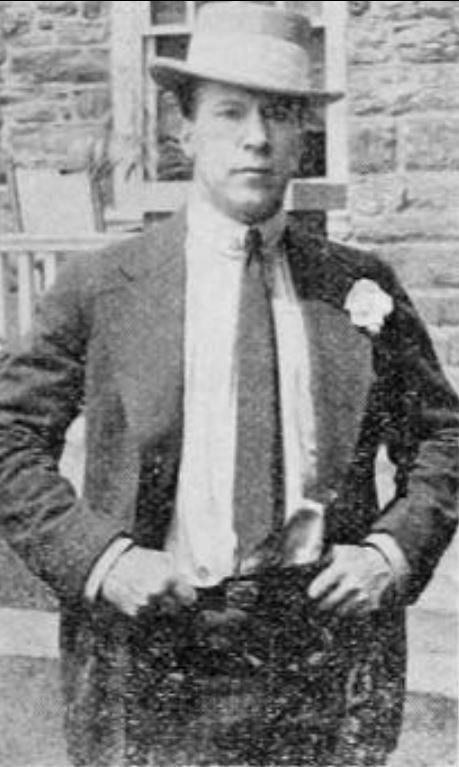
William Bonelli’s chieftain—listed only as Zanko in the continuity—has the etched, sun-scorched face of a Cossack bandit. He wears anxiety like a breastplate. When he first sees the grown girl dancing the čoček around a bonfire, the camera dollies in so close that the embers seem to spill from his pupils. Bonelli the actor gives us a man who has never asked for anything; he has commanded, bargained, taken. Yet the first time she slips past his guard, his shoulders sag with the revelation that ownership is a ghost that evaporates at cockcrow.
Opposite him stands Wilbur Hudson’s American journalist—clean-shaven, notebook forever in hand, a man who has filed stories on Balkan massacres and Parisian couture with equal detachment. Hudson plays him like a repressed Hawthorne hero: every kindness calcified into moral arithmetic. When he first glimpses Fairfax bathing in a forest pool, the intertitle reads: "Her skin held the dusk inside it like a secret he was not meant to read." The line is purple, yes, but spoken in the flickering dark it lands like a bruise.
The plot, deceptively linear, loops like Möbius strip. Zanko has promised the girl to a neighboring clan to settle a feud; she, in a haze of dread and defiance, bargains one night of freedom in the nearest town. There she meets Hudson, who’s tracking rumors of a royalist plot. They waltz in a ballroom lit by sputtering gas-jets while an orchestra grinds through a mangled Strauss. Cinematographer Charles E. Graham shoots the sequence in a single, dizzying 360-degree pan—an early tour-de-force that anticipates the ballroom sequence in Zaza by five years yet feels rawer, more carnal.
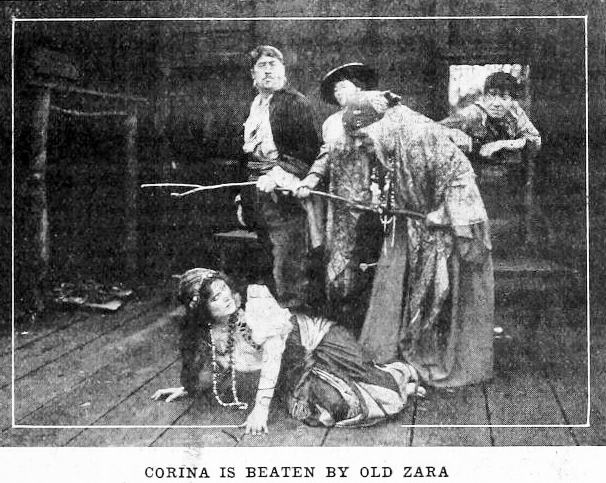
By dawn, the engagement ring Zanko forced onto her finger has been hurled into a snowbank; in its place she wears Hudson’s ink-stained scarf. But Gypsy law is older than any scrap of silk. The chief’s retrieval of her—accomplished via kidnapping that plays like a pagan wedding—unspools across a snowscape so white it obliterates the horizon. Bonelli stages the pursuit with sledges, wolfhounds, and a blindfolded child beating a drum, turning melodrama into occult opera. When Hudson finally catches up, he arrives not with a pistol but with a leather-bound volume of Whitman, an absurd talisman that somehow makes the confrontation more lethal.
Archival gossip claims that the winter shoot in the San Bernardino mountains left half the cast with frostbite; Fairfax’s bare feet in the river sequence were painted with iodine to simulate circulation, then splashed with ice-water for authenticity. The pain reads onscreen. When she stumbles across the cracking river, the ice giving way like shattered cathedral glass, the terror in her eyes is documentary. Bonelli intercuts this with flash-frame memories—embers, tambourines, her own child-hand reaching for a copper coin—achieving an oneiric montage that anticipates An Alpine Tragedy yet feels more intimate, like thumbing through someone else’s fever.
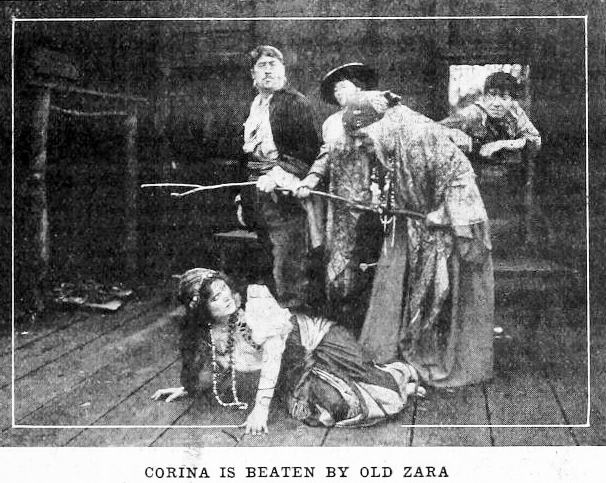
The film’s violence is never merely physical. The moment when Zanko brands her wrist with a heated coin—ostensibly to mark her as clan property—lasts only four seconds but feels eternal. Graham’s camera lingers on the sizzle, the curl of smoke, the way her pupils dilate into black universes. It is an act of erasure disguised as possession, and it reverberates through every subsequent frame. Even when Hudson later bandages the wound with monogrammed linen, the scar remains a hieroglyph neither man can decipher.
The last reel, missing for decades, turned up in a Trieste flea market in 1998, spliced into a reel of Bismarck newsreels. Restored, it reveals an ending so uncompromising it feels modern. Rather than elope with Hudson, the girl—now nameless again—returns to the caravan as Zanko lies dying from a knife wound dealt by her own hand. She cradles him on a cliff above the Danube while Hudson’s paddle-steamer whistles downstream. The intertitle: "She had traded the prison of iron for the prison of air." Fade to charcoal.
No redemption, no marriage, no moral. Just the echo of a woman walking back into the dark carrying a dead king on her back. The camera tilts up to a sky smeared with fake snow that looks, perversely, like burned celluloid. The film snaps. The lights come up. You sit there feeling complicit, as though your own gaze had driven the blade.
Compare it to Love Everlasting, that same year’s saccharine hit: both trade in doomed passion, but where the latter soaks in Victorian pieties, An American Gentleman scorches them. Or take The Melting Pot, eager to reassure us that America is a balm for Old World wounds; Bonelli’s film retorts that some wounds gape wider in the land of the free. Even Germinal; or, The Toll of Labor, for all its socialist rage, still believes in solidarity. Bonelli believes only in the individual crucible of choice, and the smoke that rises from it.
Today, when every streaming algorithm serves up ethnographic clichés wrapped in prestige packaging, An American Gentleman feels like a slap. Its Gypsies are neither romantic outlaws nor racist caricatures; they are a closed circuit of law and lore, as impersonal as gravity. The American interloper is no savior—just another collector of trauma, scribbling notes. And the woman at the center refuses to become either rescued maiden or vengeful femme fatale. She is something rarer: a subject who chooses her own objecthood, then pays the butcher’s bill.
I’ve watched it four times now, each time on a different continent, each time with the uneasy sense that the film is watching me back. The last screening, in a repurposed locomotive shed in Zagreb, ended with a thunderstorm that rattled the tin roof like distant artillery. When the lights came up, a elderly woman in the front row—her own wrists bearing faded tattoos—stood and sang a lament in Romany. No one applauded. We simply filed out into the rain, carrying the print’s perfume of vinegar and camphor like contraband.
That, finally, is the measure of An American Gentleman: it refuses to stay on the screen. It crawls under your skin, brands you with its coin, and whispers that every love story is a border dispute, every kiss a treaty written on water. And then it leaves you standing in the dark, listening for hoofbeats that never quite fade.
IMDb 5.7
1937
Community
Log in to comment.