DbcultAccessing Vault...
5.8/10
Senior Film Conservator
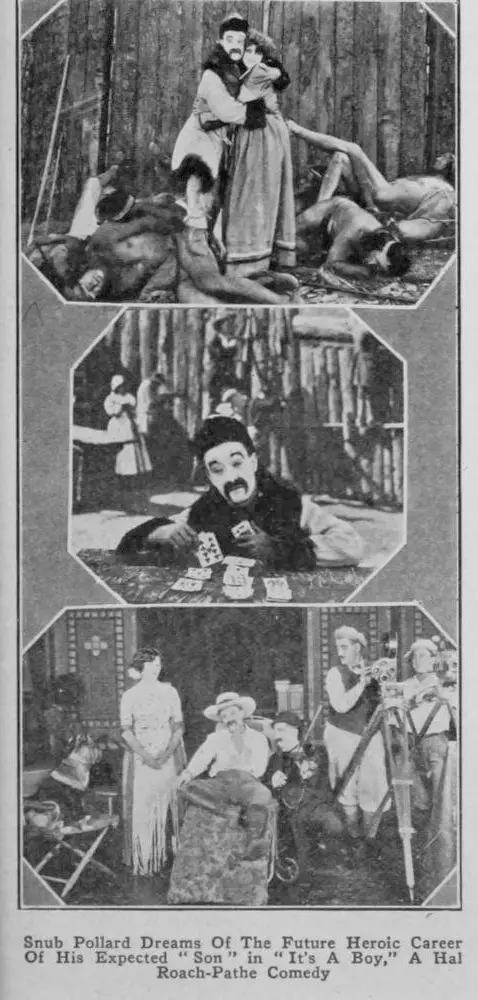
A definitive 5.8/10 rating for a film that redefined the boundaries of cult cinema. It's a Boy remains a cornerstone of transgressive art.
The 1923 short It's a Boy arrives as a compact yet incisive vignette of patriarchal expectation, anchored by the lanky physicality of Snub Pollard. The narrative pivots on a single, deceptively simple premise: a father‑to‑be, consumed by the prospect of a son, drafts an elaborate future for his unborn child, only to be jolted by the revelation that the infant is a girl. This gender reversal, rendered without dialogue, relies on visual exaggeration, timing, and a cascade of situational irony that underscores the era's preoccupation with lineage and masculine ambition.
\nSnub Pollard, whose real name was Harold Fraser, commands the screen with a blend of earnest desperation and slapstick finesse. His eyes widen in exaggerated disbelief as he flips through a ledger of career prospects—law, medicine, finance—each page a visual gag that escalates in absurdity. The camera lingers just long enough to capture his frantic scribbling, then cuts to a close‑up of the infant's tiny hand, a silent yet potent counterpoint. Helen Gilmore, portraying Snub's supportive yet bemused spouse, offers a grounding presence; her reactions are subtle, a raised eyebrow or a half‑smile that conveys more than any intertitle could.
\nSupporting players such as Tonnage Martin Wolfkeil (the over‑zealous midwife) and Eddie Baker (the bewildered neighbor) amplify the central conflict through physical exaggeration. Wolfkeil's towering stature juxtaposed with the diminutive newborn creates a visual metaphor for the societal weight placed upon gender expectations. Meanwhile, Billy Engle's cameo as a delivery boy who repeatedly misdelivers the baby’s blanket becomes a running gag that mirrors Snub's own miscalculations.
\nBeyond its comedic veneer, It's a Boy interrogates the rigidity of early twentieth‑century gender norms. Snub's obsessive planning mirrors a broader cultural script that equated male progeny with economic continuity. When the baby girl arrives, the film does not merely flip a switch for humor; it forces the protagonist—and by extension the audience—to confront the arbitrariness of his own ambitions. The short does not resolve this tension with a tidy moral; instead, it ends on a note of resigned acceptance, as Snub gently cradles his daughter, his earlier plans crumpled in his hand, a visual echo of the era's gradual, albeit hesitant, shift toward acknowledging female agency.
\nIn comparison, the gender subversion in The Man Who Disappeared employs mystery rather than comedy, yet both films share a preoccupation with identity concealment. It's a Boy leverages the silent medium to its advantage: the absence of spoken dialogue heightens the reliance on visual cues, making the gender reveal a moment of pure, unmediated surprise.
\nCinematographer William Gillespie adopts a static composition that emphasizes the choreography of the actors. The framing often places Snub at the periphery, his silhouette dwarfing the newborn in the foreground, underscoring the power dynamics at play. The use of deep focus allows background details—such as a framed portrait of a stern patriarch—to seep into the narrative, reinforcing the weight of ancestral expectations.
\nLighting remains high‑key, typical of the period, yet subtle shifts in brightness accompany Snob's emotional arc. When he discovers the baby's gender, a brief dimming occurs, casting elongated shadows that momentarily transform the comedic set into a stage for introspection. The film's black‑and‑white palette, juxtaposed with the modern viewer's colorized promotional material, invites a reconsideration of how visual contrast can amplify thematic tension.
The short adheres to a tight three‑act structure: anticipation, revelation, and resolution. Each act is punctuated by a series of escalating physical gags that serve both as comic relief and narrative propulsion. The pacing never lags; intertitles appear sparingly, allowing the visual comedy to carry the weight of exposition. This economy of storytelling is reminiscent of other 1923 comedies such as A Gentleman of Leisure, where brevity necessitates precision.
\nThe climax—Snub's frantic attempt to re‑write his career plans on a chalkboard—operates as a kinetic tableau. Chalk dust billows, the board teeters, and the camera captures the chaos in a single, unbroken shot, a testament to the director's confidence in staging.
\nWhen situated among its contemporaries, It's a Boy distinguishes itself through its nuanced treatment of gender expectations. While The Fatal Fortune leans heavily on melodramatic tropes, and Whispering Devils delves into gothic horror, Snub's film remains firmly in the realm of social satire, using humor to probe the absurdities of patriarchal ambition.
\nThe film also anticipates later works that explore similar themes, such as the 1930s screwball comedy It's a Wonderful Life, albeit with a more earnest tone. The through‑line of a father grappling with unexpected parenthood resonates across decades, underscoring the timelessness of the core conflict.
\nAlthough It's a Boy has not achieved the canonical status of Chaplin's masterpieces, its influence can be traced in the work of later silent comedians who employed gender reversal as a comedic device. The film's succinct storytelling and reliance on visual punchlines informed the editing techniques of subsequent directors, particularly in the realm of short‑form comedy.
\nModern scholars often cite the short as a case study in how early cinema negotiated social expectations without resorting to overt moralizing. Its preservation in several archives attests to its cultural relevance, and screenings at silent film festivals continue to elicit laughter, proving that the humor remains resonant.
\nContemporary reviews from 1923 praised the film for its brisk humor and Pollard's charismatic physicality. Trade papers highlighted the “delightful surprise” of the gender reveal, noting its “fresh take on domestic comedy.” Modern retrospectives, such as those found in the journal Silent Screen Quarterly, commend the short for its “subtle critique of patriarchal ambition,” positioning it as an early forerunner of gender‑aware comedy.
\nIt's a Boy endures as a compact masterclass in visual storytelling, marrying slapstick exuberance with a quietly progressive commentary on gender expectations. Its deft blend of physical comedy, tight narrative structure, and thematic depth renders it a noteworthy artifact of the silent era, deserving of renewed scholarly attention and public appreciation.
IMDb 4.4
1926
Community
Log in to comment.