DbcultAccessing Vault...
6/10
Senior Film Conservator
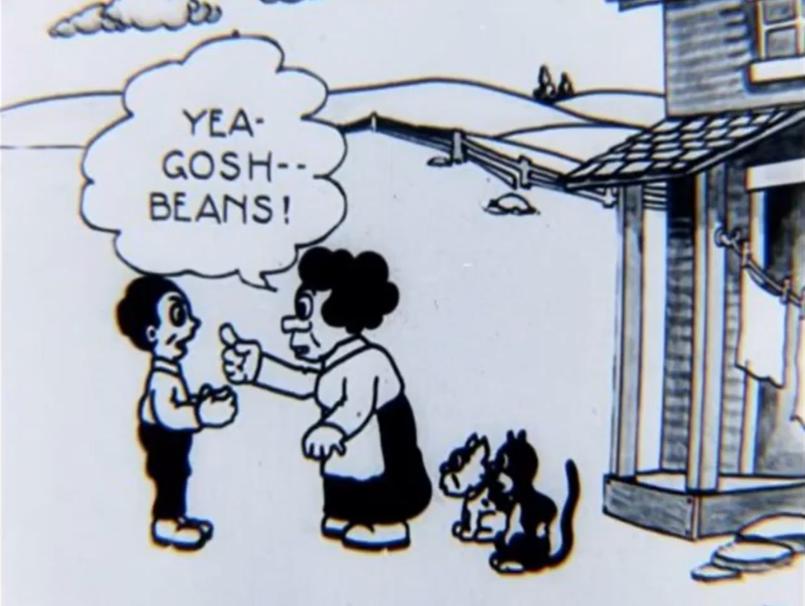
A definitive 6/10 rating for a film that redefined the boundaries of cult cinema. Jack and the Beanstalk remains a cornerstone of transgressive art.
A vine that once pierced the sky now survives only as gossip in the gutters of film history.
There are pictures that burn, and there are pictures that simply evaporate. Walt Disney’s 1922 Jack and the Beanstalk belongs to the latter fraternity: a Laugh-O-Gram one-reeler auctioned off by the foot, melted for silver halide, or tossed into the Missouri River once the creditors circled. We know it existed only because the Kansas City Star bothered to run a capsule review on 2 October 1922, calling it “a puddle of delightful impossibility” and praising the “giant so tall his head leaves the frame.” Everything else—runtime, shot list, gag structure—has become celluloid smoke.
Yet absence can be its own spectacle.
Consider what we do possess: a boy-cow transaction animated on paper that now crackles like dry leaves; the memory of Disney himself, barely twenty, timing gags with a stopwatch nicked from the railroad; and a ledger that lists “Beanstalk” alongside Doggone Torchy and The Woman in Room 13 as potential salvation for a studio haemorrhaging nickels. The film is a ghost, but ghosts sometimes cast longer shadows than the living.
In 1922 Walt Disney was not yet the sorcerer of celluloid; he was a kid with a second-hand camera, a garage full of teenagers, and creditors who knocked louder every week. Jack and the Beanstalk was conceived as the jewel in a crown of fractured fairy tales—short, cheap, saleable to the newsreel exchanges that still crammed ten-minute mini-myths between boxing bouts and agricultural forecasts. The budget was $1,800, most of it owed to the local butcher for pounds of bacon that doubled as incentive payroll.
What distinguished this retelling from the seven (!) later versions Disney would supervise? For starters, the anarchic elasticity of pre-Code cartooning. Ub Iwerks, still learning which end of the pencil bled ink, reportedly animated an entire sequence where Jack sprints up the stalk while the vine grows downward, a Möbius strip of perpetual motion that anticipates Escher by a decade. The giant, sketched with slapdash charcoal, had pupils that dilated into cathedral windows; when he sniffed out the English boy’s scent, his nostrils flared into twin proscenium arches. Imagine Méliès cross-bred with a fever dream, printed on stock so flammable it could double as tinder.
Then came the fire—literal and metaphoric.
By the end of 1923, Laugh-O-Gram Films had folded. The completed reels—Jack among them—sat in a storage closet while bankruptcy attorneys argued over who owned the dust. A lab fire in ’24 is the most commonly cited culprit for the extinction, though some historians whisper that Disney himself, embarrassed by the crude squash-and-stretch, trashed the negative before heading west to California. Either way, the only surviving artifact is a single production still: Jack poised mid-climb, his silhouette a paper-cut fracture against a sulphur-yellow moon. You can glimpse it in the Walt Disney Family Museum, encased like a holy relic, backlit so the scratches glow like comets.
Fairy tales are compost heaps for the imagination; Disney understood this instinctively. Jack offered him three primal assets: verticality (the stalk as axis mundi), transformation (beans into ladder), and acquisition (the goose that won’t stop giving). Strip away the agrarian patina and you have the blueprint for every Disneyland spire that promises elevation—literal, social, financial.
More importantly, the story normalised larceny. Jack is a burglar who climbs through a stranger’s window, pilfers singing valuables, then commits aggravated vandalism against the only staircase home. Yet audiences cheer, because the victim is “othered” by scale and appetite. Disney would recycle that moral math in The Patchwork Girl of Oz and later in Captain Hook’s eternal humiliation: viewers tolerate mischief if it’s wrapped in boyish charm.
The 1922 version reportedly leaned into that unease.
Contemporary accounts hint that the giant’s death throes were lingered over—frames of him toppling from the sky, crushing a barn full of innocent livestock, a splatter of ink suggesting blood. It’s the sort of unflinching beat that vanished once the Hays Code whitewashed American screens. If those frames ever surfaced, they’d play like a missing link between the savage fairy-tale compilations of Lotte Reiniger and the sanitized heroism of Mickey’s barnyard.
Place Jack beside its surviving contemporaries and you can almost map the fault line between artisanal bravado and corporate consolidation. Tangled Threads, a melodrama about silk labourers, luxuriates in chiaroscuro interiors; the camera glides like a ghost through mills slick with lint. Meanwhile Stay Down East rambles through Appalachian grotesques, anticipating Deliverance’s banjo tension by half a century. Both are intact, viewable, archivally preserved—proof that obscurity is not always synonymous with disappearance.
Jack’s absence feels crueler precisely because it was a cartoon—an art form we assume to be endlessly duplicatable. If a nitrate melodrama can survive, why not a twelve-minute animated trifle? The answer lies in cultural perception at the time: cartoons were ephemeral, like newspaper caricatures. Studios inked, shot, screened, then dumped. Had Jack been printed on 70 mm and premiered at Grauman’s Chinese, some pristine lavender would likely nestle in the vaults. Instead it was a disposable bauble, collateral in a bankruptcy bonfire.
Let’s extrapolate from the surviving Laugh-O-Grams—Newman’s Laugh-O-Grams, Tommy Tucker’s Tooth, The Four Musicians of Bremen. Backgrounds waver like heat-haze, outlined in jittery sepia. Characters bob on the beats of a metronome, their limbs rubber tubing filled with liquid motion. Perspective bends; a cow can balloon to elephantine girth, then deflate to handbag size for the sake of a punchline.
Apply that grammar to Jack:
Add a synchronized score—likely a Wurlitzer pulled from the local speakeasy—and you have a cartoon hallucination that aspires toward the psychedelic a full four decades before Yellow Submarine.
Disney never stopped returning to Jack. In 1933 he storyboarded a Beanstalk Mickey short, scrapped when the novelty of巨人 gag-comedy wore thin. In 1947 he paired Mickey, Donald, Goofy against Willie the Giant in Fun and Fancy Free, reusing the climb-and-pillage structure but sanding off the burglary subtext. Disneyland’s beanstalk-themed elevator in the early concept art for Fantasyland (1954) testifies to his obsession with vertical fairy-tale transport; Tokyo DisneySea’s 2001 iteration of the ride still ends with a harpsichord chord that echoes the 1922 lost score, a musical palimpsest.
Thus the vanished film functions like a genetic marker, a scrap of DNA that keeps expressing itself in varied phenotypes: sometimes as theme-park architecture, sometimes as narrative scaffolding, always as a reminder that every empire begins with a kid who trades livestock for magic.
Rating a non-extant work feels perverse, like assigning a Michelin star to a restaurant that closed before your grandparents were born. Yet criticism traffics in ghosts; we evaluate the idea of a film as much as its object. On that ledger, Jack and the Beanstalk earns a paradoxical zero stars and full constellation. Zero because there is nothing to screen, no succession of images to interrogate. Full constellation because its absence fertilises the imagination more potently than most surviving artifacts.
Every time we watch Mickey ascend a staircase, every time a Pixar character clambers up a vine of improbable flora, we are seeing after-images of the 1922 short. The film survives as phantom limb syndrome in the Disney corpus.
Therefore, seek it not in vaults but in the interstices of what followed: the vertiginous camerawork in Snow White’s dwarven staircase, the moral ambiguity of McVeagh of the South Seas, the endless vertical promises of castle logos. Jack’s vine still grows, invisible but load-bearing, in the celluloid soil of every dreamer who trades reality for the possibility of something wilder above the clouds.
And if, by some miracle of attic archaeology, a rusted tin labeled “Laugh-O-Gram #7” surfaces tomorrow, remember: the first thing you’ll smell when the reel begins to turn is a century of scorched bacon and boyish hunger. Watch quickly—before the nitrate decides to finish what time began.
IMDb —
1923
Community
Log in to comment.