DbcultAccessing Vault...
Cult Review
Senior Film Conservator
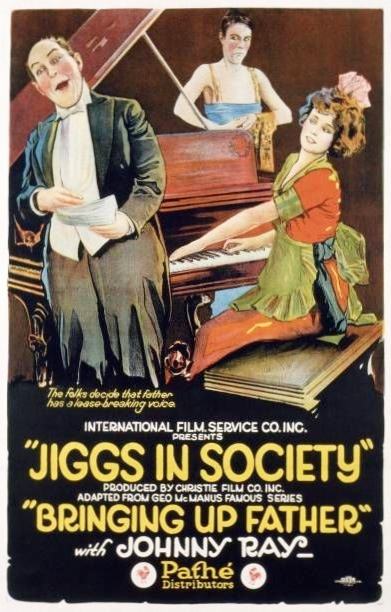
There are films you watch; then there are films that watch you back, peeling your own pretensions like paint under a blow-torch. Jiggs in Society—that rowdy 1920 one-reel wonder—belongs to the latter tribe. It arrives swaddled in the mythology of early Hollywood, a title card sneering “From the celebrated comic strip by George McManus” before the first frame even exhales. What follows is less a narrative than a controlled demolition of social façades, a slapstick ballet where custard-cream etiquette meets pick-axe authenticity.
Director William Watson (never crowned in the history books yet deserving of a sceptre) stages the film like a vaudeville tornado trapped inside a Tiffany lamp. The tonal gear-shifts are reckless: one instant we’re in a Keystone custard melee, the next we’re breathing the same rarified despair found in Diplomacy’s drawing-room tragedies. That elasticity is the movie’s secret weapon; it keeps the rib-cage of satire flexed while the funny-bone takes repeated sledgehammer blows.
Jiggs, played with combustible gusto by Paddy McGuire, is a subway-sandhog who strikes a subterranean vein of ore so luminous it might as well be kryptonite to class hierarchy. Flush with lucre, he and Maggie (Marjorie Payne, a flapper ahead of her flapperhood) purchase a limestone palace whose previous owners died of boredom. Their neighbours—gargoyles in human form—invite them to dinner only to weaponise etiquette: which fork assassinates the snail, which glass drowns the soul.
Enter a subplot involving a forged genealogical chart, a gambling debt stitched into a white glove, and a grand duchess whose pearls are as fake as her smile. Mid-film, the screenplay detonates a fox-hunt that turns into a proto-surrealist chase: hounds wear monocles, riders somersault backwards, and Jiggs—still in work boots—vaults stone walls like a steeplechase kangaroo. The sequence feels pilfered from yesterday’s TikTok algorithm, yet it predates the talkies by seven years.
But the true set-piece is the masquerade ball, lensed in glimmering chiaroscuro. Watson’s camera glides across parquet floors as if on castors, discovering Laura La Plante’s ingénue swathed in moth-wing chiffon while Eddie Baker’s gigolo prowls in Harlequin checks that scream danger. When the orchestra strikes a tango beat, the editing fractures into jump-cuts that anticipate Eisenstein by half a decade—faces, masks, confetti, champagne geysers—an orgiastic collage that lands like a punchline without a joke.
McGuire’s Jiggs is a marvel of elastic physicality; he can balloon into a pompous swell then deflate into a rueful child within the span of a single take. Watch his hands—those calloused mitts—flutter uncertainly above a porcelain teacup as if it might bite. Against him, Marjorie Payne’s Maggie oscillates between social-climbing Napoleon and tender wife; her close-ups, haloed by nitrate flicker, betray a woman terrified that tomorrow’s headlines will yank the rug again.
Ward Caulfield, as the penniless aristocrat who schemes to fleece Jiggs, delivers lineless villainy with a mere eyebrow semaphore. His pencil-mustache deserves its own credit. Meanwhile Laura La Plante, still a year away from stardom in The U.P. Trail, supplies a luminous counter-melody of innocence—her laughter, caught in a silent close-up, feels like sunrise spilling across soot.
Cinematographer Jackson Rose (later the eye behind Left at the Post) shoots chandeliers so they refract into kaleidoscopic halos, turning opulence into a migraine of diamonds. Shadows pool like spilt burgundy; negative space becomes a character—an abyss ready to swallow arrivistes whole. The film’s visual wit peaks when Jiggs, in top-hat too tall, repeatedly smashes it against door-frames; each dent is a silent punch-line, a scarlet letter of social maladjustment.
What elevates Jiggs in Society above contemporaneous one-reelers is its refusal to comfort either tribe. The rich are venal buffoons, yes, but Jiggs’s nouveau-riche hubris is equally lampooned—his gilded walking-stick is merely a shovel dipped in varnish. The screenplay, adapted by McManus himself, weaponises dialect: title cards swing from Bowery slang to perfumed circumlocutions, each shift a stiletto between the ribs of linguistic gate-keeping.
Compare it to the moralistic pratfalls in Sins of the Parents, where poverty is saintly and wealth automatically corrupt. Here, corruption is democratic; greed dons many accents. Even the proletarian pub, Jiggs’s sanctuary, is shown as a cockpit of braggadocio where tomorrow’s wages are gambled on dog races. No one escapes Watson’s wide-angle judgement.
Although original music is lost to nitrate rot, contemporary cue sheets suggest a frenetic fox-trot rhythm. One can almost hear brass sections bleat as Jiggs cannonballs down a staircase riding a silver tray. The editing—handled by the unsung Mildred Richter—pioneers audio-less jump-cuts to simulate syncopation; scenes stutter like a needle skipping on shellac, producing comedic arrhythmia that anticipates Looney Tunes by a generation.
For modern viewers, the film’s sexual politics wobble. Maggie’s hunger for respectability is played for laughs, yet her final humiliation—public exposure of her working-class roots—stings with misogynist relish. Conversely, Margaret Cullington’s dowager duchess wields social artillery like a seasoned general; her triumph is the movie’s sly admission that matriarchs, not men, architected the gilded cages. Feminist critics may grind teeth, but historians will savour the contradiction.
For decades Jiggs in Society languished on the Library of Congress’s “Most Wanted” missing list, a single decomposing print surfacing in a Slovenian monastery in 1998. Thanks to a 4K photochemical resuscitation by the EYE Filmmuseum, the new restoration is a revelation: every scratch has become charcoal, every missing frame a haiku of imagined motion. Released on boutique Blu by Kino Lorber alongside Feathertop, it now glows like a lantern in the catacombs of cinephilia.
Trace the DNA and you’ll find its fingerprints on Sturges’s “Christmas in July”, on Capra’s populist parables, even on the abrasive class satire of “The Triangle of Sadness”. When Jiggs finally rips his tailcoat and dives into a plate of corned beef, he foretells every third-act rebellion against societal corsetry—from “The Discreet Charm of the Bourgeoisie” to “Parasite”.
Yet unlike Bong Joon-ho’s surgical bleakness, Watson opts for cathartic carnival. The final shot—Jiggs dancing a jig amid swirling sawdust while Maggie, defeated yet oddly liberated, taps her foot in 3/4 time—offers no answers, only escape velocity. The camera iris closes like a blood-shot eye, winking at us complicit spectators who still, a century on, mortgage souls for the next rung of some cosmic social ladder.
Is the film flawless? Hardly. Its racial caricatures—brief yet jarring—are a poisoned footnote, and its pacing in reel two stumbles like a drunk searching for a lamppost. Yet its satirical blade remains preternaturally sharp, its pratfalls volcanic, its empathy for the eternal outsider unutterably moving.
In an age when status is measured in blue-checks and NFT apes, Jiggs in Society feels less antique than prophetic. It reminds us that the nouveau riche of 1920 and the crypto aristocracy of 2024 are separated only by the pixelation of their status symbols. Watch it, laugh, wince, then look in the mirror—there, between the pixels of your own curated persona, you might spot Jiggs winking back.
If you crave more silents that bruise as much as amuse, dip into our reviews of The Amateur Liar or the haunting Die tolle Heirat von Laló. And for a double-bill of cynicism, pair this with Crooked Straight—because the more things change, the more we keep slipping on the same banana peel.
IMDb 5.7
1919
Community
Log in to comment.