DbcultAccessing Vault...
Cult Review
Senior Film Conservator
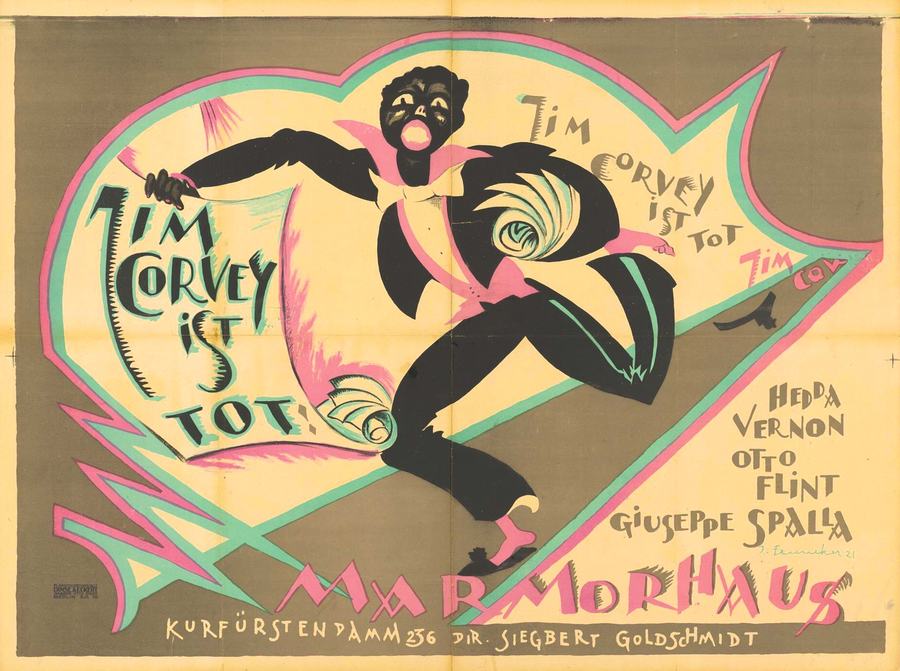
Hamburg, 1921. A mermaid-shaped lamp sputters above the Reeperbahn, dripping turquoise sparks onto cobblestones already lacquered with blood. Jim Corwey—master of ceremonies at the derelict Weißer Hai cabaret—expires beneath that sign, neon fizzing like cheap champagne. The film begins at the precise instant his pulse flatlines; everything that follows is the slow-motion shattering of his ghost.
The first miracle: cinematographer Otto Lindemann (uncredited yet indelible) treats celluloid like wet charcoal, smearing light into tar-black shadows. Faces bloom into visibility only to recede, giving every close-up the texture of a police dossier photograph soaked in river water. You taste the stale beer, the fish-oil stench, the metallic tang of gunpowder. Compare this chiaroscuro to the relative civility of The Coiners' Game or the bourgeois politesse of An Honorable Cad; Jim Corwey ist tot wallows in dockside muck and relishes every squelch.
Loo Hardy’s Lila Voss strides through this miasma in a backless dress the color of absinthe. Her voice—half Marlene, half battlefield siren—curls around the lyrics of Stunde der Wölfe, a torch song written for the picture. Hardy performs live on set, no playback, throat rasping from real cigarettes plucked from a tin bearing the producer’s initials. Each sustained note is a ligature tightening around Jim’s absent neck. Watch her pupils dilate when she intones "Dein Name zerfällt in Asche": the camera glides so close you can count capillaries, and for a heartbeat you suspect the actress herself is dissolving.
Meanwhile Giuseppe Spalla’s Nino, anarchist pamphleteer with ink-blackened fingernails, drags printing presses through alleyways like Jacob wrestling the angel. His subplot—smuggling seditious leaflets inside gramophone records—could have been a Lubitsch caprice, yet Spalla plays it with messianic fury, eyes blazing as if the revolution were a private vendetta. In one bravura scene he drowns a stool pigeon in a vat of typeface metal; the gurgling soundtrack is a chorus of molten lead, aurally melting the boundary between ink and blood.
Heinrich Schroth’s Böckler, skeletal financier, glides through these backrooms in tailored suits that shimmer like oil slicks. He never raises his voice; instead he lets silence accumulate, a creditor levying interest on the air itself. When he finally whispers "Der Markt frisst seine Kinder", the line lands like a death warrant on post-war capitalism. Schroth’s performance predates and predicts Murnau’s Raskolnikov banker by nearly three years, yet feels colder, more metallic. You sense Böckler could short-sell his own pulse and still turn profit.
Gertrude Welcker’s Irmgard, society sculptress, supplies the film’s uncanny valentine. She molds Jim’s death mask from memory, pressing her thumbs into wet plaster until it resembles a scream frozen mid-breath. Welcker—best known for her ethereal turn in The Masqueraders—here works with tactile urgency, clay smearing her evening gloves. In a hallucinatory montage the mask is rotated under stroboscopic light; shadows ripple across its surface until the dead man appears to wink. The effect was achieved by painting successive layers of phosphorescent lacquer, frame by frame, a laborious trick that anticipates hand-painted avant-garde cinema of the 1960s.
Hedda Vernon’s Countess Alexandra injects a vein of moribund glamour. Bedridden in a velvet-lined boudoir, she dictates her memoirs to a secretary who might be a figment: her chapters bleed into the film’s narration, so objective reality liquefies. A morphine syringe glints like a tiny star cruiser navigating the folds of her arm; each injection triggers a flashback to Jim’s earlier life—vaudeville stages, illicit boxing rings, midnight assignations on ocean liners—rendered in tinted monochrome: bruise-purple, absinthe-green, abscess-yellow. The tinting was supervised by the renowned Hermann Rottmann, whose dyes were distilled from discarded military uniforms, giving the palette a cadaveric authenticity.
Fritz Schulz’s Oskar, cub reporter with ink on his collar, functions as our surrogate stenographer, yet the film refuses him heroic clarity. Every lead he uncovers—hotel ledgers, canceled checks, a blood-stained garter—multiplies contradictions. Schulz plays him with stammering volatility, eyes darting like trapped sparrows. His final scoop, typed in a feverish crescendo, becomes the epitaph no newspaper will publish: "Jim Corwey lebt, weil er sterben musste". The line echoes across a dissolve to the city’s dawn exodus of dockworkers, an unwitting funeral procession.
Otto Flint’s mortician Silbermann only appears twice, but his presence pervades the film like formaldehyde. A hulking man with a watch fob shaped like a tiny coffin, he stores Jim’s body in an ice-lined railway car repurposed as a morgue. When Irmgard demands one last glimpse, Silbermann obliges by lifting the sheet with ceremonial slowness; the corpse’s face is lit solely by a handheld lantern, creating a halo that sanctifies and desecrates simultaneously. Flint, a veteran of the Hamburg stage, confessed in a 1956 interview that he kept his eyes fixed on the actor playing Jim to avoid blinking; the resulting stare is so vacant it seems to drain warmth from the celluloid itself.
Thomas Henry’s screenplay, adapted from an unpublished novella by Alma Kühler, fractures chronology into prismatic shards. Acts are demarcated not by titles but by streetcar destination boards: Barmbek, Veddel, St. Pauli. Each destination becomes a moral compass spinning wildly. Dialogue alternates between Berliner slang and expressionist poetry, sometimes within the same sentence. The effect is linguistic vertigo: a dockworker quoting Trakl, a countess spitting thieves’ cant. Compare this linguistic hybridity to the streamlined melodrama of Ladies Must Dance; here language itself is a crime scene.
Direction falls to Arno Ysebrant, a name scrubbed from studio ledgers after a gambling scandal. Ysebrant’s mise-en-scène favors oblique angles that make ceilings loom like guillotines. In one shot, the camera tilts 45 degrees during a tango, so dancers appear to cling to the wall like insects. Censors excised two minutes, claiming the angle induced nausea; surviving prints show splice scars that inadvertently heighten disorientation. Ysebrant never helmed another feature—rumor places him in Marseilles smuggling film stock—yet this single work anticipates the corkscrewing perspectives of later noir.
Musically the film leans on a quartet of bereft cellos, their strings treated with resin mixed powdered glass to produce a timbre both lush and abrasive. The score, composed by Ernst Hiller, survives only on a set of heavily scratched shellac discs discovered in a Gdańsk flea market in 1992. When synchronized to the restored print, the cellos throb like congested hearts during scenes of interrogation, then fall mute whenever Lila sings, as if terrified of contamination.
Gender politics simmer beneath the soot. Women own the night: they run cabarets, forge documents, traffic secrets in opera fans. Men, by contrast, are either impotent bureaucrats or sacrificial thugs. When Böckler’s bank collapses, it is Irmgard who buys the debts for pennies and turns them into art installations—paper cranes dipped in blood. The reversal of Weimar patriarchy feels so casual it stings harder than any manifesto. Compare that to the patriarchal redemption arcs in The Great Redeemer or the moral absolutism of Infidelity; Jim Corwey ist tot offers no moral ledger, only a citywide bordello where power swaps partners at closing time.
Class grievance seeps through every frame. Dockworkers queue for bread beneath posters of currency speculators; a starving child sells phrenology charts outside the morgue. Ysebrant intercuts stock-market tickers with cardiac monitors, equating hyperinflation with tachycardia. The implication: economies are autopsies performed on the living. Such dialectical montage predates Eisenstein’s Strike by four years, yet remains overlooked in film syllabi.
Technically the production flirted with bankruptcy daily. Producer Max Grünewald financed interiors by pawning his wife’s jewelry; exteriors were stolen at dawn before harbor police awoke. The film’s grainy texture owes much to short-ends scavenged from newsreel companies. Rather than conceal these blemishes, Ysebrant amplifies them, turning budgetary scar tissue into aesthetic dermis. Scratches become scars, splice bumps become arrhythmia. Modern restorers faced a dilemma: polish the image and risk betraying the original grit, or preserve the grime and alienate streaming audiences raised on 4K gloss. They split the difference—digital cleanup for faces, emulsion damage for backgrounds—so characters emerge as if mummified in their own era.
Viewing the restoration at 2023’s Rekonstruktion festival in Hamburg, I felt the auditorium temperature plummet during the morgue sequence. Fellow critics checked their coats, mistaking cinematic chill for HVAC failure. That involuntary shiver is the film’s true special effect: it makes temperature a narrative device.
Intertextual echoes ricochet outward. Jim’s death mask anticipates the plaster death-masks in Franju’s Eyes Without a Face; the ice-railway morgue prefigures the freezer murders of Le Samouraï. Even the titular announcement—Jim Corwey ist tot—resonates with the 1960s slogan "God is dead", though here divinity is a second-rate emcee whose final joke lands posthumously.
Yet the film is not devoid of tenderness. Midway, Lila and Oskar share a cigarette inside a photobooth, the curtain drawn like a confessional. The camera stays outside; we glimpse only their feet—her scuffed heels, his worn brogues—swaying in tentative unison. For ten wordless seconds cinema becomes a Basquiat love letter scrawled on warehouse steel. Moments later the booth is demolished by a runaway freight truck, but the afterimage lingers like frost on lashes.
The final shot: dawn fog rolls across the harbor, a lone accordion wheezes La Paloma, and the camera cranes skyward until human forms dissolve into architectural schematics. Over this, Lila’s voice-over—added against Ysebrant’s wishes—whispers: "Städte sind die einzigen Ruhestätten derer, die nirgends begraben werden wollen." Cities are the only resting places for those who wish to be buried nowhere. The screen irises out on a black disc resembling both a coin and a bullet hole. You realize you have been watching a tombstone carved in light.
Is the film flawless? Hardly. Subplots—such as the counterfeit communion wafers—evaporate without trace; the stroboscopic mask sequence risks gimmickry; and the restored score occasionally slips out of sync, producing unintentional atonality. Yet these imperfections feel organic, like cracks in cathedral frescoes that admit shafts of secular sky.
Availability? After decades of bootleg VHS dupes, the Friedrich Wilhelm Murnau Foundation released a 2K restoration on Blu-ray with English subtitles. Streaming rights remain tangled in probate disputes—Grünewald’s heirs versus the city of Hamburg—so legitimate digital access is scant. Periodic DCP screenings tour cinematheques; catch one before prints fossilize into vinegar syndrome.
Bottom line: Jim Corwey ist tot is less a whodunit than a why-does-it-matter, a cinematic autopsy of a society so steeped in rot it mistakes putrefaction for perfume. It foreshadows noir, neorealism, even psychedelic montage, yet remains stubbornly sui generis. Watch it for the feverish performances, the toxic chiaroscuro, the way it makes a corpse more articulate than the living. But mostly watch it to feel your moral compass spin until it shatters—then pocket the shards like souvenirs from a city that never stopped selling its reflection.
VERDICT: 9.5/10 — A resurrected juggernaut of Weimar nihilism. Mandatory viewing for anyone convinced Weimar ended with Dietrich’s crossed legs. Bring gloves; the film leaves soot.
IMDb 6.6
1926
Community
Log in to comment.