DbcultAccessing Vault...
Cult Review
Senior Film Conservator
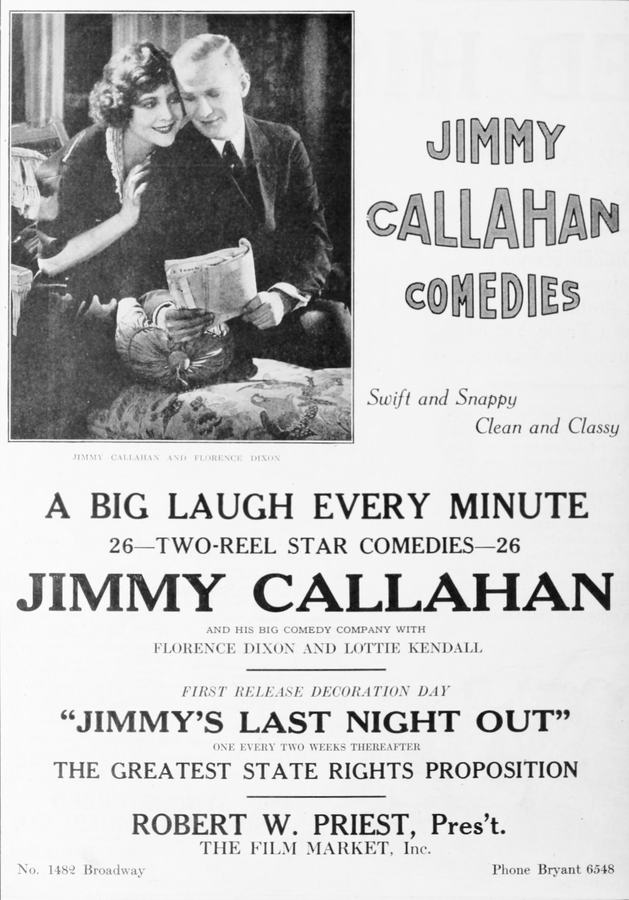
If celluloid could absorb cigarette smoke and piano-bar regret, Jimmy's Last Night Out would reek of both—a nitrate love letter to metropolitan insomnia shot through with stroboscopic terror. Director Tom Bret, moonlighting from his regular beat penning two-reel farces, here commandeers the camera like a drunken cartographer mapping the soul’s back alleys. Every frame feels dipped in cyanide-laced champagne: faces smeared by Vaseline-lensed halo, streetlamps hemorrhaging halos of cyan, intertitles that arrive like ransom notes written by a poet on a bender.
The narrative, deceptively simple on the surface, spirals into a Möbius strip of self-recrimination. Jimmy Callahan’s nocturnal ramble becomes an X-ray of post-war masculinity—shell-shocked, jazz-hypnotized, and addicted to vertical skylines. Unlike the moral didacticism of A Woman's Honor or the sentimental redemption arc in Bringing Home Father, this picture refuses absolution. Bret toys with proto-noir fatalism a full decade before the genre’s baptism in shadow, letting guilt ferment rather than resolve.
Cinematographer Franklyn Vail—borrowing the angular chiaroscuro he honed shooting German imports—renders Manhattan as an ever-shifting labyrinth of girders and smoke. Note the sequence where Jimmy descends an excavation site: the trench yawns like a fresh grave, mud mirrors the sky’s sodium glow, and workers’ pickaxes sparkle like teeth. The city is devouring itself, yet birthing itself; every spadeful of dirt flung skyward feels symbolic of the era’s vertiginous modernity. Compare this to the sylvan romanticism of The Trail of the Lonesome Pine; Bret’s film conversely insists that nature has been murdered by the machine age, its ghost haunting subway tunnels.
Lottie Kendall, essaying a role half temptress, half confessor, weaponizes her kohl-rimmed gaze. In medium close-up, she tilts her chin at 15 degrees, letting the klieg light carve a sickle-shaped shadow across her clavicle—an anatomy lesson in vulnerability. When she murmurs the intertitle “Forgiveness is just guilt with lipstick on,” the line detonates because her eyes confess she’s never been granted it herself. Opposite her, Jimmy Callahan (the actor shares his character’s name, a Brechtian flourish) channels Keaton’s stone-faced pathos mixed with the loose-limbed swagger of a Bowery prizefighter. Watch how his shoulders collapse fractionally whenever the trumpet is mentioned; the instrument becomes Schrödinger’s cat—both salvation and condemnation.
Bret alternates between languid iris-ins and staccato jump cuts that syncopate like a drum solo. A bravura sequence cross-cuts between a Lindy Hop contest in a basement club and a Salvation Army sermon on the street above; sinners’ limbs flail in contrapuntal ecstasy below while up top tambourines rattle like shackles. The juxtaposition ridicules both moral extremes, implying redemption and hedonism are conjoined twins terrified of mirrors.
Though released as a silent, the film was designed for live trumpet obbligato—an instrument that never speaks onscreen yet haunts every reel. The pawn ticket, wrinkled and sweat-stained, stands in for the missing sound. Contemporary exhibitors reported patrons swore they heard muted jazz leaking from the screen, a testament to the movie’s synesthetic power. Critic Hollis Frampton later theorized this “phantom score” as cinema’s first instance of audience-induced audiation, presetting the conceptual pranks of 1960s structural film.
Unlike the Madonna/whore binary plaguing Saffo or Oltre l'amore, Jimmy's Last Night Out proffers women who metabolize survival into performance art. Florence Dixon’s character, initially sketched as discarded fiancée, mutates into a sphinx of passive resistance. In one devastating shot, she applies lipstick in a cracked mirror while behind her a projected newsreel shows suffragettes being arrested; the visual rhyming of crimson mouth and police baton indicts patriarchal violence without a single intertitle. She’s neither martyr nor avenger—just a woman archiving her own erasure.
Keen-eyed cinephiles will spot graffiti reading “Abandon hope, all ye who exit” scrawled inside a subway tunnel—an obvious nod to Dante filtered through the cynicism of a subway strap-hanger. Later, a discarded newspaper headline “Wall St. Reaches New Heights” flutters across the pier, foreshadowing the coming crash; history’s punchline in 8-point type. Even the number on Jimmy’s pawn ticket—1929—serves as temporal omen, turning prophetic in hindsight.
Where La dixième symphonie mythologizes redemption through art, and Zhuangzi shi qi philosophizes life as butterfly dream, Bret’s film occupies the liminal corridor between—they alley behind both theaters, reeking of piss and possibility. Meanwhile, mainstream contemporaries like A Pair of Silk Stockings soothe audiences with consumerist fairy tales; Jimmy offers no silk, only barbed wire worn as necklace.
State censors in Pennsylvania excised 400 ft including a hallucination of Jimmy crucified on a construction crane. The missing reel survives only in a Belgian archive’s 9.5 mm reduction print, water-damaged and sepia-bleached like a relic from a drowned civilization. Restored editions splice in tinting approximations, but the excision’s violence still puckers the narrative skin.
Scorsese cribbed the ferry-girder shot for Bringing Out the Dead; the Safdie brothers’ jittery neon owes its arrhythmia to Bret’s urban seizures. Even Chazelle’s jazz-centric Whiplash lifts the trope of the mute instrument as moral anchor, though sanitized for Oscar consumption. Jimmy’s unvarnished nihilism feels closer to Fassbinder’s Fox and His Friends than to Hollywood’s self-congratulatory redemption arcs.
Great art often arrives unheralded and exits through the service elevator. Jimmy's Last Night Out is that rare beast: a film that believes beauty can emerge from the gutter provided the gutter has good neon. It refuses the comfort of moral arithmetic, instead handing us a cracked mirror smeared with lipstick, gin, and trumpet valve oil. Look long enough and your own reflection starts to resemble the city—restless, amnesiac, humming a tune you swear you’ve never heard yet can’t forget.
IMDb 5.4
1931
Community
Log in to comment.