DbcultAccessing Vault...
5.6/10
Senior Film Conservator
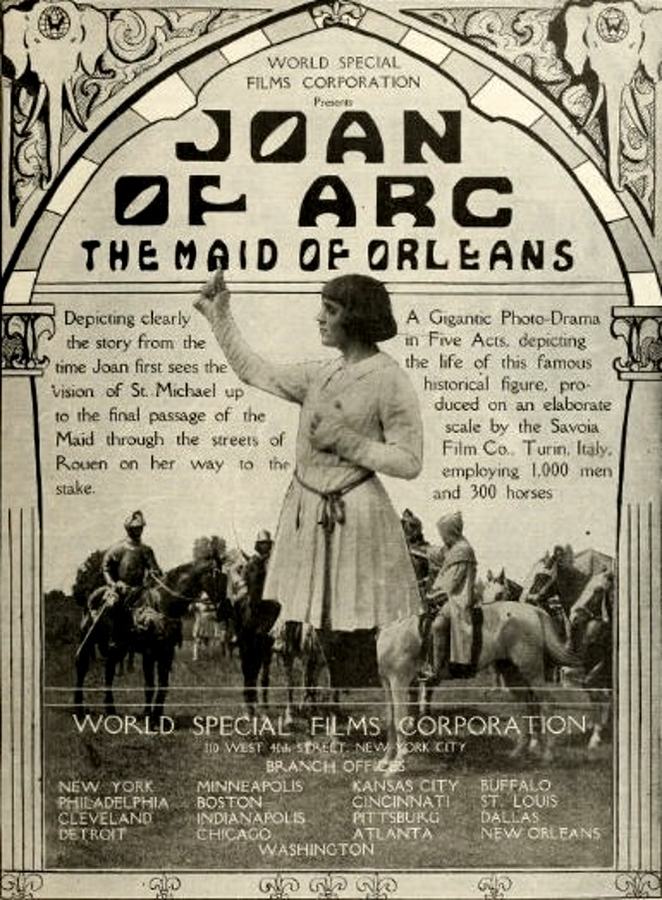
A definitive 5.6/10 rating for a film that redefined the boundaries of cult cinema. Joan of Arc remains a cornerstone of transgressive art.
The celluloid cathedral that is Joan of Arc (1915) opens not with trumpets but with the hush of sheep hooves against damp grass—an aural absence that feels, paradoxically, thunderous in the mind’s ear. Directors and cinematographers of the pre-feature era were still learning that silence could throb louder than any orchestra, and this Italian production wields that vacuum like a scalpel. We hover above the Meuse, watch smoke coils from burnt granaries, and sense a cosmos bruised by civil feud. Into this bruise steps Maria Jacobini, her face a study in chromatic contradiction: porcelain skin yet sunburned resolve, eyes that seem to collect all the blue of the river and refract it back as steel.
Jacobini’s Joan is not the stock operatic virago silent cinema loved to caricature; she is tremor and titan, a reed that refuses to bow though the tempest promises obliteration.
When the first voice arrives—intertitle rendered in glimmering gold on velvet black—it lands like a tuning fork struck against the soul. We realize the film’s true special effect is not double exposure (though saints materialize via clever mattes) but temporal vertigo: 15th-century mysticism welded to 20th-century anxiety. Every flicker of torchlight on chainmail feels like newsreel from a war we never finished fighting.
Shot on sets that stretch into painterly distance—miniature castles dissolving into real rivers—the picture anticipates the seamless mash-ups later beloved by Griffith and Gance. Yet scale never eclipses intimacy: a cut from besieged Orléans to Joan’s gauntleted hand tightening on a crucifix compresses geopolitics into one palpitating palm. Cinematographer Alberto Nepoti (pulling double duty as Brother Pasquerel) favors low horizon lines, so characters stand cruciform against skies bruised lavender; it’s as if the camera itself were genuflecting.
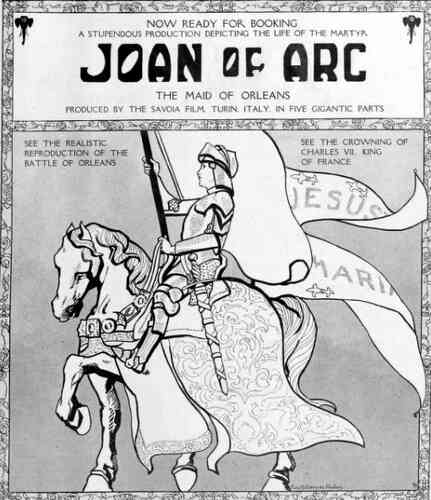
Color tinting—amber for hearthside counsel, livid green for betrayal, bruised magenta for the final pyre—operates like stained glass in motion. Because each shift is hand-pulled, fluctuations in dye density become a pulse: the film literally breathes. Archives sometimes mislabel these palettes as flaws; heresy, I say. They are the birth-cries of photogenic sanctity.
Silent film accompaniments range from penny-piano doodles to full Wagnerian assault; the Cinémathèque’s 4K restoration toured with a trio scoring on hurdy-gurdy, electric viola, and glass harmonica. Result: a drone that feels like the cosmic hum Joan alone perceives. Each arrow volley syncs with a bow-scrape scree, every saintly visitation chimes through crystal resonance. The absence of spoken French or Latin paradoxically universalizes the text; language becomes secondary to the oratory of faces.
Jacobini’s close-ups—often shot at 28 fps then slightly over-cranked—produce micro-tremors in lip and eyelid. You sense the cost of conviction: how certainty erodes the bearer even as it exalts her.
The Siege of Orléans unfolds across three terraces of depth: foreground spike-barriers, mid-ground clashing pikemen, background burning bastions. Squibs—gun-cotton wrapped in sackcloth—send geysers of earth skyward; stunt riders somersault off parapets into straw stacks painted to match river-reeds. No optical printer? No problem. Reverse footage makes banners re-erect themselves, implying divine rewinding of time. The sequence runs twelve minutes yet feels like a single lunging breath, thanks to diagonal compositions that push energy from upper left to lower right of frame.
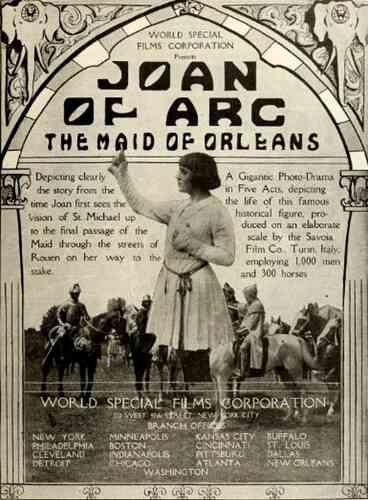
Compare this kinetic grammar to the static tableaux dominating From the Manger to the Cross or the pastoral calm of Glacier National Park; you realize how aggressively modern this 1915 epic dared to be.
Post-victory, the film pivots from open fields to claustrophobic antechambers where candle-smoke clings like gossip. Here, the screenplay weaponizes embroidery: ladies-in-waiting fondle stitched lilies while plotting the Maid’s fall. Joan, clad in ill-fitting brocade, resembles a hawk forced into peacock feathers—a visual metaphor for institutional unease with female potency. When the Dauphin—played by Mario Ronconi with perpetual flop-sweat—snatches the laurel from her helm, the gesture lands as both crowning and castration.
Gender politics ripple outward. The clergy condemn her for wearing male harness, yet the camera lingers on the same prelates’ silk slippers—hypocrisy threaded in stitches of gold. The film doesn’t sermonize; it juxtaposes, letting irony detonate in the viewer’s cortex.
The final reel pivots to proto-noir: iron grilles fling venetian-stripes across Joan’s face, rats skitter over manacles, and Loyseleur—the priest-confessor—emerges from shadows like Murnau’s Nosferatu. Intertitles here shrink, as though language itself were shrinking from atrocity. One card reads only: “And I was left alone.” White letters on black—Beckett before Beckett.
Bertrand’s attempted rescue, scored by a heartbeat on tympani, ends in a vertiginous plunge down stone turrets. The stunt double lands on real scree; dust plumes linger like guilt. Censors in Turin demanded trimming of these shots for fear of copycat suicides. Evidence survives in splices—four-frame jumps where continuity gasps. Such lacerations only amplify the horror: history itself is edited by cowards.
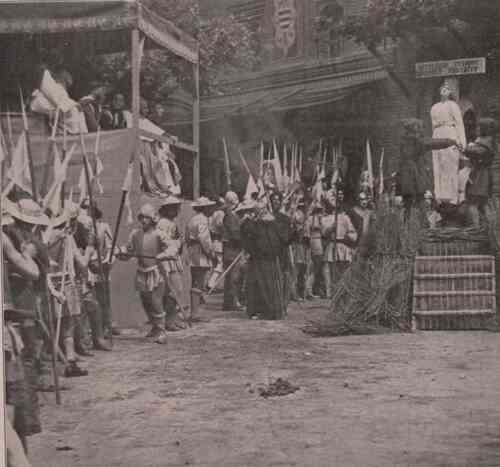
The execution is shot at twilight, utilizing natural azurite sky which contrasts the orange pyre. As flames lick upward, tinting shifts from magenta to near-crimson, achieving a gradation digital tools still struggle to mimic. Smoke forms a chiaroscuro veil through which Jacobini’s silhouette spasms. Editors intercut crowd faces—some moist with remorse, others gleaming with cruelty—achieving Eisensteinian montage years before Potemkin. When the pyre collapses, the camera tilts 30 degrees, queasy horizon, as if morality itself were slipping off the planet.
Even her tormentors murmur “We have burned a saint,” a line so subversive it was censored in Lyon prints. The film thus indicts not only medieval theocracy but also any modern spectatorship that confuses orthodoxy with truth.
Jacobini, barely nineteen during production, claimed she “fasted between takes to keep the ribs visible” beneath hauberk. The ascetic regimen translates into a physical vocabulary: shoulders perpetually forward like someone walking against gale, eyes wide yet brows knit in pre-emptive mourning. Watch her confront the Dauphin’s theologians: she answers questions with a nod that begins assertively then decays into tremor—confidence and terror occupying the same muscle. It’s a moment Cate Blanchett would echo decades later, proof that the silent era anticipated interiority no less than Expressionist frenzy.
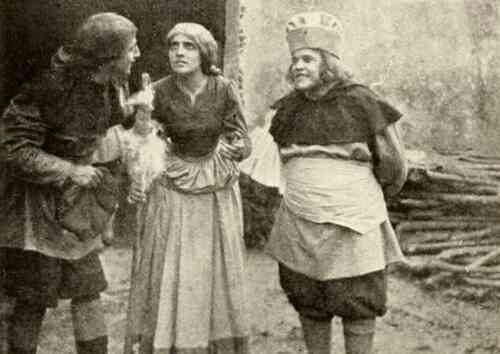
Alberto Nepoti’s Loyseleur oozes oleaginous sanctity: smile never reaches the pupils, rosary beads click like tally-counters for souls. The performance anticipates modern televangelist scandals; you sense he believes and disbelieves simultaneously, a fracture more chilling than outright villainy.
Screenwriters condense months of diplomatic tedium into brisk montage, yet retain the trial’s philosophical spine: the tension between personal revelation and institutional authority. Joan’s replies—lifted almost verbatim from trial transcripts—acquire existential shimmer when stripped of vocal inflection: “I have come from God. I have nothing more to say.” The flatness of intertitle becomes koan.
One invented scene—Joan blessing syphilitic soldiers—invokes tactile compassion: she presses her bare palm against ulcerated cheeks. Contemporary critics blasted it as Catholic propaganda; modern viewers see radical embodiment of mercy, a riposte to ecclesial hypocrisy. Art sometimes outlives the polemics that birthed it.
Released in New York as The Maid of Orleans, the print toured with a 20-piece orchestra and a parish choir, raking unprecedented box-office during WWI relief drives. In Madrid, anarchist pamphlets re-purposed stills of Joan in armor to recruit women militias. Across the Pacific, Australian bushranger ballads interpolated her name: “She rode like the maid of the Orleans glare.” Thus a regional saint morphed into transnational icon, proving cinema’s viral velocity decades before hashtags.
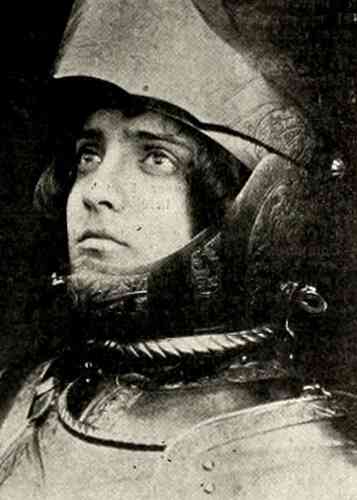
Compare this cultural osmosis to the geographically narrower impact of The Adventures of Kathlyn or the sports-centric fervor of The Corbett-Fitzsimmons Fight. Joan’s story, already archetypal, multiplied by film’s nascent global reach became a pop-culture singularity.
The 2023 4K restoration by the Cinémathèque franco-italienne unearthed a censored subplot: a lady-in-waiting secretly sketches Joan in profile, intending to sell the likeness to English spies. The charcoal drawing becomes metonym for image-making itself—how iconography can both exalt and entrap. Tinting was digitally matched to chemical analysis of nitrate edges; the once-faded sea-blue of the Loire now ripples with cyan vigor, enhancing the motif of water as moral mirror.
Scholars detected alternate takes—Joan’s gaze held longer, hinting at uncertainty. These micro-variants remind us that even finished silent films remain fluid texts, reshaped by every archivist’s ethical choices.
Fast-forward to Carl Dreyer’s Passion of Joan (1928) and you’ll spot direct quotations: the tilted dungeon grille, the tearful soldier kissing Joan’s shackles. Roberto Rossellini would borrow the documentary twilight for Stromboli; Bresson lifts the auditory absence during transfigurations. Even in Spielberg’s War Horse, the silhouetted rider against flares evokes Jacobini’s stand at Orléans. Great films never die; they procreate in the imaginations of later auteurs.
On television, recent series such as The Last Kingdom crib the color-coded battle blocks—gold for French, steel-grey for English—proving the silent epic’s chromatic strategy still solves narrative logistics.
Today, when algorithmic feeds flatten complexity into slogans, this century-old film insists on contradiction: Joan is warrior and pacifist, mystic and tactician, heretic and saint. It warns that institutions will weaponize ambiguity to silence dissent, whether by fire or by Twitter pile-on. Yet it also celebrates the irreducible spark within any individual who, hearing voices—call it conscience, art, or madness—refers to no committee for validation.
Stream it on your 4K TV, lights dimmed, headphones cranked. Let the hurdy-gurdy drone mingle with traffic outside your window. Feel the heat-lightning of Jacobini’s eyes pierce pixel and glass. You’ll emerge scorched, exalted, and—perhaps—whispering along with the closing intertitle: >“And the bells rang without hands.”
In an age where saints are rebranded as influencers, this relic of photochemical faith reminds us that some fires are not meant for likes, but for liberation.
IMDb 2.9
1915
Community
Log in to comment.