DbcultAccessing Vault...
Cult Review
Senior Film Conservator
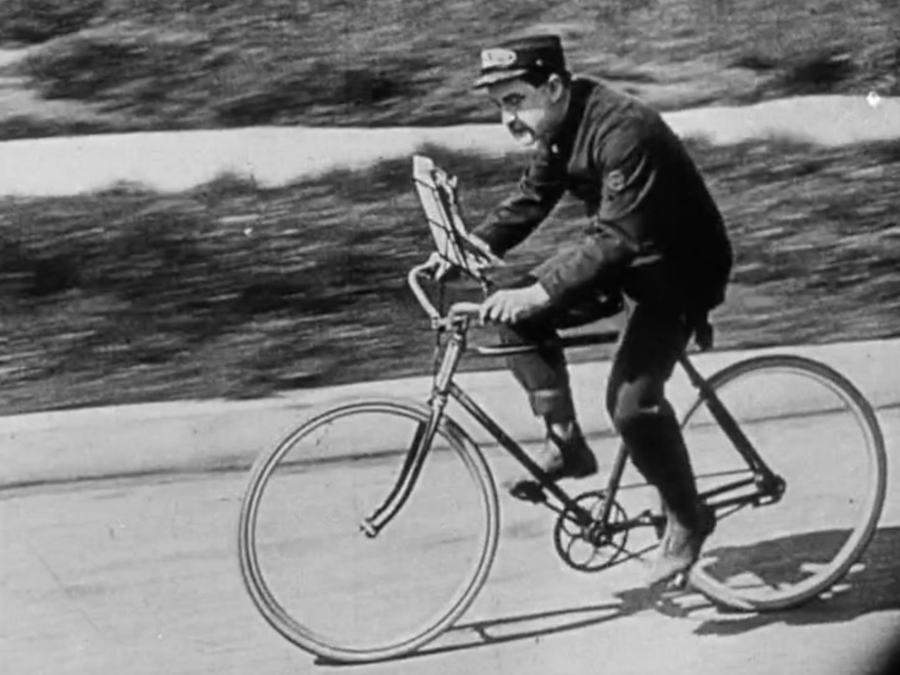
The first thing that strikes you is the grease-shot shimmer of the opening title card—white serif letters quivering like fresh bicycle spokes against a velvet-black background—promising, in the quaint parlance of 1920, "A Whirlwind of Watts and Wooing." One frame later, the camera plunges into a seaside boardwalk where Marie Mosquini glides past on a drop-frame cruiser, her cloche hat pinned with what looks suspiciously like a naval semaphore flag. She is, we quickly intuit, a woman who calculates star trajectories between sips of lemonade, a flapper astronomer in a world still lit by kerosene.
Enter ‘Snub’ Pollard, a human exclamation point in plus-fours, clutching a wrench the way other men clutch regrets. His bicycle, a spindly skeleton of rust and optimism, collapses beneath him with the sigh of a Victorian maiden. Instead of mourning, he pirouettes into a junkyard symphony, unscrewing, re-welding, and Frankensteining until the machine sprouts wings culled from broken biplanes, a klaxon robbed from a sunken tugboat, and a parasol that unfurls like a jellyfish. The metamorphosis is edited with the stutter of a skipping phonograph; each cut lands like a hiccup in the space-time continuum.
What follows is not so much a plot as a kinetic fugue. Mosquini challenges Pollard to a race across the "Cyclone Mile," a boardwalk loop rumored to coil tighter each lap until it disappears into its own axis. The stakes: a silver-plated astrolabe she wears as a brooch, versus his pledge to tattoo her initials on the moon. Yes, the moon—this is 1920, when hubris arrived pre-shrunk and packaged as charm.
The race detonates into a cascade of Rube Goldberg calamities. A policeman’s whistle morphs into a slide-whistle, then a steam calliope. A pack of beachgoers transforms into a single, many-headed scarf that trails Pollard like a comet tail. Every intertitle card—usually the driest of silent-film vertebrae—here drips with lemon-zest sarcasm: "He shifts into fourth gear: Destiny." Cut to the bike ejecting its own seat, sending Pollard skyward where he briefly shares a cloud with a bemused pelican.
Mosquini, meanwhile, pedals with the serenity of a solar eclipse. Her expression never wavers, even when side-swiped by a rogue wedding cake that explodes into a blizzard of sugared violets. She is the film’s gyroscope: while Pollard ricochets through slapstick wormholes, she maintains orbital grace, her eyes fixed on the finish line that may or may not be a metaphor for modern womanhood. Watch how she tightens her goggles—two quick snaps—and the gesture feels more radical than any flapper’s Charleston; it is the declaration of independence rendered in micro-motorics.
Mid-film, the narrative pirouettes into a cavernous warehouse where shadows are painted the color of burnt brown sugar. Here the bicycle achieves full surreal sentience: its headlamp becomes a Cyclops eye, the chain writhes like a metallic eel, and the front wheel sprouts spokes that act as piano keys. Pollard, now strapped to his creation by leather aviator straps, must play a tune recognizable to the warehouse’s resident bulldog—if the dog howls in key, the exit door unlocks. He plinks out "Yankee Doodle," off-key of course; the dog responds with a baritone aria that shatters every wine bottle in sight. Glass confetti rains onto the duo, refracting the single hanging bulb into a galaxy of amber constellations. It is, in essence, a birth scene: man and machine baptized by chromatic shards, reborn as a single mythological organism.
Compare this moment to the courtroom pyrotechnics in Justice d’abord or the sepulchral waltz of Das Maskenfest des Lebens; those films intellectualize fate, whereas The Bike Bug prefers to tickle fate until it wets itself. Slapstick, at its apex, is not low comedy but high physics: every pratfall a rebuttal to Newton, every pie-in-face a dissertation on entropy.
By the time the lovers re-emerge onto the pier, dawn has arrived like a Polaroid developing in real time. The finish line ribbon—previously a mundane strip of cotton—now billows like the veil of a Byzantine icon. Mosquini wins by half a wheel, but instead of claiming her trophy, she kisses Pollard amid the collapsing tape, their mouths full of salt and confetti. The bicycle, exhausted by its own ambitions, disintegrates into a heap of gleaming debris that looks, for all the world, like a galaxy that has misplaced its gravity. A final intertitle, almost whispered: "Love, unlike machinery, needs no spare parts."
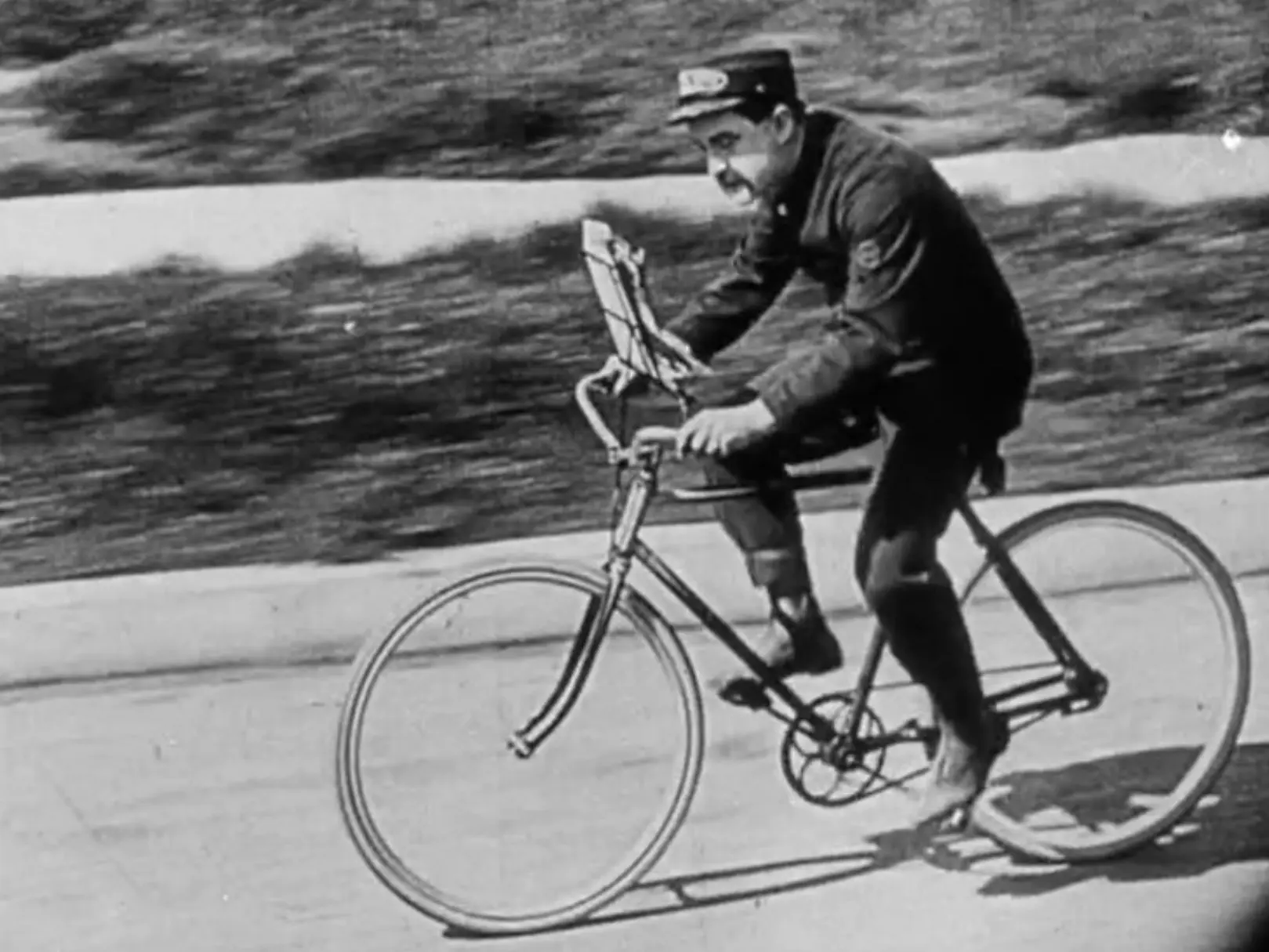
Let us now speak of temporal resonance. A century on, when CGI superheroes punch holes through multiverses, the crude, tactile wizardry of The Bike Bug feels paradoxically futuristic. Every visible wire, every over-cranked camera, every hand-painted backdrop exposes the labor of illusion; the film wears its artifice like a boutonnière. In an age when digital erasure seeks to hide the seams, here the seams sing.
Mosquini, often dismissed as a mere "ingenue," operates as the film’s Rosetta Stone. Notice how she pockets the astrolabe brooch after the kiss—not as spoils, but as a relic of the contest that no longer matters. In that gesture she foreshadows the post-war woman who will enter factories, laboratories, and eventually space programs. Compare her trajectory to the eponymous protagonist of Miss George Washington or the stifled bride in The Woman Michael Married; those characters wrestle society for agency, whereas Mosquini assumes it between heartbeats, her competence so casual it feels like sorcery.
Pollard, for his part, is the harlequin alchemist—all elbows and ecstasy. His acting style predates the Method by decades, yet there is something uncannily contemporary in the way he lets silence pool around his eyes before a gag detonates. Watch the micro-beat when he realizes the bicycle has achieved sentience: terror, pride, and paternal fondness flicker across his face at 24 frames per second. It is the silent-era equivalent of a triple-exposure photograph, a psychology rendered without words, sans orchestra.
The cinematography, credited to a cameraman known only as "R. J. Sparks," deserves its own monograph. Note the chiaroscuro inside the warehouse: shadows so velvety they seem to muffle sound, while highlights ping off chrome like ricocheting bullets. Sparks over-cranks the camera during the bike’s metamorphosis, then under-cranks the chase, creating a temporal whiplash that predates Eisenstein’s montage by several years. The effect is not academic; it is visceral, like swallowing a rollercoaster.
And the score—oh, the score, even though most prints have lost it—survives in descriptions from 1920 trade papers: "a fox-trot that mutates into a gallop, then a waltz in the key of collapsing brass." Modern restorations often pair the film with toy-piano compositions or glitch-hop remixes, but I prefer the whisper of pure silence, perforated only by the projector’s mechanical heartbeat. In that hush you can hear the ghost of the twentieth century learning to ride a bicycle.
Some historians lump The Bike Bug alongside Leap Year Leaps or Going Straight as disposable one-reelers. Such taxonomic laziness overlooks the film’s subversive core. Beneath the pratfalls lurks a manifesto: that technology, when yoked to imagination, becomes an extension of the body and the heart alike. The bike is not a gadget; it is a promise—that we may yet outrun our fates, if only we dare bolt a parasol to a freewheel.
Criterion rumors swirl, but for now the only accessible prints float on YouTube like messages in bottles—faded, flecked with mold, yet glowing with defiant joy. Seek the 4K scan from the Eye Filmmuseum; it restores the amber glow of the pier lights, the bruised lavender of Mosquini’s skirt, the mercury sheen of Pollard’s goggles. Watch it at 2 a.m., volume muted, windows open to summer cicadas. You will swear the air smells of salt, of rust, of popcorn kissed with kerosene.
In the end, The Bike Bug is less a film than a perpetual motion machine. Long after the final frame, your mind keeps pedaling, inventing new gears, new constellations, new ways to weld whimsy to longing. It is the rare artifact that restores your faith not in cinema’s past, but in its future—a future that, thanks to Mosquini’s astrolabe and Pollard’s wrench, remains stubbornly, gloriously unspoked.

IMDb 4.9
1918
Community
Log in to comment.