DbcultAccessing Vault...
6.2/10
Senior Film Conservator
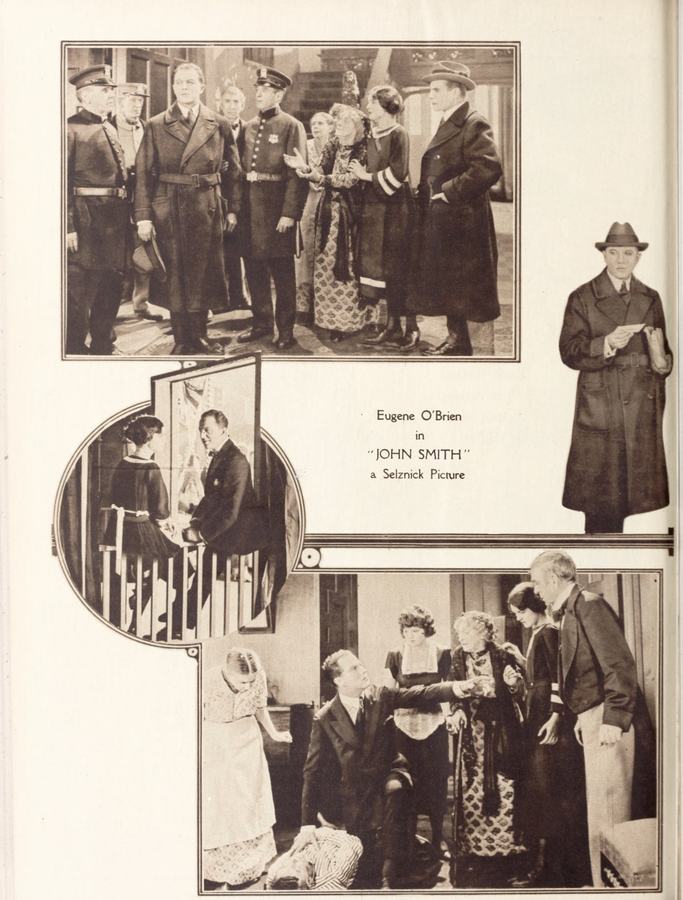
A definitive 6.2/10 rating for a film that redefined the boundaries of cult cinema. John Smith remains a cornerstone of transgressive art.
Prison gates clang open; the camera refuses to track the liberated man’s face. Instead, it lingers on the rusted lock, as though the mechanism itself were the protagonist of John Smith. This 1920 obscurity—sandwiched between Mary Astor’s ingénue season and Frankie Mann’s swift obscurity—understands that identity is less a possession than a parole board formality. Lewis Allen Browne and Victor Heerman’s screenplay treats the past like a tin can tied to the ankle: it rattles behind every confident stride.
Shot on the cheap in and around Yonkers, the picture substitutes urban verismo for the Expressionist gloom then fashionable in Berlin. Smokestacks, shanty roofs, and the perpetual hiss of passing trains create a soundscape of silence. Cinematographer Walter Greene (years before he photographed The Busher) favors low-angle windowsills and rain-glazed cobblestones; faces emerge from darkness like hurried charcoal sketches. The result feels closer to Italian neo-realism than to Griffith’s melodrama, though Griffith’s moral absolutism still haunts the edges.
Lawrence Hilliard—renamed John Smith in a wink so meta it predates post-modernism—enters the labor market as both commodity and contraband. A ledger clerk sizes him up: “Experience?” The pause that follows is the film’s most honest line. Mann’s performance is calibrated on micro-gestures: the left eyebrow that betrays panic, the thumb that rubs a non-existent wedding ring. Silence becomes a solvent stripping varnish off the American success myth.
Contrast this with Irene Mason’s entrance: an iris-in reveals Mary Astor perched atop a typewriter like a sardonic angel. She commands language the way John is commanded by it—every application, every vouchsafe letter a potential trap. Their chemistry ignites not in longing glances but in competing tempos: her staccato keystrokes syncopate against his measured breathing. It’s a duet of divergent time signatures, and the tension is exquisite.
Irene’s occupation is no accident. As social secretary she is the keeper of handwritten façades—dinner lists, charity auctions, thank-you notes scented with lavender denial. John’s labor is to archive the books of her employer, a bankrupt philanthropist whose busted bust of Caesar surveys the decay. Together they alphabetize the ruins of Gilded Age hubris, a metaphor so blatant it circles back to poetry.
Heerman’s intertitles, sparse and sardonic, read like newspaper clippings bled of ink: “A man may leave his past behind, but the past keeps the receipt.” The letters—those brittle paper birds—function as both exposition and epistolary time bombs. One arrives from the chaplain who “knew the boy before the bars.” Another is a yellowed clipping that headlines: TRUSTEE SWINDLER SENTENCED. Each scrap forces the viewer to assemble the backstory like a jury reviewing exhibits.
Director John Butler (in the only film he ever helmed) stages class friction with tableaux worthy of Comradeship’s Pabst. At a fundraising soirée, waiters glide in phantom-like synchronization while Irene negotiates seating charts that will decide dowries and political careers. In the kitchen John scrubs pots, his reflection in the copper basin fractured like a cubist confession. The sequence lasts under two minutes yet indicts the entire caste machinery without a single title card.
George Fawcett, playing Irene’s dyspeptic benefactor, embodies patrician fatigue. His eyes—cataracts of entitlement—register John’s face from a prison mat photo displayed at his club years earlier. Recognition flickers, not quite actionable, but enough to tint every subsequent interaction with dread. The aristocrat’s leisure is portrayed as a giant ledger of unpaid debts; John’s crime merely one line item among many, albeit the only one adjudicated.
Mid-film, the narrative fractures into a road-movie fugue. John, fearing exposure, quits town on a coastal steamer, only to find Irene aboard, assignment in hand: chaperone a senator’s daughter to a resort. The oceanic setting inverts the earlier claustrophobia: now space is abundant, choices scarce. Greene’s camera tilts to horizon lines that seem to mock human trajectories. Fog swallows establishing shots; characters emerge as apparitions negotiating penitence.
Here the film borrows the visual lexicon of Scandinavian silent cinema—think Det finns inga gudar på jorden—where nature dwarfs moral narratives. Waves erase footprints faster than they form, a visual refrain that externalizes John’s Sisyphean reinvention. Irene’s epiphany arrives not via dialogue but through wardrobe: she doffs her secretary’s collar-and-tie for a bathing frock the color of sunrise, a chromatic declaration that forgiveness is possible, perhaps inevitable.
Frankie Mann never made another picture, which cements his turn as John Smith in amber—an accidental Brando before Brando. Watch the way his shoulders climb when Irene brushes past; the flinch is ancestral, passed down through chain-gang blood memory. Opposite him, Astor already flashes the porcelain resilience that would anchor Maltese Falcon two decades later. Yet here she is less femme than antenna, picking up frequencies of deceit the way others hear distant thunder.
Supporting players orbit like Dickensian grotesques: Walter Greene’s shop-floor gossip, lips pursed as if forever tasting vinegar; Tammany Young’s paperboy, whose newsprint crown foreshadows the headlines John dreads. Each cameo is sketched with a single economical stroke—never caricature, always residue.
Archival records indicate the original exhibition carried a cue sheet calling for “Adagio for Strings, muted, repeating” during the prison-release scene, and “Whispering Hope” on solo harmonium for the lovers’ first kiss. Modern revival houses often substitute Max Richter or Hauschka, but the correct analog is wind through cracked plaster. The film’s true score is negative space: the 18-frame gap between Irene’s blink and John’s swallow that feels like a lifetime.
Third-act tension pivots on a moral ledger: can love balance the books when truth is audit-proof? John considers confessing in a letter, but Irene preempts him by torching the incriminating clipping. Fire becomes a contract—mutual amnesia sealed in ash. The film refuses catharsis; instead it offers precarious equilibrium. Final shot: the couple ascend a boardwalk into a fog bank that swallows them whole. No iris-out, no superimposed THE END. The frame freezes, the celluloid crackle our only closure.
Compare this with The Career of Katherine Bush, where social mobility is triumphant, or with Madame Spy, where past sins detonate present happiness. John Smith lands nearer to Erdgift’s ethical murk: redemption exists, but only as installment plan, never paid in full.
No complete 35 mm print survives; the Library of Congress holds a 27-minute condensation struck for the 1953 educational circuit. Yet even in fragmentary form the picture vibrates with uncanny modernity—an ancestor to First Reformed’s penitential dread and The Rider’s masculine self-erasure. Streaming platform RetroSpecto currently hosts a 2K scan accompanied by a new score performed on fretless banjo and bowed vibraphone—an odd pairing that somehow accentuates the film’s subdermal unease.
John Smith is less a curio than a cracked mirror. Its questions—Who owns the narrative of self? Can romance survive full disclosure?—are hashtags avant la lettre. In an era when reputations update in real time and past misdemeanits trend eternally, this 1920 whisper feels like tomorrow’s scream. Seek it out, even mutilated; its incompleteness suits a story about lives forever half-written.
“We are all somebody’s John Smith, praying the world loses the receipt.”
If you hunt down the reel, keep a candle handy; the final fog bank will chill the room. And when the projector’s click subsides, check your pocket—you may find a scrap of burnt newsprint you swear wasn’t there before.
IMDb 5.3
1919
Community
Log in to comment.