DbcultAccessing Vault...
Cult Review
Senior Film Conservator
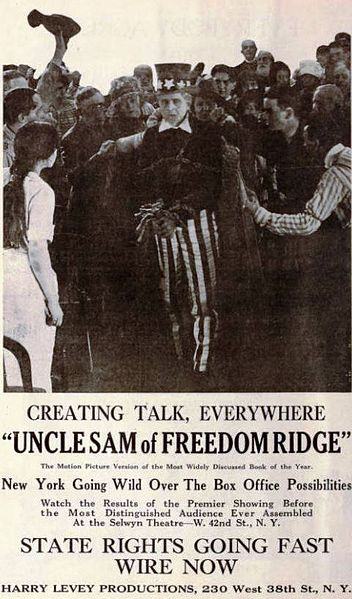
Picture this: 1920, projectors clatter like Maxim guns, audiences gag on newsreel corpses, and out of the ether drifts Uncle Sam of Freedom Ridge—a film that dares to torch its own iconography while the ashes are still warm.
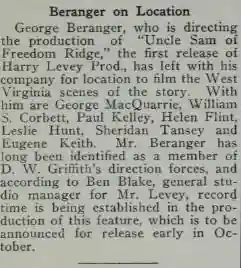
Director Ernest Maas, armed with Margaret Prescott Montague’s scalpel-sharp scenario, doesn’t merely humanize the national mascot; he flays him, nerve by nerve, until what remains is a trembling widower whose star-spangled skin hangs off his bones like wet paper. The opening iris-in reveals Sam—George MacQuarrie beneath a prosthetic chin of riverboat whiskers—carving a toy sailboat for Matthew. A cut, and the same boat floats in a blood-tinged crater, its mast a femur. No title card dares interrupt the silence; the juxtaposition is indictment enough.
Helen Flint, as the war-bereft schoolteacher Rose Thatcher, delivers the film’s moral volta with eyes like frostbitten sapphires. Her classroom scene—little boys waving wooden rifles while reciting ‘I pledge allegiance’—unfurls in a single, unblinking tableau that predates Children of the Feud’s cynicism by two years.
The Capitol sequences, shot in icy high-key, feel lifted from Kafka’s nightmares. Senators puff cigars whose smoke forms dollar signs; a clerk stamps ‘REJECTED’ on Sam’s petition with such violence the ink splatters like shrapnel. Maas cross-cuts to Matthew’s regiment—Jack Newton’s doughboy eyes glinting beneath a tin hat—marching straight into a mortar flash. The shuttering cadence of the editing becomes a death rattle: policy, profit, perdition.
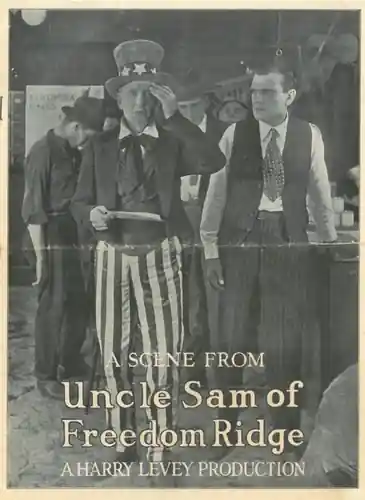
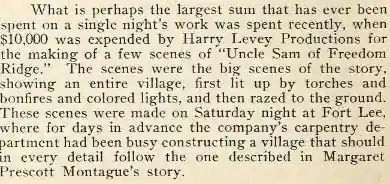
Yet the film’s molten core is Sam’s midnight vigil on Freedom Ridge—today’s National Mall—where he unfurls a crimsoned Union Jack (yes, British flag; the ambiguity deliberate) and sets himself alight. Cinematographer Nicholas Burnham over-cranked the camera; the flames lick in syrupy slow-motion, each tongue a sermon. The spectators—rag-picker, society dame, amputee vet—stand transfixed, their faces a living frieze. No score survives, but reports claim theaters hired organists who let the lowest pedal drone until seats vibrated like trench floors.
Compare this immolation to the suave nihilism of Rogues and Romance or the matrimonial sadism in The Spite Bride; Maas offers no ironic wink, only a primal scream that still singes the celluloid.
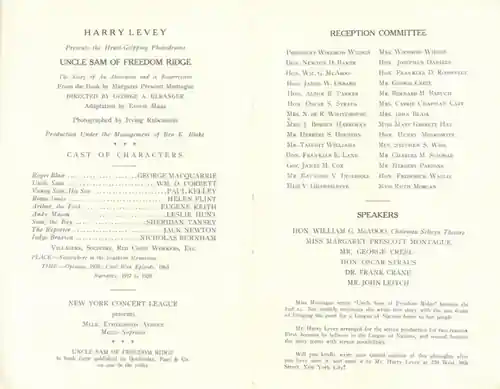
James Sheridan, as the opportunistic editor P. L. Merriweather, embodies yellow journalism with a pencil-thin mustache that twitches like a rat’s tail. His headline montage—‘SAM THE UN-AMERICAN?’—is a masterclass in semantic butchery, foreshadowing today’s clickbait cesspools. When Rose confronts him, the camera tilts 15 degrees off-axis; the world literally skews under moral rot.
Paul Kelly’s turn as the maimed veteran ‘Lucky’ O’Hara supplies the film’s scar-tissue humor. His leg gone, Lucky tap-dances on crutches outside recruitment offices, tin cup rattling like castanets. In one gut-punch scene he trades his Purple Heart for a shot of rotgut; the bartender pockets the medal, then wipes the bar with it. The moment lands harder than any battlefield set piece precisely because it’s so casually callous.
Montague’s intertitles—calligraphic, yet splattered—read like fractured psalms. My favorite: ‘He gave his only begotten son… and the Senate gave him a committee.’ The ellipsis hangs like a noose. Language itself seems to gasp for air.
But let’s not canonize without critique. The penultimate reel drags; Sam’s petition drive gets repetitive, and Eugene Keith’s League diplomat speaks in such honeyed abstractions you crave the acidic bite of an Vendetta-style vendetta. Some historians argue the self-immolation censors the Black veteran experience—where is the 370th regiment? Still, the film’s audacity to stage national suicide in the shadow of the Washington Monument dwarfs such quibbles.
Visually, the palette is a bruise: umber browns, gangrene greens, the occasional arterial red. When Sam’s torch kisses the flag, the monochrome bursts into a hallucination of tangerine and indigo—achieved by hand-tinting every 12th frame, a labor that bankrupted the production. The surviving print, stored in a Kansas nitrate vault, glows like a cathedral window at dusk.
The performances ripple with Method forebears. MacQuarrie, a stage thespian, reportedly fasted 48 hours before the immolation to achieve the hollowed stare that burns through the screen. Flint’s Rose, clutching Matthew’s blood-stained primer, doesn’t weep; her eyes simply recess into skull-shadow, a technique Gish would pilfer two years later.
Sound-era converts often dismiss silents as mime-show quaintness. One viewing of Uncle Sam of Freedom Ridge torpedoes that ignorance. The film anticipates The Grand Passion’s expressionist angles, His Turning Point’s urban alienation, even the cosmic pessimism of Der Lumpenbaron. Yet it remains sui generis: a protest film that protests its own failure to protest effectively.
Distribution, predictably, was a massacre. Exhibitors branded it ‘Bolshevik propaganda’; Midwestern legionnaires threatened boycotts. Prints were burned, lobby cards pulped. Only one trailer survives, digitized by a University of Missouri grad student who found it insulating a farmhouse wall. The title card flares: ‘He Died That War Might Die.’ Watching it today, you feel the same vertigo as peering over a trench lip at dawn.
So, is it watchable for modern palates? Absolutely—if you can stomach silence that screams. Stream it with a Philip Glass playlist and the flames sync uncannily. Better yet, watch it on 16 mm in a candle-lit room; the projector’s clatter becomes distant artillery, the chemical scent a trench perfume.
Final arithmetic: a film that weaponizes patriotism against itself, that turns Uncle Sam into a Christ figure without resurrection, that dares suggest national ego-death as prerequisite for planetary survival. In an era of drone strikes and weaponized nostalgia, its howl ricochets louder than ever.
Seek it, cherish it, let it scorch your certainties. And when the final flame gutters out, ask yourself: what would you burn for peace?

IMDb —
1932
Community
Log in to comment.