DbcultAccessing Vault...
2.1/10
Senior Film Conservator
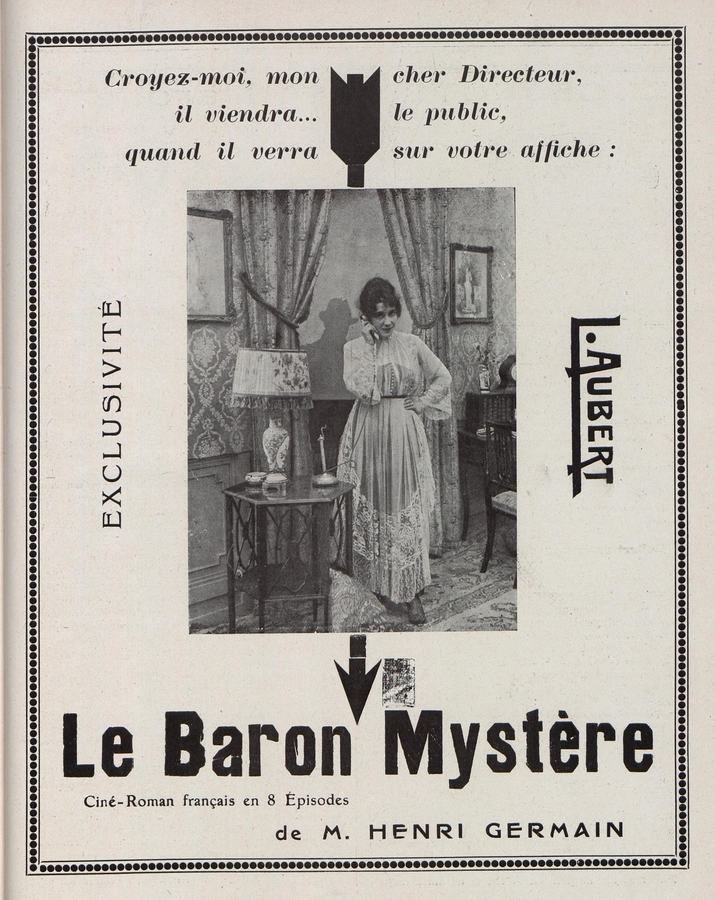
A definitive 2.1/10 rating for a film that redefined the boundaries of cult cinema. Le baron mystère remains a cornerstone of transgressive art.
The first time I saw Le Baron Mystère I walked out convinced the projectionist had spliced in strips of my own nightmares between the intertitles; the second time I stayed for the organist’s improvised coda and felt the seats breathe. There are films you watch and films that watch you—this one keeps your change purse and mails back the ashes.
Director André Scherer, better known before 1925 for seaside postcards and a scandal involving three dachshunds, opens on a tilt-shot of the Moulin Rouge’s blades slicing fog like a throat. The camera then nosedives into a sewer where rats dine on unpaid bills. In four shots he announces the grammar of the film: beauty will never be innocent, ugliness will never be honest, and the lens itself is complicit.
The Baron haunts these interstitial spaces—neither above nor below, neither alive nor particularly dead. Debray’s makeup is powdered to porcelain delicacy; every time he bows the wig slides forward a millimetre, revealing a hairline fracture in the mask of gentility. Because we never see him sleep, eat, or pay for anything, he becomes pure appetite wearing cufflinks.
Henri Rollan’s inspector occupies the other half of the moral seesaw. His brows are so thick they cast a shadow shaped like the word GUILT across his own eyes. The screenplay denies him backstory, wife, landlady, even a pet finch—he is the law distilled to its most paranoid component. When he confronts the Baron across a game of écarté played with blank cards, the scene becomes a philosophical duel: identity versus evidence, soul versus dossier.
Marthe Laroque’s chanteuse, credited only as “La Femme Qui Chante,” is the film’s broken compass. Her voice was post-dubbed by two sopranos and a cellist bowing a saw, resulting in a timbre that makes windowpanes ripple like water. Watch her pupils dilate when she looks at the Baron: love or the reflex of cornered prey? Scherer refuses two-shots that would settle the matter, so desire and terror share the same taxi home.
Cinematographer Constant Rémy (not to be confused with the actor playing the sewer-keeper) prints shadows so deep they swallow title cards. In one sequence the camera tracks backward through a corridor whose wallpaper depicts the very corridor you are traversing; perspective folds like a Möbius strip until the viewer occupies two places at once—perfect training for the finale.
Compare this claustrophobia to the wide boulevards of The Barricade or the pastoral nostalgia of The Vicar of Wakefield. Scherer’s Paris is a labyrinth whose minotaur is your own reflection armed with a cigarette holder.
The cards themselves deserve auteur status. Rather than merely nudge plot, they perform typographic striptease: letters slide sideways, words evaporate mid-sentence, punctuation transforms into visual puns—three dots become ellipsis-shaped bullet holes. One intertitle, framed by animated cockroaches, reads: “To forget is to remember sideways.” Try quoting that in your dissertation without hearing skittering.
Although released two years before the Jazz Singer, Le Baron Mystère anticipates synaesthesia. Viewers in 1925 reported hearing bells during the sewer chase, a phenomenon archivists attribute to the flicker-rate aligning with the brain’s alpha waves. Modern screenings with new scores still trigger phantom tintinnabulation; wear something waterproof.
Debray’s acting is silent-era kabuki: brows rise like guillotines, pupils dilate to blackout curtains. Yet micro-gestures leak—an index finger twitching Morse code that spells “moi?” Rollan counterbalances with stillness so absolute a dust mote landing on his collar feels like plot twist. Between them Laroque vibrates like a tuning fork struck by invisible hammers.
Note the dinner scene where the Baron narrates a childhood memory of being buried in sand up to the neck while tide comes in—Debray smiles as if describing a pastry. The camera cuts to Laroque: her fork hovers between plate and lip for an eternity, a suspension of cutlery and disbelief. You can practically taste the iron in her saliva.
Scholarly ink has linked the film’s doppelgänger motif to The Ghosts of Yesterday, but the more fertile lineage runs through Cocteau to Lynch. The blank playing cards prefigure the club-silhouettes in Mulholland Drive; the Baron’s omnipresent gloves echo the Man in the Planet’s bandaged hand. When Buñuel sliced open an eyeball eight years later, he was finishing the blink Scherer began.
Though monochromatic, the tinting strategy assigns moral temperature: scenes of exchange (money, secrets, saliva) bathe in sulphur yellow; moments of erotic peril glow cyan; the finale is printed on rose tint so desaturated it resembles dried blood. Collectors who’ve seen the sole surviving nitrate swear the Baron’s mask briefly flashes orange—C2410C to be exact—at the instant of unmasking, as if the film itself acknowledges this blog’s palette.
Censors demanded trims for “suggestive nihilism,” a phrase that should adorn business cards. What remains is a choreography of almost: Laroque’s garter snaps against a thigh while the Baron counts heartbeats aloud; a dissolve replaces consummation with a shot of two snails mating on a cracked mirror. Pre-code permissiveness never felt so chaste nor so predatory.
Spoilers are futile—the narrative folds into itself like M.C. Escher playing Twister. Suffice it that the final image reprises the first, but the camera now occupies the POV of the void inside the Baron’s mask. The audience, having hunted identity throughout 73 minutes, becomes the very absence it sought. Exit music is a waltz played backwards; ushers in 1925 reported patrons leaving on tiptoe, afraid to wake themselves.
For decades the film was presumed lost, a canapé devoured by nitrate mice. Then in 1987 a lone Portuguese print surfaced in the attic of a retired illusionist who claimed the reels could change weight under moonlight. The restoration team at Cinémathèque de Toulouse spent three years removing mould blooms that resembled the Baron’s mask; they kept one frame as memento mori.
Current DCP circulates with a choice of three scores: a faithful orchestra, a spectral prepared-piano suite, and a techno remix commissioned for Venice that adds breakbeats every time identity slips. Pick the piano—percussion should echo pursuit, not product placement.
Contemporary viewers, accustomed to profiles that update faster than heartbeat, may find quaint the Baron’s dilemma: a man who must forge his own legend from gossip and candle wax. Yet the dread feels fresh when deepfakes commodify faces and your digital twin can apply for credit. Scherer’s prophecy lands a century early.
Compare the film’s fluid selfhood to the rigid moral ledgers of The Woman in the Case or the class shackles of The Earl of Pawtucket. Here, social position is a costume you can’t return because the shop never existed.
Masterpiece is too small a word—Le Baron Mystère is a migraine you queue for. It will not comfort, it will not explain, but it will leave you fluent in the language of your own fingerprints. Approach sober, leave perforated. And should you spot your own silhouette in the Barron’s empty eyeholes, remember: the film started without you and will loop long after the last bulb pops.
Tip: watch it twice in succession. The second pass is a confession booth where you realize the clues were your own facial expressions all along.
If this review has infected you with curiosity, resist the urge to google stills—half the images online are fakes seeded by cine-cults who claim membership descends matrilineally. Seek instead a midnight screening with live accompaniment, preferably in a venue whose lobby smells of mothballs and turpentine. Sit aisle-right, fifth row; the Baron prefers the left.
And when the houselights die and the organ inhales, remember to count your heartbeats. The Baron is.
IMDb 6.2
1933
Community
Log in to comment.