DbcultAccessing Vault...
Cult Review
Senior Film Conservator
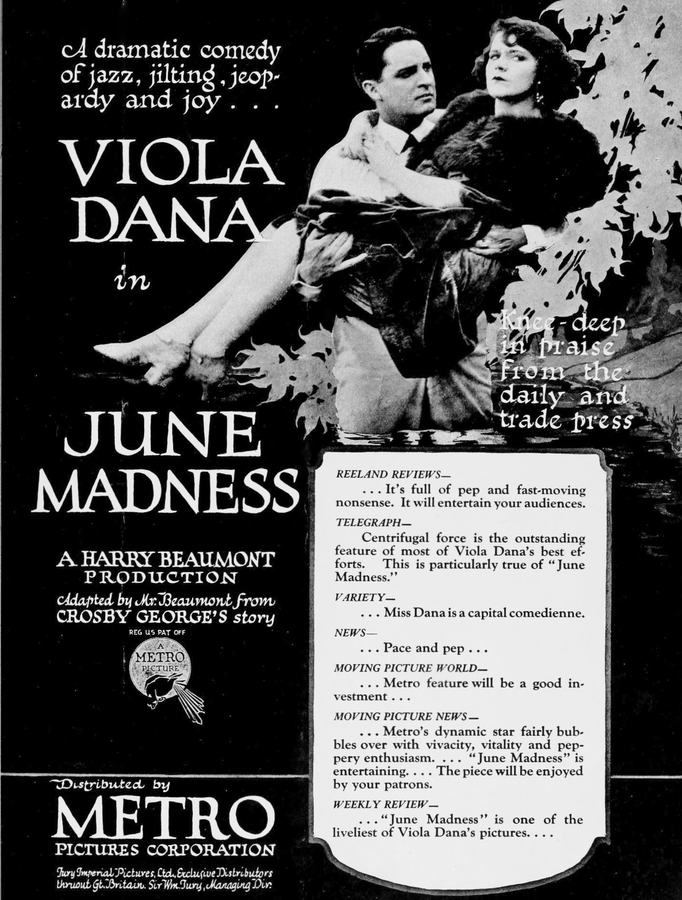
Picture, if you can, a cathedral nave drenched in ecclesiastical gloom—incense curling like gossip around Corinthian columns—where Viola Dana’s Clytie Whitmore stands trussed in satin, eyes wide as Roosevelt dimes, listening to the organ wheeze the opening bars of a life sentence. Then, without warning, the camera itself seems to inhale a slug of bootleg bourbon: the bride bolts, veil snapping like a torn sail, and plunges straight into Bryant Washburn’s roadster, a flivver that smells of valve oil, gin, and the future.
That single cut—altar asphalt to jazz-joint neon in a heartbeat—crystallizes why June Madness still crackles a century later. Director Harry Beaumont, a year shy of his watershed Our Dancing Daughters, treats the screen like a trampoline. Every setup bounces from drawing-room propriety to speakeasy delirium; every intertitle lands with the staccato pop of a champagne cork.
Gerald Pring’s Cadbury Todd—his surname a punchline about confectionery blandness—embodies the stultifying contract the Jazz Age promised to shred. He’s all starched cuffs and debentures, a man who pronounces “dear” with two syllables. Clytie’s escape is less infidelity than insurgency: she vaults from contractual chattel to co-author of her own legend, anticipating the flappers who would soon jitterbug across every fan-mag spread.
Yet the film refuses to moralize. Instead it luxuriates in the kinetic dissonance between Puritan marble and saxophone brass. When Clytie’s satin heel clangs against the church’s flagstone, the percussion syncs with a muted trumpet in the orchestra pit—an auditory hallucination that makes the viewer complicit in her trespass.
Production designer William Cameron Menzies—yes, the future Gone with the Wind visionary—turns Pennetti’s into a fever chart of Deco debauchery. Fringed lampshades drip like molten topaz; a trompe-l’oeil skyline of Manhattan looms behind the stage, its windows flickering with hand-tinted amber, suggesting a city perpetually on fire. When Clytie improvises a shimmy in Sonora’s absence, the camera glides past a drummer whose sticks blur into hummingbird wings, then lands on a patron snorting laughter through a straw of illicit powder. No Hays Office prude has arrived yet to blur these edges.
Viola Dana performs her own terpsichorean stunts, and the long take that captures her torso spiraling through a veil of cigarette smoke feels proto–SteadiCam decades avant la lettre. The celluloid itself seems sweaty; you half expect fingerprints to materialize.
Leon Barry’s columnist—pencil mustache trimmed like a switchblade—skulks through scenes with the persistence of a bad conscience. He’s not after mere scandal; he craves narrative ownership, the power to reduce human caprice to tomorrow’s fish-wrap. Watch how Beaumont frames Peeke in a mirror flanked by chorus girls, so the reflection multiplies him into a hydra of yellow journalism. The visual gag lands harder than any intertitle could.
There’s a sly meta-wink here: silent-era fan mags trafficked in the same star-myth machinery. By making Peeke both predator and plot motor, June Madness anticipates our own parasocial appetite for celebrity meltdowns—only the bandwidth has changed.
Post-raid, the lovers’ nuptials transpire in a ten-dollar parlor officiated by a justice whose suspenders keep slipping like excuses. The ceremony is framed through a rain-streaked window, the pane’s rivulets warping the scene into a living Monet. Beaumont withholds a close-up until the kiss, which erupts in a swirl of iris-in, the black vignette swallowing them like a secret too delicious to share. It’s one of silent cinema’s most ecstatic elopements—ranking beside The Broadway Bubble in its intoxicated rush.
When the couple return to the Whitmore estate, the tonal pivot is breathtaking. The mansion’s foyer, once mausoleum-cold, now glows with hearthlight; Clytie’s mother (a regal Eugenie Besserer) descends the staircase not to scold but to embrace, her pearls catching the fire’s shimmer like droplets of forgiveness. The film ends on a crane shot that soars above the terrace, revealing confetti strewn across manicured hedges—a visual whisper that rebellion, when alloyed with love, can fertilize even the most calcified tradition.
Viola Dana operates at 24-frames-per-second lightning. Her eyes perform arpeggios: a downward glance that lands like a blue note, a sideways flicker that telegraphs anarchic mirth. Watch her in the roadhouse dressing room, daubing kohl while humming a tune we can’t hear; the mirror captures two Clyties—one literal, one imagined—both itching to escape their frames.
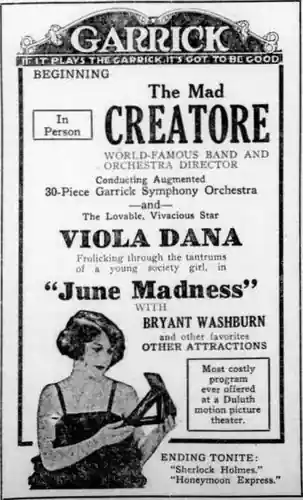
Bryant Washburn’s Ken Pauling could have been a mere cigarette-ad archetype, yet he gifts the role a Humphrey-Bogart-before-Bogart weariness. In the getaway roadster, he drums fingers on the steering wheel to a rhythm only he perceives, the dashboard light carving half-moons beneath his eyes. The gesture reads less as musicianly affectation than as existential metronome—each tap a reminder that time, like a sax solo, is improvised.
Snitz Edwards, as Pennetti’s browbeaten maître d’, steals every scene with the efficiency of a pickpocket. His double-takes—eyebrows ricocheting like faulty window blinds—deserve their own Vitaphone short.
Cinematographer Allen G. Siegler toggles between chiaroscuro and phosphorescence with the finesse of a sommelier pouring contraband champagne. The church scene oozes Germanic gloom: vaulted ceilings swallowing candlelight, confessional grilles latticing faces into cubist shards. Cut to Pennetti’s and the palette detonates—magenta gels, emerald spotlights, a disco ball jury-rigged from a steel helmet, flinging confetti constellations across sweating flappers.
The roadhouse raid is staged like a futurist battle. Police boots stomp in abstract rhythms; truncheons rise and fall in silhouette, transforming violence into a sort of Expressionist ballet. A stray bullet punctures a gin cistern; the liquor arcs in slow motion, a liquid aurora. Contemporary critics complained the sequence glorified lawlessness; modern eyes will detect an embryonic music-video grammar, predating Singin’ in the Rain’s Broadway Melody hallucination by three decades.
Archival records indicate the original tour engaged a nine-piece ensemble weaving W.C. Handy blues with foxtrot variations. Today’s viewers encounter the film via repertory screenings where accompanists riff like jazz cats let loose on Bix Beiderbecke. The marriage of improvised score to silent image replicates the film’s thematic core: structure as springboard, not cage. If you stream a version with a generic piano track, do yourself a favor—cue up “Potato Head Blues” on Spotify and mute their audio. The sync will not align perfectly, but the spirit will.
Place June Madness beside Mrs. Slacker and you see two divergent answers to the same post-war female question: what if domesticity feels like a straitjacket? Where Mrs. Slacker opts for didactic comeuppance, June Madness chooses centrifugal joy. Pair it with On the Jump and you map a continuum of chase-comedy liberation, from Mack Sennett slapstick to romantic fugue.
Curiously, the film also rhymes with Soviet agitprop like Zapugannii burzhui: both sprint toward the exhilarating notion that personal life can be revolutionary praxis, that fleeing the altar might be as seismic as storming a winter palace—only here the bullets are saxophone riffs.
For decades, June Madness languished in mislabeled cans, misfiled under “comedy shorts.” Then a 2018 MoMI retrospective screened a mint 35 mm print, and Twitter convulsed with GIFs of Clytie’s veil-stream bolt—her rebellion looped into infinity, a proto-meme of #LeaveTheAltarChallenge. TikTok teens who’ve never heard of Viola Dana now overlay the clip with Doja Cat beats, proving the film’s central thesis: desire, once unshackled, ricochets through history like a rogue sax solo.
Criterion rumors swirl; if it emerges on 4K, pray for a commentary track pairing a jazz historian with a feminist film scholar. The discourse would detonate.
June Madness is not merely a curio for silents aficionados; it is a manifesto in a champagne bottle, a celluloid firecracker whose fuse still splutters. It argues that marriage, like cinema, is at its liveliest when improvised, when the congregation becomes conspirators in a getaway narrative. Watch it when the world feels too buttoned-up, when your own pulse thuds to a rhythm society refuses to permit. Then, dear reader, consider what altar you, too, might sprint from—and who waits in the idling roadster, engine thrumming like a promise.
June Madness is currently streaming on select archival platforms, and a restored Blu-ray is slated for late 2024. Do not wait for permission; elope with it.
IMDb —
1927
Community
Log in to comment.