DbcultAccessing Vault...
5.9/10
Senior Film Conservator
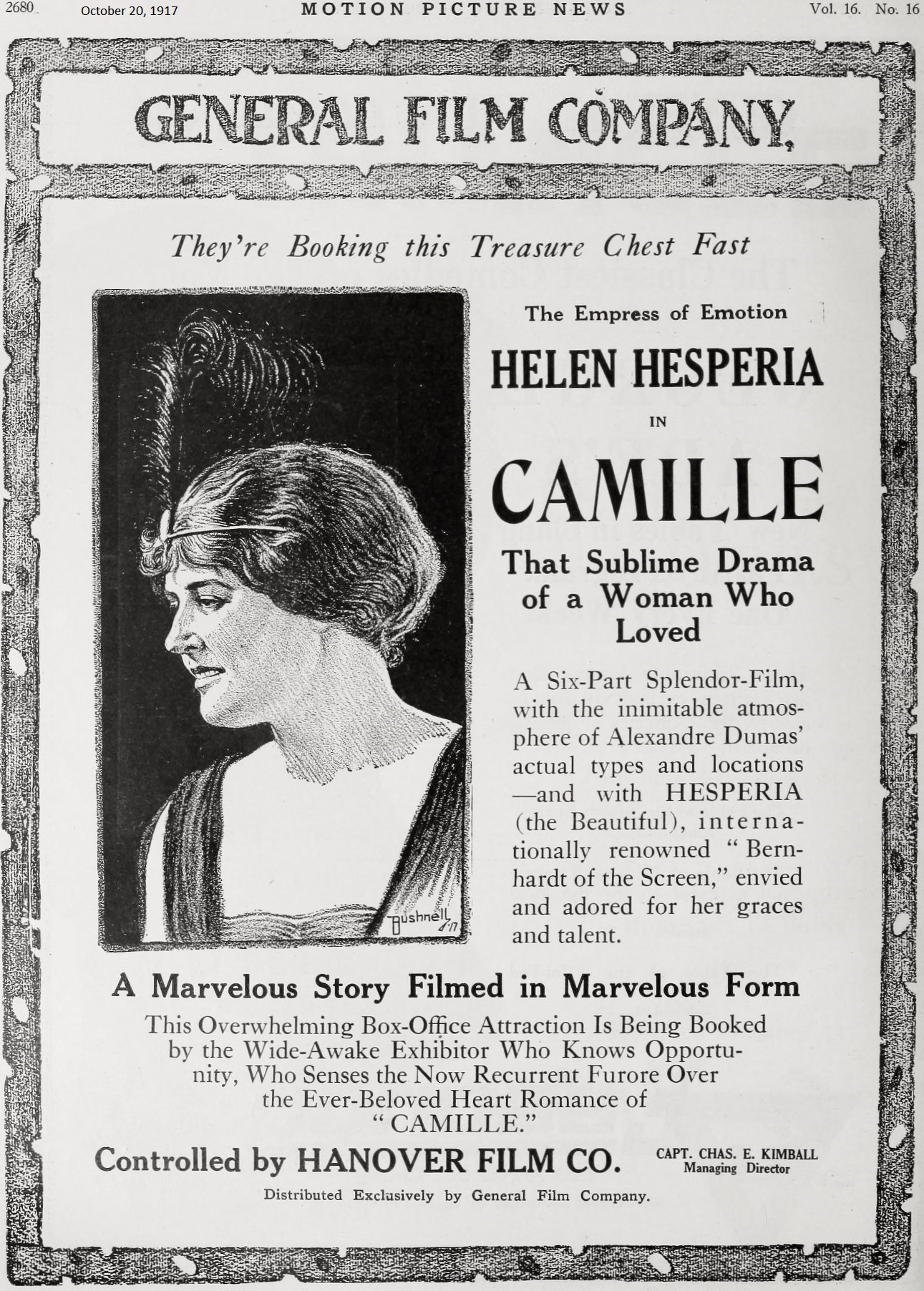
A definitive 5.9/10 rating for a film that redefined the boundaries of cult cinema. Camille remains a cornerstone of transgressive art.
Paris, 1915. While Europe convulses in the mechanized carnage of the Great War, a camera cranks quietly in Cines studios, capturing a different carnage of the heart.
Baldassarre Negroni’s Camille—known to Italians as La storia di Camille—slips through time like a clandestine letter. Ninety-three surviving minutes (out of an alleged original twelve reels) feel both moth-eaten and miraculously intact; scratches dance across Hesperia’s cheekbones like silver scars, and the nitrate bloom around streetlamps becomes accidental expressionism. Yet within these imperfections pulses an aching modernity: the film understands that tragedy is not the opposite of desire but its logical terminus.
Hesperia, a Roman stage diva imported to ignite the screen, embodies Marguerite Gauthier with the languid cruelty of a cat and the sudden frailty of a snuffed match. Watch her in the opening salon sequence: she enters wearing a gown the color of dried blood, a living wound among tuxedos. The actress doesn’t play the courtesan; she audits her—calculating the exact wattage of a smile required to bankrupt a viscount. When she first notices Armand (Alberto Collo, all knees and elbows, a poet who has misplaced his sonnets), her pupils dilate not with tenderness but with curiosity, as though he were an exotic currency she had not yet learned to spend.
Negroni’s camera, tethered to static wide shots by the era’s orthodoxy, nonetheless finds ways to stalk intimacy. A cut to a medium insert of gloved hands exchanging a letter becomes a seismic event; the sudden proximity to lace and skin feels like being shoved from the orchestra stall into Marguerite’s lap. Later, when Armand’s father (Alfonso Cassini, beard trimmed to biblical severity) kneels in the garden to beg Camille’s sacrifice, the director stages them against a topiary labyrinth—an externalization of the moral maze in which women like her wander without exit.
Intertitles, usually the blunt instruments of silent narration, here achieve a brittle elegance. “My life has been a soirée that lasted too long,” reads one, over an image of Camille’s empty chaise. The sentence, attributed to Dumas fils but trimmed by screenwriter Negroni, distills an entire social economy: a woman’s body as a rented ballroom, lights dimming, orchestra packing up. Another card, appearing after Camille’s exile, simply states: “The boulevard laughed—she was not in on the joke.” The film trusts the viewer to feel the chill beneath the epigram.
Comparative cinephiles will detect DNA shared with Shadows of the Moulin Rouge (1913), where the demimonde also flickers between gaslight and gratitude. Yet whereas Shadows aestheticizes poverty behind a cabaret proscenium, Camille drags it into the boudoir, refusing to varnish the transaction. Likewise, the post-war Legion of Honor (1918) will later attempt a redemptive arc for its fallen woman; Negroni’s film harbors no such delusion. Camille’s sacrifice buys nothing but Armand’s unwitting resentment; her renunciation is less noble than bureaucratic, a paper pushed across the desk of patriarchy.
The third act’s descent into consumptive squalor is rendered with pitiless spatial economy. Camille’s garret, a diagonal slice of roof and skylight, shrinks the aspect ratio long before Instagram thought to do it. Hesperia’s performance pivots from statuesque hauteur to a tremor so minute it seems like the camera itself is shivering. When she sells her horse, her carriages, her furs, each transaction is a mini-death scored by the thud of coin on wood. The most lacerating cut, however, is internal: a flashback superimposition—achieved through double exposure—of Armand’s garden courtship over her fevered face. Memory becomes a second disease.
Restoration notes: the 2022 Cineteca di Bologna 4K scan harvested what remained of the original nitrate from Turin’s Museo Nazionale del Cinema. Tints were recreated via Desmet method—amber for interiors, viridian for gardens, cobalt for the final snow-mantled bedroom. The nitrate warping around the edges of frames was preserved; those fluttering white specks are not damage but snow remembered by celluloid. The score, commissioned from avant-pianist Beatrice Rana, refrains from Gallic cliché, opting instead for a minimalist ostinato that disintegrates into single notes, mirroring Marguerite’s vital signs.
Gender discourse: contemporary viewers might flinch at the father’s paternal bargain, yet the film complicates complicity. Camille’s agency lies precisely in her capacity to refuse future happiness for a man who will never grasp the cost. It is a reverse dowry: she pays to not marry. The moment she signs the letter of farewell, Negroni inserts a close-up of her hand pausing above the ink—an eternity in which we read every courtesan’s realization that love and liquidity share the same root.
Cinematic DNA: the final deathbed tableau—Armand barging through a corridor of indifferent domestics—prefigures the climactic rush to the heroine’s bedside in The Secret Sin (1915) and the frantic train-station rendezvous of Over Night (1916). Yet Camille withholds reconciliation; its last shot freezes on Armand’s back as he exits into a Paris that has already forgotten her address. The camera stays inside the room, watching the door close, watching the light leak out of Hesperia’s eyes until the iris-in swallows her like a secret.
Performances in miniature: Ida Carloni Talli, essaying Prudence the procuress, supplies a masterclass in accessory acting. Observe how she fingers a cameo brooch whenever she lies—an unconscious tell that turns exposition into character. Giulia Cassini-Rizzotto, as Camille’s consumptive neighbor, coughs into a handkerchief embroidered with violets, a floral irony that prefigures her friend’s fate. Even the bit-player creditors, framed in doorways like gargoyles, bring the texture of Balzacian bureaucracy to what could have been mere melodrama.
Era context: shot in late 1914, the film premiered in Rome’s Teatro Quirino while newspapers outside hawked the first casualty lists from the Marne. Audiences, hungry for a different kind of mass death, embraced Camille’s expiration as surrogate grief. Reviewers praised the film’s “Latin sobriety,” a backhanded compliment meant to distinguish it from the excesses of American or French adaptations. In truth, Negroni’s sobriety is more corrosive; by muting hysteria he forces viewers to supply their own anguish, a participatory sorrow that anticipates post-war modernism.
Contemporary echoes: if you stream Sumerki zhenskoy dushi (1913) afterward, note how both films equate female sexuality with a ticking pocket-watch—pleasure measured in dwindling minutes. Yet whereas the Russian heroine seeks spiritual transcendence, Camille seeks mere liquidity enough to die indoors. The contrast illuminates how Latin Catholicism commodifies penitence, whereas Orthodoxy mystifies it.
Final calculus: is the film “great” or merely “historical”? The question itself is market jargon. Camille survives as a shard of mirror—jagged, reflective, capable of cutting. It will not comfort you with feminist triumph, nor will it deliver the cathartic purge Aristotle promised. Instead it offers something rarer: the spectacle of a woman who learns that the most expensive thing you can own is someone else’s forgiveness. Long after Armand’s footsteps fade, what lingers is the echo of Hesperia’s last breath, a faint rasp across a century of nitrate, asking whether love was ever more than a promissory note written in disappearing ink.
Watch the HD restoration on Criterion Channel or snag the region-free Blu from Il Cinema Ritrovato. Pair with absinthe, a warm blanket, and the phone off—because some transactions still require silence.

IMDb —
1927
Community
Log in to comment.