DbcultAccessing Vault...
Cult Review
Senior Film Conservator
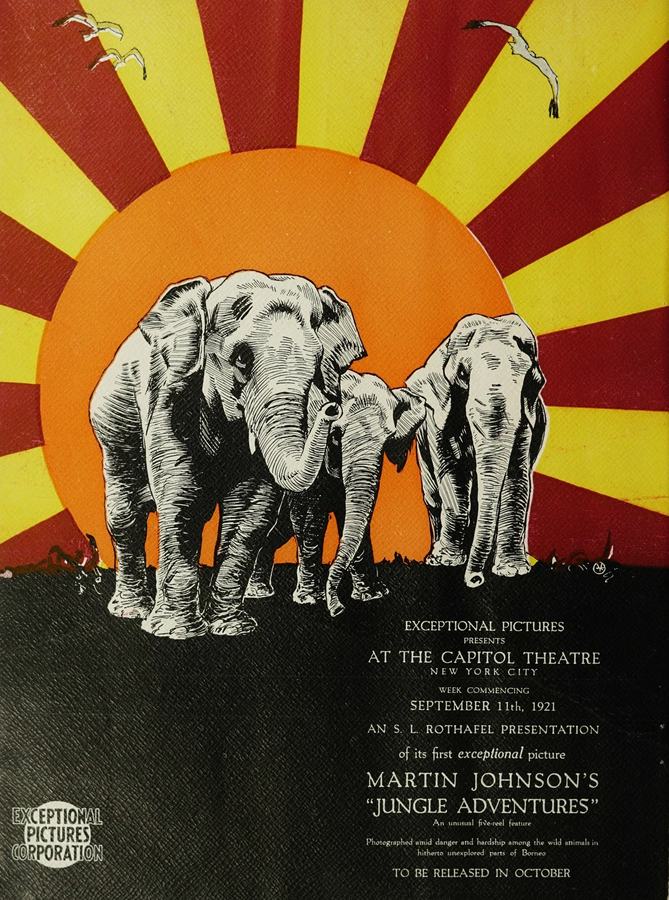
The Johnsons' 1930s expedition to Borneo yielded a cinematic artifact that remains startlingly fresh in both technique and sensibility. What initially appears as a straightforward natural history film rapidly reveals itself as a layered tapestry of ecological observation, cultural anthropology, and early 20th-century cinematic innovation.
Shot at a time when color photography was still in its infancy, the film's monochromatic palette becomes a strength. The Johnsons exploit black-and-white film's capacity to render texture - the rough bark of ceiba trees, the iridescent sheen of beetle wings, the rippling of sunlight through water - with a clarity that color would have muddied. Their approach is reminiscent of the stark beauty in 'The Adventures of Kathlyn' (1916), but elevated by a more nuanced understanding of spatial composition.
What distinguishes Jungle Adventures from contemporaries like 'The Ring and the Ringer' is its ethical stance. Rather than exoticizing its human subjects, the film adopts a documentary ethos that anticipates the observational techniques later perfected by Frederick Wiseman. The Dayak people are shown in their daily rituals - weaving, hunting, communal feasting - with the unobtrusive patience of a painter capturing a still life. This contrasts sharply with the more exploitative portrayals of 'America Goes Over,' where soldiers were mere propagandistic cogs.
The film's structure follows a loose narrative arc, beginning with the Johnsons' arrival in Borneo and ending with their departure, but the true narrative lies in the rhythms of nature itself. The soundtrack, though primitive by modern standards, employs ambient jungle sounds with a sophistication that foreshadows Walter Benjamin's theories on soundscapes. When coupled with Arthur Hoerl's narration - less a voice of authority and more a literary companion - the film achieves a lyrical quality absent in the more didactic 'The Cloud.'
Technically, the film showcases remarkable ingenuity. The Johnsons' use of long lenses to capture wildlife without disturbance anticipates the techniques of Jacques Cousteau and Sir David Attenborough. One sequence of an orangutan family, filmed over several weeks, demonstrates a patience and ethical consideration that contrasts with the staged naturalism of 'The Barker.' The film's most striking sequences - a storm lashing the jungle canopy, a river teeming with crocodiles - could have easily veered into spectacle, yet maintain a documentary integrity.
The film's cultural anthropology is equally groundbreaking. The Johnsons document the Dayak's headhunting ceremonies with the same clinical detachment they reserve for botanical studies, avoiding the moralizing present in 'Married in Name Only.' This approach aligns with the more neutral stance of Marcel Proust in documenting bourgeois life, yet carries the immediacy of cinema. The interplay between the Johnsons' European sensibilities and the indigenous cultures they document creates a fascinating dialectic, similar to the cultural collisions in 'Et Syndens Barn.'
One cannot discuss Jungle Adventures without considering its technological limitations. The 35mm film stock, while superior to 16mm, still struggles with the jungle's low-light conditions. Yet these imperfections - grainy textures, occasional overexposure - become part of the film's authenticity. The Johnsons' decision to film in native dress when among the Dayak people, rather than maintaining an anthropologist's clinical distance as in 'The Raggedy Queen,' earns the documentary its emotional resonance.
The film's educational purpose is evident in its meticulous taxonomic approach to flora and fauna, yet it never descends into the dryness of 'Corruption.' The Johnsons' camera lingers on the intimate details - a spider weaving its web, a child's dance, the texture of a fern - with the attentiveness of a Renaissance naturalist. This attention to microcosms, reminiscent of the Dutch masters' still lifes, elevates the film beyond mere ethnography.
Jungle Adventures also reveals the Johnsons' evolving perspective on their own role as documentarians. Early sequences show them as observers, but as the film progresses, they become participants in the culture they're documenting. This transition mirrors the narrative arc of 'Imar the Servitor,' though with a more authentic cultural engagement. The final scenes, showing the Johnsons leaving Borneo with their invaluable footage, evoke a bittersweet farewell to a world they've helped preserve.
In the context of 1930s cinema, Jungle Adventures represents a high water mark for documentary filmmaking. Its influence can be traced through to the BBC's natural history series and the work of Robert Flaherty, though it lacks the mythic quality of 'The Cloud.' The film's greatest achievement lies in its ability to balance scientific curiosity with artistic vision, a feat that eluded many of its contemporaries, including 'After the Bawl.'
The film's preservation history is as compelling as its content. The original negatives, stored in nitrate film cans, were on the brink of disintegration before a major restoration effort in the 1990s. This preservation effort, comparable to the restoration of 'Sally in Our Alley,' has ensured that the film remains a vital document of a rapidly changing region.
For modern audiences, Jungle Adventures serves as both a historical document and a cautionary tale. The pristine jungles it depicts have been largely replaced by palm oil plantations, making the film a poignant record of a lost world. This ecological message is delivered subtly, without the didacticism of 'Dionysus' Anger,' allowing viewers to draw their own conclusions about humanity's relationship with nature.
In conclusion, Jungle Adventures is more than a relic of early documentary filmmaking. It is a testament to the power of cinema to preserve, educate, and inspire. Its legacy endures not only in the preservation of Borneo's cultural and natural history, but in the standards it set for ethical ethnographic filmmaking. As a cinematic achievement, it stands alongside 'The Ring and the Ringer' in its ambition, yet surpasses it in emotional depth and ethical considerations.

IMDb —
1935
Community
Log in to comment.