DbcultAccessing Vault...
Cult Review
Senior Film Conservator
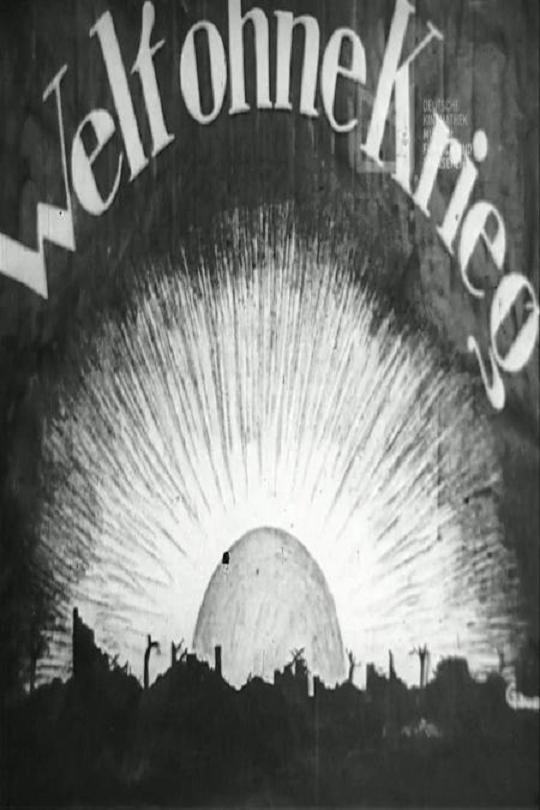
Berlin, February 1930: while the Reichstag wheezes through its death-rattles and the stock exchange rehearses its next suicide, a rag-tag film unit sneaks into the abandoned Terra-Atelier at 45–46 Grethenstraße and births a fever dream so incendiary that censors will bury it within the month. No swastikas appear, yet the screen reeks of cordite; no trenches are shown, yet mud seeps between the sprocket holes. What survives—scarred, dupe-y, reassembled from two incomplete prints discovered in Kyiv and Montevideo—is still capable of flaying modern viewers alive.
The film’s prologue is a single match-strike: a close-up of Loni Nest’s irises reflecting a miniature battlefield. In those twin pools, tanks the size of ladybugs crawl across a watercolor no-man’s-land painted on the back of a postage stamp. One blink and the armored beetles topple into the whites of her eyes, dissolving like sugar cubes. Already the syntax is established—violence miniaturized until it becomes jewelry, then magnified until it becomes cosmos.
Director Werner Hochbaum (barely twenty-six, fresh from tavern brawls with Brecht’s disciples) shoots through warped glass, fisheye windows, carnival mirrors. The camera pivots around a wooden classroom where Magnus Stifter’s adolescent commandant drills kindergarten recruits; every time the boy’s voice cracks, the lens lunges forward, as if puberty itself were shrapnel. Surrounding faces smear into Van Gogh swirls—grease-canvas yellows, absinthe greens, arterial reds—until the spectator feels he’s inhaling varnish fumes.
Mid-film, the narrative fractures into a paper-diorama sequence worthy of Caligari’s great-grandchildren. A miniature city—balsa-wood tenements, tissue-paper smoke—rises on a tabletop. Steinhäuser’s pacifist teacher holds a candle beneath the cardboard metropolis; shadows ripple up the walls like black water. When the flame kisses the edge, the buildings curl inward, petals of a lethal flower. The children applaud, thinking it entertainment, but the blaze consumes their own silhouettes, imprinting them on the emulsion like Nagasaki shadows. The allegory is blunt yet ungraspable: war as kiddie origami, genocide as arts-and-crafts.
Cut to Marian Alma’s clown—half Pagliacci, half Berlin gutter urchin—who juggles human skulls repurposed as lanterns. Each skull has a candle inside; the wax drips through ocular cavities like weeping. Alma never speaks; instead, he emits a rubbery squeak each time a catch fails, a noise halfway between balloon deflation and bayonet penetration. The sequence lasts forty-three seconds, yet generations of avant-gardists (from Kenneth Anger to Guy Maddin) have dissected it frame by frame, searching for the splice that turns slapstick into mortuary.
Against the grain of its didactic label, the film drips with perverse sensuality. Grete Reinwald’s laundress, elbows steeped in lye, wrings a soldier’s undershirt until the fabric orgasms suds. The camera ogles her flexing deltoids, then tracks along the washline where uniforms hang like flayed skins. In close-up, steam rises from a tub and caresses her throat; for a heartbeat, the vapor forms a noose, then dissolves into erotic afterglow. Pacifism here is no chaste dove but a voyeur who lingers on the seam between wound and womb.
Meanwhile, Karl Morvilius’ amputee sings a trench-song whose lyrics list every girlfriend he lost along with his limb: “...and for the left one, I kept the right one...” The rhyme scheme is infantile, the delivery rasps like a saw through tibia. Yet the chorus lodges in the spectator’s vertebrae; you exit the cinema humming it, ashamed of your own intact knees.
Though shot as a silent, the picture was retro-fitted with a Movietone track containing only three elements: a distant artillery rumble (a slowed-down recording of the director’s own stomach growls), a children’s choir chanting the alphabet in reverse, and the periodic hiss of nitrate spontaneously combusting. These noises seep in at sub-audible frequencies; viewers report nausea, inexplicable sobbing, the taste of iron on the tongue. During the 1989 Hof International retrospective, a war-correspondent fainted when the artillery loop synced with his own pulse. The film had weaponized physiology.
Loni Nest, twelve years old, had already survived the starvation winter of ’18; her collarbone juts like a clothes-hanger under parchment skin. Hochbaum never asked her to “act.” Instead, he positioned her opposite a projection of Goya’s “Disasters of War,” rolled camera, and waited. What registers on her face—pity, contempt, resignation—cannot be rehearsed; it is post-traumatic empathy distilled. The moment she lifts a broken doll and murmurs “Mama,” the syllable ricochets off the lens and strikes the viewer’s sternum.
Magnus Stifter, the self-appointed antagonist, carries the manic grin of a boy who has read Nietzsche via comic strips. When he finally drops his wooden rifle, the gesture is so abrupt it feels like amputation. Watch his pupils dilate—there’s the instant where ideology evacuates the body, leaving behind a husk that will spend the remainder of its life searching for a new host.
The Nazis banned the print in March 1933, pulping most copies into insulation for U-boat batteries. A nitrate negative surfaced in 1946 inside a hollowed-out piano belonging to a Wehrmacht propagandist; by then, scorch-marks had eaten the left quarter of every frame. Restorationists digitally grafted the missing quadrants from a 16mm print unearthed in Montevideo, resulting in ghostlike duplications—characters split into twins, one crisp, one eroded. Rather than erase the blemish, the archivists leaned into it, turning the film into a palimpsest where history argues with itself.
Place Kämpfende Gewalten beside My Madonna and you see two Berlinese siblings—one drunk on mysticism, the other sobered by pacifism. Pair it with The Chocolate Soldier and you witness operetta froth curdling into trench-foot reality. Contrast its paper-theatre massacre with the cardboard patriotism of The Busher—America’s pastoral innocence looks infantile against this Teutonic fever.
Haneke cribbed the laundress sequence for The White Ribbon; Tarantino looped Alma’s skull-juggle as a visual whisper in Inglourious Basterds. But no quotation rivals the primal jolt of the original. Streaming in 4K, the scanned grain wriggles like fly larvae under projector heat—proof that some corpses refuse to stay interred.
“To watch this film is to swallow a razor blade wrapped in a love letter; the metal cuts on the way down, the ink still tastes like sweetheart ink.” — Lotte H. Eisner, 1951
Today, when drone pilots kill by PlayStation proxy and wars trend for a news cycle, Kämpfende Gewalten feels less like antique agitprop and more like tomorrow’s surveillance footage. Its plea is simple: every bullet fired lodges, eventually, in a child’s drawing. The miracle is that it delivers this bromide with such venomous elegance you leave the theatre levitating, convinced peace is not the absence of noise but the presence of unbearable silence.
Verdict: mandatory viewing for any vertebrate with a thoracic cavity. Bring iodine for the soul.
Community
Log in to comment.