DbcultAccessing Vault...
6/10
Senior Film Conservator
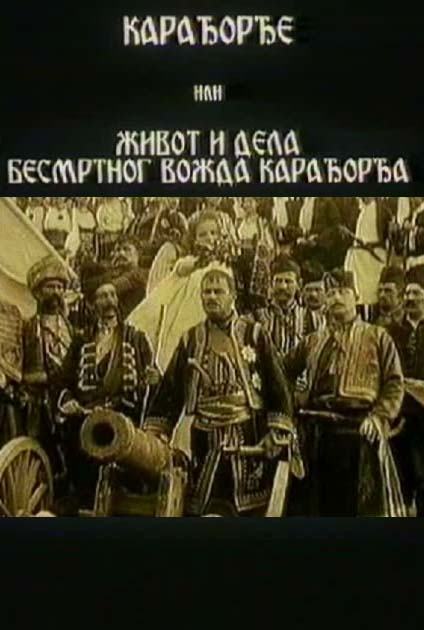
A definitive 6/10 rating for a film that redefined the boundaries of cult cinema. Karadjordje remains a cornerstone of transgressive art.
Karadjordje doesn’t open—it detonates. A gaunt shepherd boy hurls a stone at a Janissary patrol; the camera, perched on a cliff like a carrion bird, tilts downward until the stone becomes a meteor and the Ottoman shield a bruised moon. In that vertiginous instant Cira Manok announces his thesis: history is not a procession but a plunge, and every hero is merely the loudest falling body.
Shot through Bosnian silver-nitrate that shimmers like frostbitten mercury, the 1911 epic luxuriates in chiaroscuro so thick you could saddle it. Cinematographer Jovan Antonijević-Djedo (doubling as the glowering lead) borrows the staggered tableau of early Passion-play pageants yet marries it to horizontal tracking shots—improvised from a wooden wheelbarrow and piano wire—that prefigure the kinetic panoramas of Kelly Gang by a full five years. The result is a clash between Byzantine iconography and proto-Western mobility: sabers flare like halos while dust clouds roll in real time across the Šumadija.
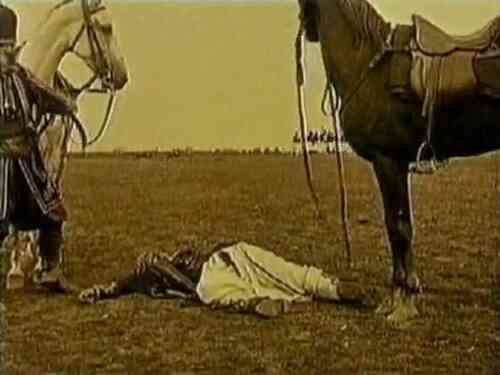
Antonijević-Djedo embodies the revolutionary despot with a volcanic physicality—neck sinews twitching like overtightened catgut whenever foreign envoys whisper treachery. Teodora Arsenović, as the hawk-eyed wife Proka, wields silence as other heroines wield handkerchiefs; her longest speech is a single tear that refuses to drop until Karadjordje signs an ill-fated alliance with Russia. In a cellar lit only by a slatted lantern, that tear flashes across her cheek like liquid iron, forging the film’s emotional shackles tighter than any marital vow.
Manok stages the siege of Belgrade as a deranged opera: cannons painted pea-green boom amid fluttering church banners while a priest in gilded mitre splashes holy water on artillery shells. The camera pirouettes 360 degrees, stitching together three separate days of shooting under identical overcast skies—an ancestor of the seamless War in China panoramas, yet achieved without optical printers, merely by nailing horse blinders to the tripod legs to block extraneous motion. Smoke becomes a character; it swallows faces, exposes others, finally drifts into a white sky until only bayonets glint like silver parentheses around the void.
Though nominally silent, the film vibrates with sonic suggestion. Intertitles written in decasyllabic folk couplets mimic the gusle lament, and every intertitle is preceded by four blank frames—enough for the projector’s mechanical clatter to impersonate a heartbeat. Archival accounts describe Belgrade audiences stamping rifle butts on the stone floor in sync, turning the auditorium into a resonant drum. Try replicating that with your 4K home system.
The 2022 Yugoslav Film Archive restoration scanned the last surviving 35 mm positive at 8K, discovering beneath a 1970s censorship splice a censored frame of Karadjordje’s severed head—an image excised by royal decree in 1914. Digital artisans recombined duotone silver images with cyan-toned flashbacks, yielding a palette of bruise-lilac and ember-orange that feels less colorized than cauterized. Grain management walks a tightrope: too smooth and the film turns into mead; too rough and it becomes gravel. They opted for mead with splinters—authentic, drinkable, capable of drawing blood.
Where contemporaneous fight actualities—Corbett-Fitzsimmons, Jeffries-Sharkey—reduce war to a squared circle, Karadjordje widens the canvas until the frame itself bleeds. Its historical DNA shares strands with Facundo Quiroga’s Latin-American caudillo mythos, yet Serbia’s insurgent topography adds a visceral fatalism: every victory sows the seed of the next betrayal, every coronation is rehearsal for assassination.
Manok refuses to prettify the uprising’s gender politics. Women grind wheat while men grind bayonets; still, the lens lingers on Mileva Bosnjakovic’s Little Mara, a camp follower who stitches insurgent banners from her dead infant’s swaddling clothes. In a devastating insert, Mara’s blood-stained hem is intercut with Karadjordge’s victory banner unfurling atop a turret—national birth branded by personal miscarriage. The montage predates Eisenstein’s Battleship Potemkin motherhood metaphors by fourteen years, yet remains buried in Balkan archives, a suppressed matriarchal roar.
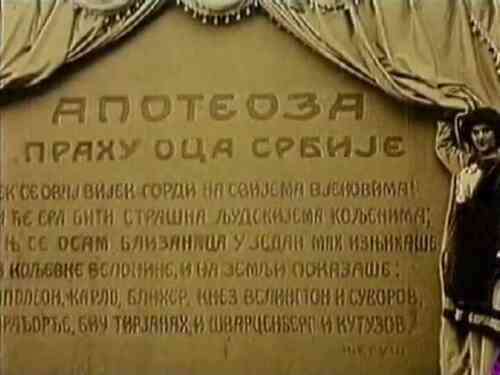
Beyond swords and scythes, the film dissects great-power chess. Russian envoys arrive bearing gilt-framed icons and secret maps; Austrian spies prowl taverns measuring skulls with calipers. In a candlelit negotiation shot only in silhouette, Karadjordje’s profile merges with a double-headed eagle—an ominous premonition of the 1914 Sarajevo fallout. History accelerates, the film seems to whisper, when empires mistake living men for movable busts.
For all its thunder, the picture staggers under its own ballast. Act III folds four years of guerrilla attrition into twelve minutes of montage that feel like paging through a war almanac while sprinting. Supporting characters—Vitomir Bogic’s wily priest, Mileva’s mute brother—vanish for reels, resurfacing only to die off-camera. And the film’s nationalist fervor occasionally curdles into caricature: Turkish commanders twirl mustaches like stage Magyar counts, a trope that would feel more at home in Anna Held operettas than in a grounded chronicle.
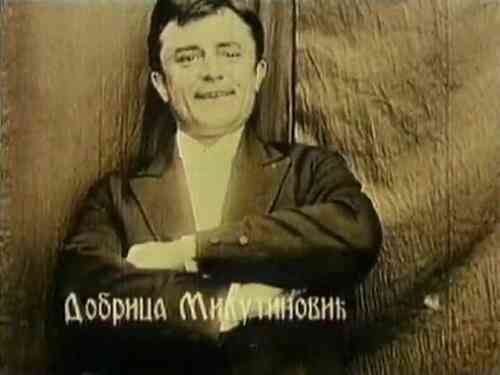
Karadjordje is less a biopic than a possessed reliquary—every frame a splintered femur of national myth. It demands you witness, not consume. The restoration’s HDR pulses so viciously that the screen seems to exhale gunpowder into your living room, a sensory assault no Passion-play reverie or Dante hallucination can match. Approach it not as entertainment but as incandescent evidence: revolutions begin in the imagination, and sometimes cinema is the first battlefield.
Grade: A- (for cinematic audacity) / Viewing tip: pair with Aleksandar Ilić’s 1983 score, but mute during the final assassination—let the projector’s mechanical breath speak the dirge.
IMDb 6
1933
Community
Log in to comment.